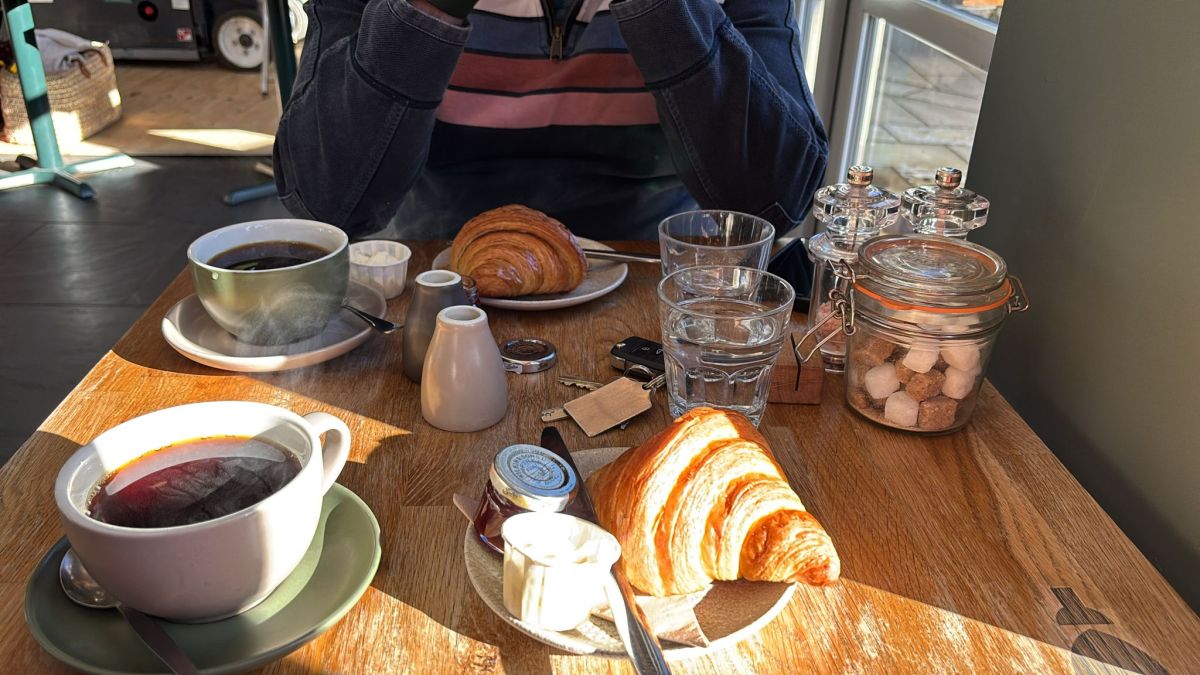
There are plenty of things to do in the area, but you could just sit in the cafe and enjoy the coffee and a delightful croissant.
Graham’s Guidelines
* Rating (1 to 5)
Coffee
4*
Food
5*
Conversation
5*
People Watching
5*
On a recent day out to Sizergh Caste we decided to start the day with refreshments. The National Trust property doesn’t open its cafe or gardens until 10:00am and we needed to be back home for mid-afternoon. Levens Kitchen, however, opens at 9:30am, is only a short distance from Sizergh Castle and is, in many ways, superior to the pleasant National Trust cafe.
The Hall itself has a fascinating history, and has long been famous for its topiary garden. The Hall and gardens are well worth a visit. In recent years Levens Hall has added further distinction through Levens Kitchen. There has long been a cafe at Levens Hall, inside part of the old building, it was dark and not particularly welcoming. In 2019 a new purpose built facility was opened, since then the kitchens have gone from strength to strength, including the addition of the Levens Bakery in 2023. The opening of the bakery followed the appearance of Robert Stacey, the head chef, on Bake-off: The Professionals.
Levens Hall sits alongside the A6 north of Lancaster and Milnthorpe, and a short hop off the A590. There is free parking at Levens Hall which is accessed via the driveway, lined by crocus in the spring.
We often use Levens Hall as the starting point to one of our favourite walks through Levens Deer Park alongside the River Kent, which I’ll add a guide for at some point, but is already available as a route in Graham’s Walks.
The breakfast and lunchtime menus at Levens Kitchen are glorious. I’m repeatedly drawn to the salads whenever we come in the middle of the day, the roasted beetroot a particular favourite, the soup with a cheese scone is regularly a delight, and in a morning the bruleed greek yoghurt hits the mark. On this occasion, though, we were looking for a little something before heading out on our planned visit and settled on a simple croissant and coffee. It’s often the simpler things that define quality and the croissant from the bakery, next door, was delicious. The locally roasted coffee is normally very good and this time was no exception.
On this occasion we loved watching Freddie Wimsett as he progressed the wonderful new mural on the large gable wall opposite the serving counter. Can there be any better people watching than that? It was also intriguing to watch people’s different reactions to the surprise. I find it fascinating that some people tend to delight at something new, where others opt for grumpiness. Most people’s response was delight, but there were a few whom the creation of a large mural of plants, flowers, birds and animals met with immediate disapproval which I found sad.
Wonderfully refreshed we headed off for the rest of our day at Sizergh Castle which turned out to be a revelation.
A short walk from my front door is a portion of the Guild Wheel. From where I join I can walk east and soon get to Fulwood Row, if I walk west I reach Fernyhalgh Lane. Both of these roads allow me to traverse the M6 motorway and then onward into the mixed countryside beyond.
I’ve pondered a few different ways of depicting the matrix of walks that are available from this local area and decided on a few of guides with lots of descriptions of the available variations. Think of the variations as a menu of options that can be added on, or taken away, depending on your day. If you do venture into this area my advice to you is to follow the lines on the map and follow the lines on the ground. There are lines on the ground that are delightful but aren’t on the map, there are lines on the map that aren’t that well defined on the ground.
This walk is shown as starting on Fulwood Row at about the point where it goes under the motorway. There are normally plenty of places to leave a car here if that’s your method of transport.
While the adjacent houses are relatively modern, ours was built right at the end of the last century, the routes are mostly ancient. Fulwood Row and the initial footpath is clearly visible on the archive maps from the 1840s as are the other major landmarks of this walk. The most significant landmark that isn’t on the maps from the 1840s is the M6 motorway, that wouldn’t arrive until the 1950s.
This is a long post, there’s a lot more to describe in the this environment, particularly one where the old is intersected by the new.
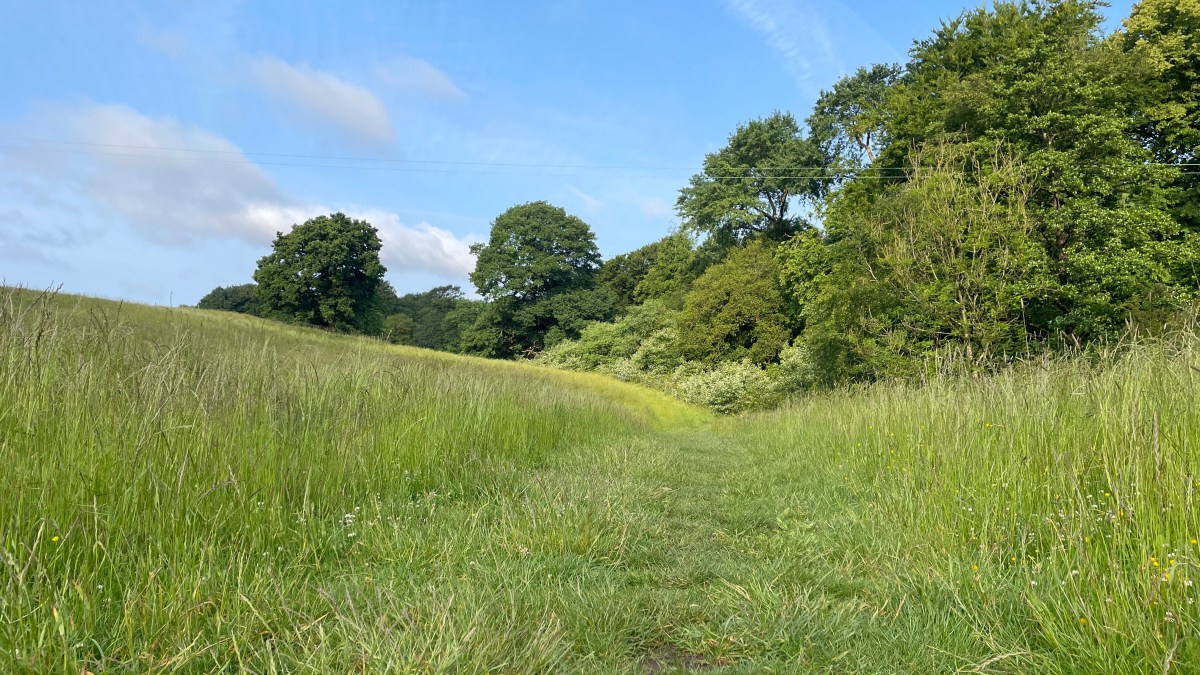
Our walk begins on Fulwood Row which we follow under neither the M6, up the hill on the other side, past the Guild Wheel exit on the right continuing on to Clock House Farm. Continue across the front of the farm buildings, none of which appear to be used for farming anymore. Beyond the farm buildings you’ll come to gate with a stile a little further along. Hop over the stile and onto a bridleway running alongside several fields. These fields are regularly visited by Roe Deer and Hare, there’s also a good selection of birds including a local Tawny Owl. Buzzards nest in the trees on the other side of the field.
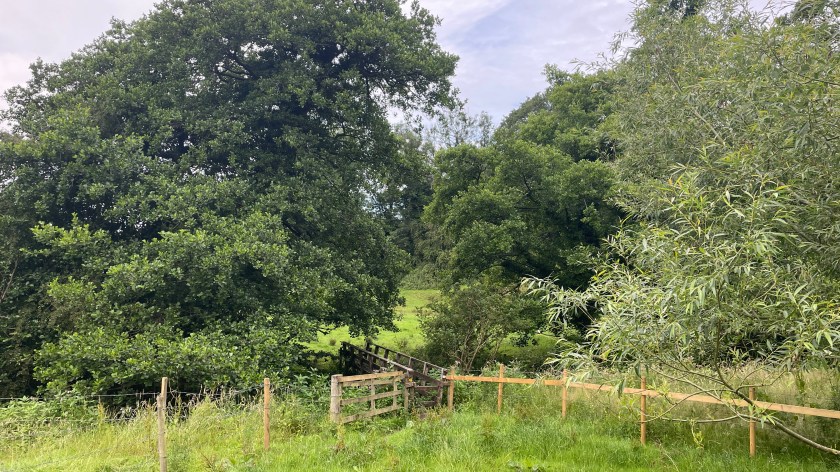
At the end of the fields you’ll come out onto Cow Hill, carry on straight, along the road a while further until you see a stile on the left. Walk across the field along the hedgerow to another stile. Once over the stile turn left on the road where the lane to Clarkson’s Fold is visible. You’ll also notice the local, normally patriotic, flagpole. Travel along the lane, through the farm, out the other side, across a field, over a small footbridge, across another field, over a stile and onto a narrow tree lined lane. You can’t see any of this from the farm gate because the footbridge is down a slope and hidden behind some trees, also, the paths across these fields aren’t really visible on the ground. When I last went over the stile, just this morning, it was broken which made for an interesting scramble. Turn left one over the stile.
This lane is another one of those ancient routes that used to be vital links between small communities in a time before cars. From Cow Hill this lane goes out to Haighton and the farms beyond, we’ll leave the many routes beyond here for another guide. Head down the hill around the back of a house on the left and onto a road. Walk past some fancy gates and across a bridge where you’ll see a path on the right alongside Savick Brook. The brook flows through Preston, out the other side and into the Ribble, for the latter part of its journey it becomes the Ribble Link Canal. There are several places where you can walk alongside the brook, I have a plan to string a route together at some point.
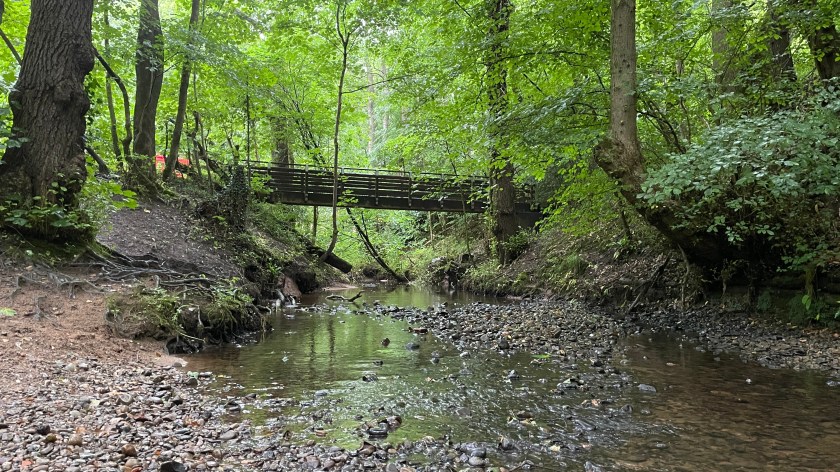
After the bridge the path travels alongside the grounds of Haighton House. In the spring and early summer the stream is banked with successive wild flower; Snowdrops to Bluebells, Wild Garlic to Campions and Cow Parsley. Sadly, in recent years, this area has become completely engulfed by Himalayan Balsam by the mid summer. While we are talking about alien species it’s worth noting that this is also the stomping ground of a local flock of Ring-necked Parakeet with their distinctive call.
The path takes a few twists and turns here, but if you follow the path on the ground you won’t go wrong, and will arrive at a footbridge over which you will join the white-fence lined driveway of the House. The wood here is known locally as Bluebell Wood, on the map is titles Fulwood Park Wood, some people also call it Squire Anderton’s Wood, but that’s somewhere else. I have a morning ritual in these wood, this is a headphone free zone, the birdsong is so varied that it would be a shame not to listen in, besides there’s good evidence that birdsong is good for our mental health. Is there anything like the chorus of Blackbird, Wren, Song Thrush and Robin accompanied by Nuthatch, Treecreeper, Gold Crest and many more.
At the end of the driveway you’ll exit through some gates onto the road. A little further along there’s a path off to the right just before the road crosses back over the brook to the left. The house on the hill is called The Mount which is apt. Here we are on Fernyhalgh Lane which takes us to Ladywell, a place of pilgrimage since at least the 11th century. There’s an interesting legend about a sailor who, in danger of shipwrecked, prayed to the Virgin Mary and received instructions to create a shrine at a place with a spring called Fernyhalgh, hence the name Ladye Well. It’s also worth noting that the name Fernyhalgh is a combination of two Anglo-Saxon words – “ferny” meaning old and “halgh” meaning shrine. This place may have been a place of pilgrimage even before Christianity came to England. Ladywell and Ladyewell, with and without an “e”, are both used on signs in the local area. There’s still a chapel, retreat and shrine on the site which you will see on the right as you walk up the cutting past the outflow from the spring.
Just beyond the entrance to the shrine grounds there is a small gate on the left with a path across a field. At the far end of the field there’s a stile. To the left you’ll see a path across another field and a footbridge over the motorway. On the other side is a path that runs alongside the motorway back towards Fernyhalgh Lane. The houses here sit on the site of some of the skirmishes prior to the Battle of Preston during the Second English Civil War. There’s a sculpture that commemorates this not far from the end of the footbridge, we aren’t going that way today.
As the path nears the bottom of the bank there’s a t-junction, to the left will take you across a footbridge and up on to Fernyhalgh Lane, we’ll go right and rejoin the flow of Savick Brook. Further along cross the footbridge over the brook to the left and up onto the Guild Wheel again notable by a return to tarmac. The Guild Wheel will take you back to your transport if you head left (you will get to your transport if you head right but not for many miles). Having crossed Fernyhalgh Lane for the last time you’ll pass a local landmark known as Peter’s Garden which commemorates Peter Ward who was one of the driving forces behind the Guild Wheel, following a lifetime of cycling.
Now, the variations, where to begin?
At the start of the walk, rather than following the route onward to Clock House Farm you could take a right turn on the Guild Wheel. This is a good walking alternative, but opens up another set of walks which I’ll cover in another guide. There’s also a couple of options on the left of Fulwood Row, one is almost opposite the Guild Wheel junction, this will take you across some fields and drop you onto Fernyhalgh Lane near to the motorway and cut out most of the walk. The other option on the left is just before Clock House Farm, this takes you down another ancient pathway to the footbridge over Savick Brook near to Haighton House, this route can be very muddy, but is a good option for a shorter walk.
Once you’ve travelled across the fields beyond Clock House Farm and you drop onto the road at Cow Hill rather than continuing straight on, you can turn left. The road will bring you to a right-hand turn and another lane on the left. If you follow the lane down the hill it will bring you to bridge over Savick Brook with the path off to the right immediately before it. In the same way, you can skip the lane down to Clarkson’s Fold and continue on the road to the same lane from the other direction.
As you come through the fancy gates at the end of the Haighton House driveway you can extend the walk a bit by heading up the hill to Shepherd’s Hill Farm, walk through the farm and out the other side from where you’ll see a path off to the left. This path will bring you around the back of Ladywell Shrine. You can also continue a bit further before heading back to the footbridge over the motorway.
At the end of the driveway for Haighton House you can shorten the walk a bit by turning left across the bridge over Savick Brook. This is Fernyhalgh Lane, continue along until you get to where the Guild Wheel crosses.
Another variant of this walk comes as you head up the hill past the Ladywell Shrine, rather than heading left across the field you can carry on a bit further where there’s another footbridge across the motorway. The map shows a path running from the end of the bridge alongside the motorway, that is one of those paths that’s not very well marked on the ground and you’ll find yourself tramping through waist high vegetation. To avoid the tramping you can carry on straight beyond the end of the bridge and will come out onto Pittman Way, from here you have a multiple choices to get back onto route.
From the end of the footbridge over the M6 on the original route, there are several paths through the houses that bring you out onto Midgery Lane which connects up with the Guild Wheel just beyond the bridge over the brook. This path will take you up through Hindley Hill Woods – I have no idea why it’s called Hindley Hill Woods.
Beyond Clarkson’s FoldThe entrance to the path alongside Savick Brook (on the right)Follow the path on the ground…Savick Brook in the early springWinter treesThe footbridge into the woodsJoining Haighton House driveway
I am sat at home and the TV is showing a programme that I like, but I’ve seen it before. I’m also engaged in general chit-chat with my wife. I occasionally look down at my phone as various notifications pop-up. Then my watch vibrates and tells me that it’s time to stand up. I am suddenly conscious that my wife is looking at me expecting a response. I know where the conversation was going, but somewhere in my automated switching between stimuli I’ve lost the thread and it’s floating away. This is where I have a choice, I can try to style my way out of the situation and hope that a chuckle and a smile is enough to get things going forward in the hope that the thread will return, or I can own up to being distracted again, take the consequences of this revelation, and continue watching the TV, engaging in the chit-chat and flicking through my phone. Another possibility is that I apologise for being a poor husband turn the TV off and put the phone out in the foyer and seek to engage fully in a conversation with my wife.
This is the world that we live in. This is the world of continuous partial attention.
Something interesting pops up on my watch, it’s too long to read on the phone so I pick up my phone to investigate a little further. I see that it’s another report on the latest celebrity news so move on quickly. While I have my phone in my hand, without thinking, I open a social media app, death scroll my way through it. Then switch on to another social media app and do the same. Everyone is a member of at least four social media apps right? I scroll through each one absent-mindedly. Almost automatically I move on to a couple of news apps and get depressed by the world. Finally I take a quit look at the stock market and check who’s up and who’s down, unfortunately for me today is a red day.
This is the world that we live in. This is the world of continuous partial attention.
I am sat on a train trying to write a blog post, this one, I’m making good progress when a chat from a colleague pops onto my screen. While I’m responding to the message I notice the person on the other side of aisle from me. They are a tall athletic looking individual cuddling a tiny white fluff of a dog while, at the same time, running WhatsApp across three different phones. He’s jumping from one to another as we travel, switch-scroll-type-switch. My watch vibrates and it’s a friend asking if I’m available for the usual Wednesday breakfast catch-up. I look back at the blog post and wonder I was up to.
This is the world that we live in. This is the world of continuous partial attention.
You might be reading this and thinking that I’m describing multi-tasking and perhaps you are right, but I like the differentiation of Continuous Partial Attention as something diffeent.
Linda Stone, who first publicized the term, puts it like this:
Continuous partial attention and multi-tasking are two different attention strategies, motivated by different impulses. When we multi-task, we are motivated by a desire to be more productive and more efficient. Each activity has the same priority – we eat lunch AND file papers… At the core of multi-tasking is a desire to be more productive. We multi-task to create more opportunity for ourselves – more time to do more and time to relax more.
In the case of continuous partial attention, we’re motivated by a desire not to miss anything. There’s a kind of vigilance that is not characteristic of multi-tasking. With CPA, we feel most alive when we’re connected, plugged in and in the know. We constantly scan for opportunities – activities or people – in any given moment. With every opportunity we ask, “What can I gain here?”
I spend far more time in Continuous Partial Attention than I do multi-tasking. I’m much more likely to be switching to fulfil my desire to be in the know, on the pulse, all caught up, connected. When I sit on my sofa in an evening with multiple screens, usually at least three, I’m not seeking to achieve something on each one, I’m quietly urging each one to be bring me something interesting.
This isn’t good for us. We aren’t built to process all of the inputs that are being fired at us every day. We are meant for a simpler life.
The Wikipedia article on Continuous Partial Attention highlights some of the areas where this behaviour is probably not good for us. I don’t have the attention cycles available to go and check, so I’ll let you link over there and see whether it makes sense. If nly half of what is written there is true we have a lot to be worried about.
Header Image: This is the view along the length of Thirlmere whilst descending Steel Fell after a day of two halves weather wise.
My wife’s family heritage is rooted in the hill farms of the Lake District, and I’ve been fascinated by the history, nature and indeed the natural history of the fells of what is now Cumbria for as long as we’ve known each other. My father-in-law was born in a farmhouse, by a tarn, in a hamlet a few miles from a main road.
Perhaps my interest started earlier than that?
I remember secondary school geography classes where we were shown the impact of tourism on the National Park. We studied the volume of cars and the need for roads and parking, which was nothing compared to today. The pressure for accommodation, cafes, and shops. We looked at the significant impact on the Lak District hotspots, of Bowness & Windermere in particular. That was more than 35 years ago. Today the pressure of tourism is greater than ever, and in amongst it all there are communities trying to work out a livelihood within the constraints of being a National Park and a UNESCO World Heritage site.
The Lake District countryside has been shaped over thousands of years by two things farming and mining. Mining may no longer be economic; the farms, however, are still there. It may look like an idyllic way of life, but all is not well.
There’s a conflict between the desire for the National Park to be a place of natural beauty and the needs of farmers to make a living. I’m no expert on the challenges on either side, they are deep seated and long in the forming, but I would like to understand more, hence the reading pattern.
Across the Lake District there are groups of people trying to change things, experimenting with different paths. People trying to see if there are different healthier ways, ones that provide a long-term future for people and wildlife, together. One such group is the RSPB in Haweswater, Lee Schofield is one of the rangers there and this is the story of their journey.
Schofield talks about a desire to see wildlife, flora and fauna, return to a corner of the National Park that gets a moderate number of tourists, but is off the standard tourist routes. Situated on the eastern edges Haweswater is a man-made reservoir that supplies water to Manchester via a 96 mile long gravity-fed aqueduct. About 25% of the water for the North West of England comes from here, which makes it nationally important. In many ways Haweswater is industrial, yet it is also remote and peaceful. When I’ve walked there, I’ve always enjoyed a sense that I am somewhere where others aren’t, but I’ve not been looking with the eyes of Lee Schofield.
One the joyful parts of this book are the names of the various plant species that I so easily overlook. I can’t even remember most of the names but Schofield reels them off in a way that is glorious – Alpine Catchfly, Sessile Oak, Devil’s Bit Scabious, Goldenrod, Wood Crane’s-Bill, Lesser Meadow-Rue, Yellow Mountain Saxifrage, Globeflower, Melancholy Thistle, Common Polypody, Bog Myrtle, Bedstraw, Tormentil. The sad part is that this diversity is all too sparse in an environment where it should be abundant.
Although Schofield works for the Royal Society for the Protection of Birds, this book is much more about the creation of the right environment for the flora to thrive and in so doing enable the fauna to rejuvenate, including the birds.
This book is subtitled “Fighting for nature in a Lake District hill farm” – while I find the word “fight” to be a bit over-combative, having read the book, it’s certainly a struggle. The farming community is a loyal group and having outsiders come in was never going to be an easy journey. The book outlines those challenges, but also the inspirational successes that can be achieved when you work with people.
There is a big plan for Haweswater, the area is huge and there’s lots to do – rewiggling of rivers to allow healthy meandering, blocking water drains to enable mosses to reform and bogs to come back to life, fencing in areas to reduce the impact of grazing, changing grazing patterns and species to encourage different flora, to name a few. Each one having a different impact on the ecology of the whole area.
I’ve read a few other books covering similar themes:
If these book share something in common it’s not surprising Lee Schofield and James Rebanks are practically neighbours, and they’ve both been inspired by the work of Isabella Tree at Knepp.
The book concludes with the dream of a better future, a future that is thankfully looking like it might just be possible. Until a few years ago Haweswater was famous for being the only place where you could still see a Golden Eagle in England, sadly that’s no longer the case. I look forward to a day when we enable their return.
Header Image: This is the view across Haweswater with the dam at the far end. The few trees in the distance on the right are old woodland, the trees nearby aren’t native species. I’ve walked through both and the difference in diversity is stark.
I’m always on the look out for books that people are reading and finding helpful, interesting, entertaining, etc. Sometimes people recommend something to me, at other times I see a video or a talk by someone and decide to read their book. I found this one via a different route.
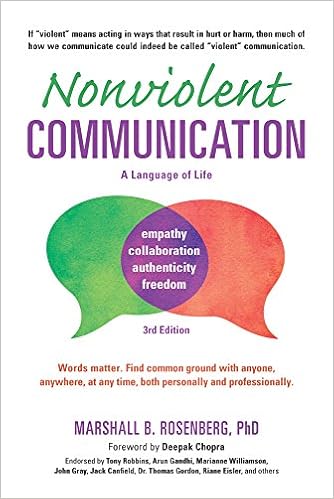
One of the subjects that I find interesting is organisational change, particularly in large organisation. The change at Microsoft since Satya Nadella become CEO has been on of the most dramatic organisational changes in recent years. I read his book Hit Refresh a little while ago and was fascinated by the definition of the organisation as a group of warring factions. What I missed from that book and only understood later on was that he had made his entire leadership team read a book as part of changing the warring factions situation – Nonviolent Communication is that book.
This isn’t a new book having been first published in 1999 based on research and experience that dates back to the 1960s. Nor is this a “Business Management” book of the type that you may expect the leader of a large enterprise to be giving out. This book isn’t a business management book at all, really, it would be better to describe it as a “tools for life” book.
As the name suggests this is a book about communication, another subject that has fascinated me for a very long time.
As the introduction to the book says:
“NVC (Nonviolent Communication) is founded on language and communication skills that strengthen our ability to remain human, even under trying conditions. it contains nothing new; all that has been integrated into NVC has been known for centuries. The intent is to remind us about what we already know – about how we humans were meant to relate to one another – and to assist us in living in a way that concretely manifests this knowledge.”
Nonviolent Communications – A Way to Focus Attention
In these posts I normally give a bit of an overview of the book; I’m not going to do that this time because this is a book that deserves to be read and not consumed as a summary.
The other thing I normally do is provide some personal observations; I’m not going to do that either. Many of my personal observations are very personal and require a bit longer to become part of who I am before I write about the. What I will say is that reading through this book has helped me to see a number of things that I do when I communicate that I need to change, it’s also given me some tools to make those changes.
What I will do is to say what this book isn’t. This book isn’t a how-to prescriptive manual for counselling conversation, although much of what is in the book would be helpful for those situations. Neither is it a book of listening skills, although it includes many great insights on how to be a great listener. It’s not even a manual on how to be politically correct, although some of the examples could be read that way if you were so inclined. This book isn’t just about giving good communication, it’s also about receiving it well.
I started reading this book part way through a series of posts that in my head is called “fascinating conversations”. Once I’d started reading this book I felt that I needed to finish it before continuing those posts for fear of simply adding to my catalogue of poor behaviour. I haven’t yet decided whether I will restart those posts, I probably will, but I need to change some of the language.
Having read it I can understand why Satya Nadella made it mandatory reading for his leadership team.
Why do you do what you do, when you do it? That is the fundamental question threaded throughout this book. The reality is, for many of us, we have unconsciously walked into a When of life that has little to do with productivity, performance or even well-being.
We have a tendency to treat all of our awake time as equal, we schedule our days around the priority of an activity and little else. We sit in afternoon meetings conscious of things going a bit slow, but choose to power through. We visit our doctor and expect the best performance from them whenever we go. We remember sitting in afternoon exams wondering why it was so hard. Yet, we all know instinctively that we have certain times of the day where different things are more enjoyable, and times when we are better at doing certain things.
In When, Daniel H. Pink, gives a framework for understanding ourselves, and those around us. As with many human conditions we all sit somewhere on a spectrum and not rigidly into any neatly defined box, but having the boxes helps us to understand ourselves and others. In When the boxes are:
Lark
Third Bird
Owl
Analytic Tasks
Early morning
Early to mid-morning
Late afternoon and evening
Insight Tasks
Late afternoon/early evening
Late afternoon/early evening
Morning
Making an Impression
Morning
Morning
Morning (sorry owls)
Making an Decision
Early morning
Early to mid-morning
Late afternoon and evening)
Most of us are third-birds – we’re neither extremely larkish or blatantly owly.
If you look through this table you may notice that the mid-afternoon isn’t a great time for anyone or anything and that’s because it isn’t. That post-lunch slump affects most of us and isn’t a great time to progress anything, which is why it’s the ideal time to take a break. Some cultures have breaks built-in with extended lunches and early afternoon naps. This was perhaps the case in the UK some years ago, but it’s certainly isn’t now. Most people have their lunch at their desk while covering their keyboard with crumbs. That, it turns out, is a massive mistake, we would be far more productive if we took a proper break and had a nap.
When is full of advice on how to take good breaks: micro-breaks, moving-breaks, nature breaks, social breaks, even mental gear-shift breaks. Pink’s exhortation is for us to get serious about breaks, to schedule them in and to stick to the schedule.
The mid-point slump, doesn’t just apply to our daily routines though, the same pattern applies to most things – we start and finish with enthusiasm, but struggle in the middle. Pink devotes a number of sections to this phenomenon and in his usual style mixes scientific research with concise practical advice for handling these situations whether that’s a mid-point in a career, in a project or even in a relationship.
I’m not going to cover all of the sections in When here, because there is a lot that I liked about this book and much to apply and the post would be too long if I did. The one remaining section I will touch on though, is the one on synchronising. Getting together with others and performing a task has a powerful impact on our mental and emotional well-being. Having sung in groups most of my life I recognise the power of it in that situation, but I’m predominantly an introvert and wouldn’t go out of my way to join synchronisation opportunities, that’s a challenge. I think that my first step on that one is to join a yoga class, I currently use an app on my iPhone to do my practice, but I recognise that this is robbing me of the synchronisation high that comes from being in a group.
There are certain books that you read and wish that you had read them earlier, this is one of those books. Although, as I reflect upon it, as someone who in many ways is in the middle of things, perhaps it’s best that I read it now, when I need it.
Problem-setting is basically, it’s not enough to get the design right, you’ve got to design the right thing. And so, if you just leap in and start building something where you’ve got a solution, you have no idea if that’s the best option. There might have been a better way and you didn’t take time because you are already behind schedule. But here’s the crazy thing. At the beginning of the product cycle, you have a small team just getting going. Your burn rate, in terms of what it’s costing you per week in terms of the project and that, is very, very low. So, what you then should be doing is thoroughly exploring a range of different alternatives. Problem-setting, part of that process is this notion of, you cannot give me one idea. You have to learn how to work quickly and give me multiples. That’s a technique for this whole issue of, how do you deal with the problem-setting? And by exploring the space first… oh, that’s the real problem… Put it this way. You have a bunch of people that talk about user-centered design. And they’ll say, you know, go talk to your users and they will tell you what to do. Okay. Would you go to a doctor where you walked in, and the doctor said, okay what’s wrong with you, what operation do you need and what drugs should I give you under what dose, right? And that’s how some people naively interpret user-centered design, is “listen to users.” And, no. I’m going to ask you all kinds of questions. But I’m going to take all of those as part of the information that helps me make a diagnosis. And so, where do we collect the symptoms to find out where the real problems are? You’re telling me this. I understand the situation. Now, I have to know enough about your industry to ask pertinent questions. And for me, that’s what the problem-setting is. The designer, the main equipment is to have that meta-knowledge. And that’s where the diverse interests come in, so how do you get that knowledge? But if you don’t even know that’s the kind of knowledge you need to get, you’re not even going to go looking for it.
If you’ve not heard these exact words, you’ve heard something very similar to them:
We are currently experiencing an unusually high volume of calls, please hold and a member of our team will be with you as soon as one becomes available.
You are then tortured by some music that is completely inappropriate for the narrow frequency response capabilities of a phone until there’s a short pause, just long enough for you to think “ah, a person”, and then you are again greeted with:
We are currently experiencing an unusually high volume of calls, please hold and a member of our team will be with you as soon as one becomes available.
You continue this experience until your ears are number and your brain is craving to do something more intellectually taxing – like watching daytime TV.
As is often the case, the person that you eventually get to talk to sounds plausible, and makes you believe that they have resolved your problem, so eventually you hang-up. You say to yourself, again, that there’s another hour of your life that you aren’t going to get back, but there at the back of your mind is a question, what constitutes “an unusually high volume of calls”?
You leave it a few days before you check on the progress of the thing you wanted sorted only to discover that it hasn’t and submit yourself to the inevitable second phone call to the service centre. It’s a completely different time of day, it’s a completely different day, and yet, there it is, ready to greet you like the smell of a dog that has been playing in a stagnant pond:
We are currently experiencing an unusually high volume of calls, please hold and a member of our team will be with you as soon as one becomes available.
Another hour later you still have that question, what constitutes “an unusually high volume of calls”?
What is the measure? Is this statement made on the basis of the average across a day? Or a week? Is it based on a model that factors in seasonal and regional differences? Has some significant national or global event happened that I haven’t been aware of meant that everyone needs to phone right now? Or, as I suspect it is, the definition of “unusually high” is one more than the number of service personnel that the organisation decided to roster for that time, on that day, and that the staff scheduling has little do with customer demand. The volume of service staff is almost certainly governed by the finance team with little relevance to the poor individual wanting to get a refund on their overcharged insurance bill. (Anyone guess what’s happened in my house today?)
I have wondered about setting up a web site where people can see the times and days when an organisation is normally experiencing “an unusually high volume of calls” based on crowd sourced input from people. My hope would be that people could then phone in during the non-unusual times with a high probability of speaking to an actual person, but I suspect that for some organisations there are no non-unusual times. And there is my problem, if there are no non-unusual times then sitting waiting for a service person is normal and that shows utter contempt for customers and we should all leave such organisations. Who’s with me?
(No, we won’t be using that insurance company again).
“Tell me how you measure me, and I will tell you how I will behave”
Measurement and behaviour are closely linked, but that’s not always in a good way.
We are surrounded by situations where measurements and targets result in illogical behaviour, unintended consequences and perverse outcomes.
Give manufacturers an environmental test to pass and they will pass it, but may do so by changing the way the product works in the test conditions.
Give hospital administrators a target for certain diseases and that target will be met, but also, the care of other diseases will decrease.
Give teachers a set of measures that need to be met and tohse measures will be met, but teaching as a whole will be narrowed.
Give financial advisors a bonus for selling certain products and they will sell that product, even if it’s not appropriate for the person buying it.
Give policymakers a target to build houses and they will build houses, wherever they can, even if they aren’t needed where they are built.
Implement a policy of closely monitoring people’s working hours and they will work the hours that they are expected to work, but they won’t work any more than those hours.
Give policymakers a target for reducing the amount of household waste that goes to landfill and restrictions on access to landfill will meet the target, but also, the amount of flytipping will increase.
The list goes on and there are many specific examples in the Wikipedia article on unintended consequences. My favourite is this one:
The British government, concerned about the number of venomous cobra snakes in Delhi, offered a bounty for every dead cobra. This was a successful strategy as large numbers of snakes were killed for the reward.
Eventually, enterprising people began breeding cobras for the income. When the government became aware of this, they scrapped the reward program, causing the cobra breeders to set the now-worthless snakes free.
As a result, the wild cobra population further increased. The apparent solution for the problem made the situation even worse, becoming known as the Cobra effect.
We have to be very careful when we are setting a target that the reverse of that target is desirable. Sometimes that’s why the counter-intuitive response is the most effective. Sometimes not measuring something is the best approach.
Having been paid to do a fancy show with a big crewe and a budget The Slow Mo Guys return to their roots in the garden messing about with paint and a speaker.
The Slow Mo Guys are at their best when it’s wonderfully Heath Robinson (apart from the top of the range Hassleblad and Vision research cameras that they’ve been loaned).
We have a way of co-opting words into office speak. The latest for many people in the technology arena is agile.
The word agile means:
able to move quickly and easily.
Something that many organisations aspire to do. They want to move more quickly and without it being so hard to do. In our office speak this has become known as “agile with a small ‘a'”.
This word has then been co-opted by a methodology that was birthed in the software development arena, but is becoming more widely used outside that arena. In our office speak this has become known as “Agile with a capital ‘A'”.
We need to differentiate as we speak so that we know which meaning is being used. It’s easy in written text, but as we speak we have no way of differentiating and sentences can have a very different meaning depending on which is being used:
“My customer wants to be more agile.”
Meaning: customer want to be able to move more quickly and stop taking so long to do anything.
“My customer wants to be more Agile.”
Meaning: customer wants to do a better job of adopting the principle of the Agile Manifesto.
This is where it gets fun, because one of the ways a customer may become more agile is by adopting Agile. Which is easy to understand written down, but when you are speaking you need to say:
one of the ways a customer may become more agile with a small ‘a’ is by adopting Agile with a capital ‘A’.
That’s clear isn’t it?
But it doesn’t stop there. There’s also lean and Lean and sometimes Lean and Agile are used together to help organisations to become more lean and agile 🙂
There’s more, don’t forget about safe and SAFe, waterfall and Waterfall, word and Word, workplace and Workplace, need I go on?
I’m off now to write a few words into a Word document for an organisation that has a nice workplace next to a waterfall about how they may communicate using Workplace as they move away from Waterfall toward Lean and Agile, because they aspire to become more lean and agile 🙂
Despite all I have seen and experienced, I still get the same simple thrill out of glimpsing a tiny patch of snow in a high mountain gully and feel the same urge to climb towards it.
Edmund Hillary
To travel, to experience and learn: that is to live.
Tenzing Norgay
The ascent of Everest was not the work of one day, nor even of those few unforgettable weeks in which we climbed… It is, in fact, a tale of sustained and tenacious endeavour by many, over a long period of time.
Sir John Hunt
Thank goodness. Now we can get on with some proper climbing.
Eric Shipton
History has a way of picking heroes and of either building them up, or pushing them down, they tend to stand and fall as individuals. The two names I knew from the ascent of Everest were Edmund Hilary and Sherpa Tenzing (Tenzing Norgay). These two individuals did a remarkable thing, they were the first people to stand on top of the world but I knew little about the events that got them there.
My schoolboy knowledge of the events of 1953 had overlooked the tremendous efforts of John Hunt, the leader of the expedition. John Hunt was just as famous as the Tenzing and Hilary at the time but I was born 15 years after 1953 and he no longer featured in the story I was told.
Names like Charles Evans, Tom Bourdillon, Griffith Pugh, George Band, George Lowe, Michael Westmacott and all the others were just as unknown by me, until now. The larger than life character of Eric Shipton was also a new one to me. Yet, each of these individuals played a significant part in the events that lead to two people standing higher than anyone else had ever stood.
The world has changed a huge amount since 1953, something that this book makes evident as a parallel story to the main event. We are so used to world where a couple of hundred people climb to the summit each year in organised groups that include everyday people. We are used to people flying into Nepal and travelling around by helicopter. We are used to modern breathing apparatus and mountain equipment making these endeavours reasonably safe. We expect communications to be instantaneous.
It wasn’t anything like that in 1953.
The journey to the roof of the world took an expedition with military planning and relied mostly on manpower to get the ten thousand pounds of equipment in place. Even with extensive planning the ultimate ascent relied on “tenacious endeavours” to overcome the unforeseen challenges, freak events, illness and unique weather conditions. In almost every situation the margin for error was tiny, a single decision made by Tom Bourdillon and Charles Evans was the difference between their names being the ones written into the history books and those of Tenzing and Hilary.
Everest 1953: The Epic Story of the First Ascent by Mick Conefrey is a wonderful telling of the events and characters that accomplished this tremendous feat. I really enjoyed it’s wonderful story telling and engaging details but most of all I was struck by people’s ability to keep going when there’s a goal that they need to achieve.
The book also describes the events following the ascent which serves as a warning about the two sides of fame. Success did not lead to happiness for everyone involved.
Disclaimer: I didn’t read this book, I listened to it on Audible.














 We have a tendency to treat all of our awake time as equal, we schedule our days around the priority of an activity and little else. We sit in afternoon meetings conscious of things going a bit slow, but choose to power through. We visit our doctor and expect the best performance from them whenever we go. We remember sitting in afternoon exams wondering why it was so hard. Yet, we all know instinctively that we have certain times of the day where different things are more enjoyable, and times when we are better at doing certain things.




 Graham Chastney