
Blessing #205 – A Bit of Nonsense

I was talking with someone the other day about how I quite like nonsense rhymes like this one:

I eat my peas with honey;
I’ve done it all my life.
It makes the peas taste funny,
But it keeps them on the knife.

Or this one (the version I remember anyway):

One fine day, in the middle of the night,
Two dead men got up to fight
Back-to-back they faced each other
Drew their swords and shot each other.

Some places quote extra lines, others change a few words, but the nonsense is still the same.

Another one:

Spring is sprung, the grass is ris.
I wonders where the birdies is.
They say the birds is on the wing.
Ain’t that absurd?
I always thought the wing was on the bird.

Interestingly, most of these rhymes seem to be attributed to that wonderful person: Anonymous.

Jesus quite liked a bit of nonsense, we don’t really see it because we’ve heard the stories so many times and we don’t understanding the cultural context in which he was writing:

When the father runs towards the prodigal son it was nonsense – no father would have done the running. (see Luke 15:11-32).

When Jesus makes the Good Samaritan the hero of the story it was nonsense. Samaritans were never heroes (see Luke 10:25-37).

The day Jesus told a rich young ruler “One thing you lack,” he said. “Go, sell everything you have and give to the poor, and you will have treasure in heaven. Then come, follow me.” He was talking nonsense, wealth showed that you were blessed, if you gave it away you were no longer blessed (see Mark 10:17-27).

I quite like a bit of nonsense.

I'm a man in the middle

Robert Frost once said:

“The middle of the road is where the white line is-and that’s the worst place to drive.”

But that’s the reality of much of my life – I’m in the middle.

  • I’m middle-aged
  • I sit, as a member of Generation X, between the baby boomer generation and Generation Y or as they seem to have become the Millenials.
  • I work in middle management. There are people above and people below.
  • I’m in the middle of the grade structure at my employer.
  • I’m of average height.
  • Although I used to wear Regular (middle) length trousers at some time in history my trousers have become marked as Short though my legs are no shorter.
  • I used to wear tops with an M in them, they normally now have an L instead, probably because I am above average weight.
  • I have an average sized waist. Not sure I understand how I can be average height, have an average sized waist, but be above average weight?
  • I drive a medium-sized car.
  • I have a family that is as close to medium-sized as it’s possible to get without having part of a child.
  • I live very close to the geographic middle of the UK, and the geographic middle of Britain (yes they are different things).
  • Income is a tricky one, that’s above the median, but there are people earning a lot more than I am and a lot of people earning less. I need to remind myself sometimes that I’m not in the middle here.
  • I live in a city that is about as close to having a median (medium) population for the UK as it’s possible to get.
  • I think I’m middle class, but that’s difficult to be clear about that these days because, thankfully, the class system isn’t as definitive as it used to be.
  • The average tenure at most employers is between 9 and 10 years, my tenure has been significantly longer than that.
  • I have an average commute to work for my region.
  • I have the average number of connected device.
  • Looking on my utility providers web site we use an average amount of energy for our region.

The reality is that we all live our lives in the middle of something, but is that really the worst place to drive?

Blessing #204 – Clearing Out

As I look out into our back garden now covered with Autumn leaves I see all sorts  colours. From the brightest reds, to the deepest browns, there are evergreen and moss greens it’s an array of flora that has recently exploded into colour and is now spread across the garden. It will need clearing up, but there’s no rush, it has only been a couple of weeks since we spent time picking and sweeping. There’s a neighbour out in their front garden with a leaf blower he’s there most weekends, their garden is much neater than mine.

Beyond my garden there is a high hawthorn hedge which belongs to a bungalow. In the garden of the bungalow there are all sorts of left-over building materials and enough building equipment to stock a hardware store. I pass the front of the bungalow on my morning walk sometimes. In the driveway there are at least four vehicles which are full of more building materials, each vehicle is surrounded by more building material and I wouldn’t be surprised of there are more vehicles hidden under the other material. At the entrance to the driveway there are two more vehicles which are themselves full of building material and other detritus, they stay at the entrance because they can’t get in the drive. I’ve never met the person who lives in the house but it doesn’t look like a happy place to live.

A couple of months ago I had some time available on a Saturday to start to clear out the garage which had got a bit messy with things being delivered, stored and restored. It was becoming frustrating clambering over things all the time trying to find the thing I was looking for. Unfortunately the clearing out had only got to that point where it didn’t really look much better than when I had started before I had to finish. I wanted to get the tidying finished so that I could store the garden furniture for the rapidly approaching autumn and winter. A couple of weeks ago I again had some time available to finish the job. After sorting, sweeping and a few trips to the local tip it felt so rewarding to put everything in its place and to see how much free space there was in there and how easily the garden furniture fitted.

There are parts of my life that like each one of these places, a bit messy like the garden, in need of serious clearing out like the bungalow and nicely tidy (for now) like the garage. There’s something very rewarding about clearing these places out but some of them look like a big job and that’s when we need help. Thankfully Jesus doesn’t expect us to have a cleared out life, he just wants to help us with the tidying and to get to know us in the process. Thankfully he’s not comparing our level of cleanliness to our neighbours, he knows us and wants to meet us where we are. From my experience Jesus is more interested in getting to know us that getting everything right in our lives.

"Performance ratings data within companies is all bogus"

Most of my exercise is accompanied by podcasts. Whether I’m out for a walk or in the gym I’m likely to have someone speaking in my ears.

This morning something went “YES!!!” in my head when I heard these words:

“Performance ratings data inside companies is all bogus. It doesn’t actually measure what it says it’s measuring. Which, of course, is hugely problematic because we end up promoting people, and paying people, and training people, and deploying people based on those rating data and they’re invalid.  “

These are the words of Marcus Buckingham speaking on The Future of Work Podcast in which Jacob Morgan.

Sometimes you hear something and you know intuitively that there’s something significant about it, and that’s what happened to me this morning.

I’ve been subject to a number of rating systems in my time, some of them with forced bell curves others not; some of them have had a few points of assessment others with many areas of assessment. These assessments have always been done on an annual basis with the occasional mid-term review. None of them have made a significant difference to what I’ve done day-to-day and they’ve all felt like they were being done to tick-a-box for the corporation. I’ve always been diligent in ticking that box because the numbers in the assessment have made a difference to the money in my pocket but little else.

There have been a number of high profile organisations switching away from these systems:

Marcus’ own article also cited Deloitte – Reinventing Performance Management.

The Performance Review systems that I’ve experienced tend to link together development and reward. Often they are the only conversation about development and reward that an employee has with their manager. Everyone knows that this shouldn’t be the case, but it’s what happens.  I can’t remember a time when a Performance Review has resulted in a change of my Development Priorities. The times that I’ve developed the most have always been whilst working for an effective team leader, hence some other words from the podcast resonated:

“I strongly suggest the future of work should be built around the practices of what the best team leaders do anyway, and they do not do a one every six-week conversation…what they do do is check in with each person each week about the work, it starts with the work.” Marcus Buckingham

We may not be in a position to change the performance rating system, but we can all make a different to people’s development in the places where we lead.

I like Marcus’ principle of 5 minutes to tell me about 5 things for the next 5 days.

Blessing #203 – High-Mileage Songs

The other evening I was out for a walk while Sue was visiting a friend.

I’ve had some kind of portable music device since I was a teenager and I’ve always liked listening to music as I walk. First it was cassette tapes then CD’s and latterly some kind of MP3 player.

On this particular evening I was listening to a playlist of songs that iTunes had automatically created based on one of my favourite songs.  Most of the songs on this playlist date back to my cassette tape days and it got me thinking about how many miles some of these songs have travelled with me. Miles walking, miles driving and even miles flying.

The playlist continued and then I heard a few cords and these words:

Sing this with me, this is “40”

I must have heard those words hundreds of times, before they had even been spoke I knew what was  coming next:

I waited patiently for the Lord
He inclined and heard my cry
He brought me up out of the pit
Out of the miry clay

I will sing, sing a new song

These words were being recorded in 1983, over 30 years ago and they’ve meant a lot to me through the years. This has been one of my signpost song with signpost words.

Words that have been there as a signpost through exams at school, college and university.

How long to sing this song
How long, how long, how long
How long to sing this song

Words that have been there as a signpost through engagement, marriage and children.

He set my feet upon a rock
And made my footsteps firm
Many will see
Many will see and hear

Words that have been there at work and at play.

I will sing, sing a new song

Words that have been there from rental to buying smaller onto buying bigger.

How long to sing this song
How long, how long, how long
How long to sing this song

How long to sing this song? I don’t know but for a long while yet I hope. I like new songs, but I also love high-mileage songs, songs that have formed signposts in my life.

The song is call “40” because it’s based on Psalm 40. That makes them words that are thousands of years old and signpost words for generations.

Those signposts are important markers of where we have come from.

(The picture is of the sunset that night taken on the beach in Southport)

My Stories: Concussion

All memories are manipulated by the passage of time, I’m aware that for this one I’m particularly conscious of that.

The other evening I was talking to my parents about an event that happened when I was a teenager. In those days I played rugby at least once a weekend, but more often twice. This involved playing for both a local rugby club and for my secondary school. My Dad’s recollection is that in this particular game I was playing for the school team, against the school teachers, that’s not something I remember so I’m not sure whether this is true or not. The game was certainly being played on one of the pitches at school.

At some point during the game I received a boot to the chin. My recollection is that this was received whilst trying to dive in front of  a ball that a member of the opposition was kicking further up the field.  Clearly I mistimed my dive and got a bit too close.

The rest of the game is a mystery as is the journey home.

The next thing I have is a dim memory of falling down the stairs – while I was trying to go to the toilet. This isn’t as odd as it sounds, at my parent’s house the door to the toilet is next to the top of the stairs, but it does mean that I missed the toilet door by at least a metre.

My next dim memory is of my mum talking to me in the car (on the way to the hospital). Apparently, I was steadily drifting off and the only voice that I would respond to was my Mum’s.

Time continued it’s merry journey, but my participation in it was limited. I have a memory of lying on a bed with people trying to get me to do things, but that’s about all. My Mum’s memory is of walking into the Casualty unit at the hospital and being waved through by the receptionist; I clearly looked unwell.

The following morning I awoke and looked around to find myself in a hospital ward. The bed opposite was occupied by a man who had a shaved head and stitches that started just above one of his eyes and reached all the way over his head beyond where I could see. He smiled at me and said “morning!” The man in the bed to the right had a similar cut but this time from ear to ear. My first response was to run my hands over my head to see where the damage was. Eventually I found a graze on my chin which was developing a nice bruise beneath it; it was a relief.

Later on that morning there was a ward round. The person leading the round (a Consultant I assume) was not impressed. In my notes there were a lot of x-rays of my head, the Consultant looked through each one slowly.

“Why did we take so many x-rays?” he asked.

“Because he wouldn’t stay still.” was the answer from one of the juniors.

“Wasn’t it obvious what was wrong with him?” the Consultant responded.

There was no response to this question.

“This young man has a mark on his chin and he’s been playing rugby. Surely concussion is the obvious diagnosis!”

That was all that was said, no one spoke to me, I was just the patient. What needed to be said had been said and it was time to move on. Later on that day it was my time to move on.

My Tools: Instagram

As part of my normal routine I go for a walk in the morning. Most mornings I take a picture of something that I find interesting, some days I take a video. The pictures are taken on my iPhone and posted directly to Instagram.

The Instagram client on my iPhone has all sorts of features available for enhancing the picture before it’s posted – filter, brightness, warmth, saturation, fade, shadows, vignette, etc. I tend to post pictures without too many enhancements, but it’s fun to fiddle sometimes.

Instagram has a reputation for pictures of three things: pets, selfies and food. I don’t have any pets, I rarely post selfies, I sometimes post food pictures, or more normally coffee pictures.

Similar to Facebook and Twitter, Instagram has a concept of followers which allows you to create social interactions and to see what others have posted. The people who I follow tend not to post pictures of pets, selfies or food.

Like other social network platforms Instagram allows people to interact. In the case of Instagram interaction is via likes and comments. You can also post links to Facebook and Twitter which create other avenues for interaction.

While writing this post I’ve considered a question – why do I use Instagram? I started using Instagram because it did something unique, Twitter didn’t really handle pictures at the time you had to use third-party capabilities, Facebook always handled pictures, but it’s functionality is aimed at collections and albums of pictures. Twitter now supports pictures quite well, but I continue to use Instagram. Why continue as part of another social network? I tried to come up with a logical reason involving features and capabilities, but the answer is far simpler. I continue to use Instagram because I like it.

If you want to interact you can find me here: @grahamchastney

Instagram

I missed a birthday – a 10 year birthday

My first post on this blog was simply titled Welcome and was written on the 5th April 2005.

In those days I was writing under the title Oak Grove which is the root meaning of my surname.

I can’t tell you what the most popular posting has been over that entire time, because I’ve not managed to maintain a consistent statistics platform for all of it. I can tell you though, that the most popular post since 2009 has been this one on Rich Pictures.

Rant Over

I try to write positive and informative items.

I try not to write rants.

I could easily write rants, but there are plenty of people doing that already and I don’t see any value being just another voice in the crowd.

This morning I started writing a posting about a phrase I’ve been hearing quite a lot recently. It’s one of those management phrases that gain popularity, are repeated endlessly, but don’t stand up to scrutiny. These phrases get under my skin. Having written most of the posting I read through it to realise that it was just a rant, so you’re not going to get to see it. I’m going to have to think a bit longer before I can write something informative.

I do write critical articles, but I hope that they are informative rather than ranting. If I do write something that you think is just a rant please feel free to point it out.

Using an iPad at bedtime? How's your sleep?

There is a growing body of evidence that using an electronic device like an iPad before sleep isn’t good for your sleep. The issue is with devices that use a screen that shines light at you.

A recent report published in Proceedings of the National Academy of Sciences of the Unites States of America under the title Evening use of light-emitting eReaders negatively affects sleep, circadian timing, and next-morning alertness defines the significance of the problem like this:

The use of light-emitting electronic devices for reading, communication, and entertainment has greatly increased recently. We found that the use of these devices before bedtime prolongs the time it takes to fall asleep, delays the circadian clock, suppresses levels of the sleep-promoting hormone melatonin, reduces the amount and delays the timing of REM sleep, and reduces alertness the following morning. Use of light-emitting devices immediately before bedtime also increases alertness at that time, which may lead users to delay bedtime at home. Overall, we found that the use of portable light-emitting devices immediately before bedtime has biological effects that may perpetuate sleep deficiency and disrupt circadian rhythms, both of which can have adverse impacts on performance, health, and safety.**

In other words, that electronic device shining light at you is seriously messing with your sleep.

The more I read about sleep the more I think that we are causing ourselves all sorts of damage by the ways we mess about with it.

Here’s some advice from the NHS on sleep hygiene:

Also reported here:

**highlight mine

My Tools: Hill Lists – Ticking or Bagging?

I’m in the process of trying to complete a set of hills described by Alfred Wainwright.

Some people call this ticking, others call this bagging. In Scotland people definitely bag Munro’s – there is less clarity as to what the climbing of a Wainwright is called – I prefer ticking.

I use two things to track my ticking; one is a map on the wall of my study which gives a clear visual representation; the other is an application called Hill Lists.

The first screen for Hill Lists is a set of available lists to be climbed, below is the standard starter list to which you can add extra lists. It wasn’t until I started using this app that a realised how many lists there are:

Hill Lists

Selecting a list shows the hills in the list alongside a number of statistics.

Selecting maps from the list shows a colour coded map of the hills within the list:

Hill Lists

From either the list itself, or the map you can select the details for a hill:

Hill Lists

Selecting the plus sign allows you to add a record of a climb for that hill. The map icon take you to external sites that give details of routes. The cloud icon take you to the Mountain Weather Information Service report for the hill area.

Acronyms: PDA

PDA: Personal Digital Assistant

I thought this acronym had gone to the acronym retirement village sitting next to its relative PIM (personal information manager). I thought that PDA was a term only used when talk about the past, but recently someone used it when talking about current technology. This got me thinking, when did we stop talking about PDAs?

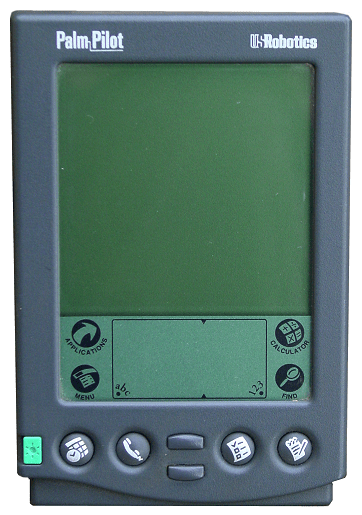
I never really got into the Palm Pilot or any of its siblings. I did plenty of fiddling around with them in support of other people using them though. These were the first PDA for most people:

I also did some fiddling around in support of HP Jornado devices. Windows CE was such an interesting operating system but it wasn’t that engaging:

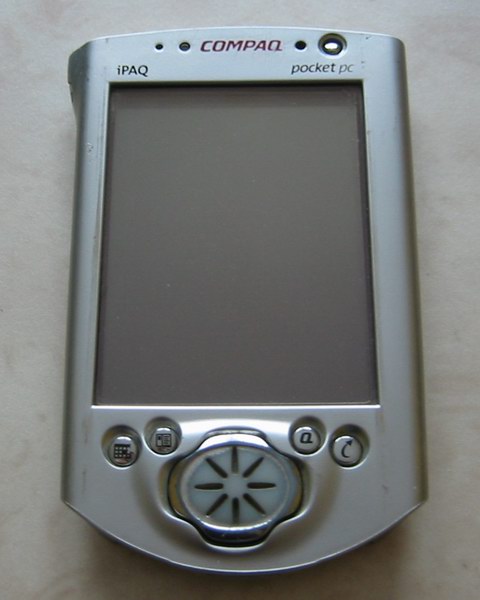
My first PDA was a Compaq iPaq which is still in the legacy device museum in the garage; it won’t boot and its battery is dead.

I didn’t buy it because, at the time, I was a father of two young children – I won it at a conference. It was such good fun to try to synchronise it with cc:Mail:

None of these devices was an out-and-out success and they were all blown sideways by the first iPhone; the iPhone 3 blew them away completely with each one leaving the field soon after its release.

The device that survived for a little while longer were a series of Blackberry devices, my favourite was probably the Blackberry Bold 9000, but I don’t ever remember calling this a PDA:

Jimmy does BlackBerry

Blackberry had little chance against the iPhone; when Android was purchased and subsequently release by Google it delivered a bullet wound from which it is still on intensive care but is highly unlikely to recover.

I’m currently carrying around both an iPhone 5S and a Samsung Galaxy S4 Mini – I definitely don’t call either of these a PDA. The current smartphones are nearer to the initial vision of the personal digital assistant than anything that has come beforehand, but we’ve moved on. We’ve retired the acronym before it came to fruition, or so I thought? Perhaps we should go retrospective and bring it back?