Because it's Friday: "Why we all need to practice emotional first aid" by Guy Winch

A TED talk as you head into the weekend. For those of you who are going to be having a weekend off, what are you going to do that will improve your emotional hygiene?

“How is it that we spend more time taking care of our teeth than we do our minds. Why is it that our physical health is so much more important to us than our psychological health?”

"What you get by achieving your goals is not as important as…

“What you get by achieving your goals is not as important as what you become by achieving your goals.”

Zig Ziglar

I'm a man in the middle

Robert Frost once said:

“The middle of the road is where the white line is-and that’s the worst place to drive.”

But that’s the reality of much of my life – I’m in the middle.

  • I’m middle-aged
  • I sit, as a member of Generation X, between the baby boomer generation and Generation Y or as they seem to have become the Millenials.
  • I work in middle management. There are people above and people below.
  • I’m in the middle of the grade structure at my employer.
  • I’m of average height.
  • Although I used to wear Regular (middle) length trousers at some time in history my trousers have become marked as Short though my legs are no shorter.
  • I used to wear tops with an M in them, they normally now have an L instead, probably because I am above average weight.
  • I have an average sized waist. Not sure I understand how I can be average height, have an average sized waist, but be above average weight?
  • I drive a medium-sized car.
  • I have a family that is as close to medium-sized as it’s possible to get without having part of a child.
  • I live very close to the geographic middle of the UK, and the geographic middle of Britain (yes they are different things).
  • Income is a tricky one, that’s above the median, but there are people earning a lot more than I am and a lot of people earning less. I need to remind myself sometimes that I’m not in the middle here.
  • I live in a city that is about as close to having a median (medium) population for the UK as it’s possible to get.
  • I think I’m middle class, but that’s difficult to be clear about that these days because, thankfully, the class system isn’t as definitive as it used to be.
  • The average tenure at most employers is between 9 and 10 years, my tenure has been significantly longer than that.
  • I have an average commute to work for my region.
  • I have the average number of connected device.
  • Looking on my utility providers web site we use an average amount of energy for our region.

The reality is that we all live our lives in the middle of something, but is that really the worst place to drive?

How I process information (2015 update)

Back in February I wrote a post called How I process information (normally). This is an update to that post with a few tool changes and a few activity changes. I tinker around with my own personal productivity on a regular basis constantly seeking something that fits the demands being placed on me and my personal style, this is the latest iteration of that tinkering. Updates are in italics.


One part of my job is to stay current with the ever-changing technology and business landscapes. This means that I process hundreds (probably thousands) of items of information every day.

I don’t read all of them, but I try to process all of them on a normal day. It should be noted here that I try to have normal days as often as possible, but there are many days when that’s not possible. On those many days I do what I can to keep the framework working.

how-i-process-information-2015-update

The normal way that I process information focusses on mornings. I’m mostly a morning person so that’s the best time for me to be alert because processing lots of information you should do when half asleep.

The morning is also the best time, for me, to establish and work through a routine. My morning routine works in six phases:

  • Quiet Time – when I read something that is meaningful normally using an application on my iPhone. I’ll then journal about this into a moleskine notebook.
  • Walk Time – I try to start each day with at least 40 minutes walking. During this time I’ll listen to a podcast on my iPhone. I’ve moved from using the inbuilt podcast application to using overcast it has a few nice features that I like (specifically an easy skip forward capability), but also the inbuilt podcast application ran into a problem and I couldn’t get it working..
  • Scan Time – I will work my way through the overnight deluge of blogs via Feedly and all the interesting updates from Twitter. My focus on Twitter is a set of people I have in a list called Interesting, I am likely to scan through the first few tweets from the rest of the people who I follow but not always. In Feedly I’ll mark some items as Save for Later; in Twitter I’ll Favourite some tweets. Both the favourited tweets and the saved Feedly posts will get copied into Evernote via IFTTT. During scan time I’ll also add a few things to a Buffer queue to get posted on Twitter (and Facebook) during the day, or the next day. Buffer allows me to space out posts so that they don’t all get blurted out in the first hours of the day.
  • Email and Calendar Time – I try to limit the time I spend on work emails. The part that I do in the morning routine is to get to inbox-zero by moving items into one of two folders – Actioned or To ActionIn 2015 we have moved our email services over to Outlook based on Office 365. After more years than I care to mention on Lotus Notes I’ve found the change over to Outlook relatively painless, but I have used Outlook in other aspects of life and for some customer projects so it wasn’t completely alien.
  • Plan Time – I have a physical folder with pre-printed Productivity Schedules in it. I’ll fill one of these out for each day. This becomes my plan for the day, it isn’t a task list it’s more than that, I’ll write about it some time.

It’s worth noting that there is only one application in these phases that is provided by my employer; the rest are either free, or I pay for them, this is my personal productivity regime.

Having written this post I realise that I’m still a bit delinquent on posts for the My Tools series; time to do some catching up.

A number of colleagues have written something similar:

Icons by Garrett Knoll, Brian Gonzalez, Andrea Verzola and Agustin Amenabar Larrin from The Noun Project used under Creative Commons – Attribution (CC BY 3.0)

Because it's Friday: Massive Crusher- The Slow Mo Guys

When my kids were younger they would take Frubes with them in their lunchboxes. Having stood on a few misplaced Frubes in my time I was quite intrigued when I saw that the Slow Mo Guys had the fun  of crushing a load of Go-Gurt (which is what Frubes are known at in the USA).

The results are wonderfully messy:

The fall and rise of Accidental Empires

I have been re-reading Accidental Empires by Robert X. Cringley which was written in 1992 and then updated in 1996.

(The full text is available online)

The book charts the changing technology landscape at a time when it was the PC that was rising to be the dominant computing platform much to the surprise of the established computing companies like IBM.

Apart from taking me back to a time when I was relatively new in the business I was reading the book for contrasts and parallels to today’s changing market. The IT market was going through a turbulent time with organisations making strategic moves to grow their businesses and others having a terrible time trying to defend their dominance in another part of the market, sound familiar? Dell has just purchased EMC for $67B; is this a strategic attack or defensive move? Time will tell.

What is clear from re-reading Accidental Empires is that things have changed a lot. I thought I would look up the Fortune 500 list for 1992 and have a look through the IT companies then, and the IT companies in the current Fortune 500 list. There is no perfect list for such things, so I’ll also comment on current Market Cap for some of the organisation.

IBM

Back in 1992 the largest IT company on the Fortune 500 was IBM coming in at Number 4 with a revenue of over $65B but already showing challenges in a loss of over $2.8B. IBM were the biggest IT company on the planet, I say were, because today they come in at #24 with a significant cohort of organisation ahead of them. IBM’s place in the Fortune 500 could also be regarded as flattering when you consider the current Market Cap which would put them behind an even broader cohort including Apple, Alphabet (Google), Microsoft, Amazon, Facebook, Oracle, Intel and Cisco.

Other Strugglers

Other organisations have struggled also:

  • Eastman Kodak were at #18 and is now at #966. Revenue of $19.6B down to $2.1B.
  • Xerox were at #22 and is now at #143
  • Motorola were at #39 and is now #363

Kodak has long been regarded as the primary example of missed opportunity, they had everything they needed to dominate the digital photo business but failed to make strategic moves at the right time.

The Departed

There’s also a set of organisation from the 1992 list that no longer exist:

The Risers

There’s also a group of organisations on the current list that didn’t exist in 1992. Many of them are renowned for their use of technology, but technology isn’t necessarily the business they are in:

  • #29 – Amazon
  • #40 – Google
  • #172 – ebay
  • #242 – Facebook
  • #458 – Expedia
  • #474 – Netflix
  • #483 – saleforce.com

Not only did these organisations not exist in 1992, their type didn’t either. Amazon, Google, ebay, Facebook wouldn’t exist without technology, but they’re not really a technology organisation they are selling experiences that happen to use technology.

There are also some thoroughbred technology companies on the current list that weren’t there in 1992:

  • #60 – Cisco
  • #81 – Oracle
  • #121 – EMC
  • #405 – Symantec
  • #408 – SanDisk
  • #428 – NetApp

It’s worth noting that this list was compiled before Symantec split into two organisations and EMC was engulfed by Dell. The winds of change are blowing around these organisations.

The Others

Apple and Microsoft, who both existed, weren’t on the Fortune 500 list in 1992, today they are #5 and #31 respectively.

Dell was on the 1992 list at #490, but isn’t on the current list because it’s now a privately owned organisation and doesn’t declare it’s revenue or profit numbers.

Intel and Advanced Micro Devices (AMD) are unusual because they are on both lists. Intel has progressed from #106 in 1992 to #52 currently, AMD has moved from #295 down to #473.

HP appears on both list: #26 in 1992 – #19 now; this was before their split into two organisations.

The Rest of the World and China

I wanted to use the Global 500 for this post, but I couldn’t find an archive of that from 1992; I don’t even know whether it existed. The Fortune 500 only focusses on US listed organisations and that’s only a part of the story.

Looking at the current Global 500 shows us that whilst Silicon Valley has been the dominant innovation engine for the IT industry since before 1992 it no longer has it all its own way.

Some observations from the Global 500:

  • #13 – Samsung Electronics (Apple is at #15)
  • #31 – Hon Hai Precisions Industries – owner of Foxconn Technology (#32 is Allianz which is Europe’s largest insurer).
  • #55 – China Mobile Communications (#56 is BMW)
  • #160 – China Telecommunications (Intel is at #182)
  • #231 – Lenovo (#232 is Coca-Cola)

Alibaba Holding isn’t on the Global 500, but currently has a Market Capitalisation higher than Oracle, Intel and Cisco.

What I’ve Overlooked

I haven’t reflected much in this post on the massive change in telecommunication organisation, primarily because it’s not my field and it would need a whole post in its own right.

I’ve also chosen to overlook the increasing use of technology by companies such as Boeing, General Electric, JCB, Rolls Royce, Walmart and United Technologies. Technology is no longer a peripheral on the side of most organisation, it’s core to how they do what they do.

Concluding

It’s been great to look back and see what has changed.

I’ve not got much foresight to give other than the observation that things are continuing to change, making the right moves at the right time will define whether an organisation becomes Silicon Graphics, Xerox, Intel or Alibaba.

We always overestimate the change that will occur in the next two years and underestimate the change that will occur in the next ten. Don’t let yourself be lulled into inaction.

Bill Gates

Automated bad process is still bad process

Google has a new technology in Inbox called Smart Reply:

Smart Reply suggests up to three responses based on the emails you get. For those emails that only need a quick response, it can take care of the thinking and save precious time spent typing.

You might think that this is a brilliant idea, when I read it my heart sank and my head screamed “NO!”

This post is my attempt to unravel that emotional response.

In the early days of the BlackBerry my boss at that time took to responding to every email he received from his mobile keyboard. If you sent him an email you would receive a response in a few seconds, or not at all. The problem was that none of the responses were of any value. They would be quick responses, they would be short responses, but they rarely dealt with the questions that I needed a response to in enough rigour that I didn’t have to send another email for further clarity. I soon learnt not to send him emails with more than one question in because he would only ever respond to the first one. Smart Reply would have been his best friend, and my worst nightmare.

Don’t get me wrong it’s not the technology of Smart Reply that I have a problem with but the human behaviour that it facilitates. It automates what I regard as poor process, for me email isn’t the medium you use when you want a short reply.

In the GIF above that shows Smart Reply working the examples replies show my issue. These are the replies to the question: “Do you have any documentation on the new software? If not maybe you could put something together, it would be really useful for onboarding.” This is a sensible, valid, email question.

Let’s look at the available responses:

  • “I don’t sorry” – This would be an extremely frustrating answer because it only answers half of the question. The complete answer should be something like “I don’t sorry, but it is on my list of activities to do and should be available by next blue moon.” Getting half an answer is neither use, nor ornament, it’s just frustrating.
  • “I will have to look for it” – This is, again, an incomplete answer.  When are you going to look for it? Why can’t you look for it now?
  • “I’ll send it to you” – This is the chosen answer, but in many ways it is the worst answer of all. Why didn’t you just send it to me? Or, more appropriately for a Google focussed answer why didn’t you just share it with me? Now that you’ve replied and got it out of your inbox my suspicion is that you’re going to forget to send it to me. Why didn’t you just wait to respond when you could send it to me?

Rather than sending me a short incomplete answer I’d rather wait for a slower but complete answer. I’ve sent you the question on email so I’m not expecting an immediate response anyway. Rather than automating poor process I’d rather encourage good process.

I’ve not had chance to look at how Smart Reply works in production. Reading the description and looking at the mock-ups it shows that the Smart Reply is only the start of a message for you to build from, which is great, my concern is that the start might not lead to a complete response, just a response.

The rapid-fire-mobile-emailer can shoot out hundreds of responses an hour and leave anarchy behind them. My concern is that Smart Reply helps them fire quicker a just increases the anarchy.

I’ve used these words from Peter Drucker on several occasions:

“There is nothing quite so useless, as doing with great efficiency, something that should not be done at all.”

I think they sum up my emotional response.

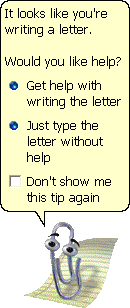
On a more humorous note: Seven Sinofsky suggests that Smart Reply is kind of what Microsoft were trying to do with Clippy all those years ago:

Now let me see:

Blessing #204 – Clearing Out

As I look out into our back garden now covered with Autumn leaves I see all sorts  colours. From the brightest reds, to the deepest browns, there are evergreen and moss greens it’s an array of flora that has recently exploded into colour and is now spread across the garden. It will need clearing up, but there’s no rush, it has only been a couple of weeks since we spent time picking and sweeping. There’s a neighbour out in their front garden with a leaf blower he’s there most weekends, their garden is much neater than mine.

Beyond my garden there is a high hawthorn hedge which belongs to a bungalow. In the garden of the bungalow there are all sorts of left-over building materials and enough building equipment to stock a hardware store. I pass the front of the bungalow on my morning walk sometimes. In the driveway there are at least four vehicles which are full of more building materials, each vehicle is surrounded by more building material and I wouldn’t be surprised of there are more vehicles hidden under the other material. At the entrance to the driveway there are two more vehicles which are themselves full of building material and other detritus, they stay at the entrance because they can’t get in the drive. I’ve never met the person who lives in the house but it doesn’t look like a happy place to live.

A couple of months ago I had some time available on a Saturday to start to clear out the garage which had got a bit messy with things being delivered, stored and restored. It was becoming frustrating clambering over things all the time trying to find the thing I was looking for. Unfortunately the clearing out had only got to that point where it didn’t really look much better than when I had started before I had to finish. I wanted to get the tidying finished so that I could store the garden furniture for the rapidly approaching autumn and winter. A couple of weeks ago I again had some time available to finish the job. After sorting, sweeping and a few trips to the local tip it felt so rewarding to put everything in its place and to see how much free space there was in there and how easily the garden furniture fitted.

There are parts of my life that like each one of these places, a bit messy like the garden, in need of serious clearing out like the bungalow and nicely tidy (for now) like the garage. There’s something very rewarding about clearing these places out but some of them look like a big job and that’s when we need help. Thankfully Jesus doesn’t expect us to have a cleared out life, he just wants to help us with the tidying and to get to know us in the process. Thankfully he’s not comparing our level of cleanliness to our neighbours, he knows us and wants to meet us where we are. From my experience Jesus is more interested in getting to know us that getting everything right in our lives.

"To be nobody but yourself in a world which is doing its best, night and day, to make you…

To be nobody but yourself in a world which is doing its best, night and day, to make you everybody else means to fight the hardest battle which any human being can fight; and never stop fighting.

E.E. Cummings

Handle it once! Getting back to Inbox Zero.

Like many people I get a significant amount of junk-mail through the letterbox every week. Most of the time the junk-mail goes straight from the floor below the letterbox into a dedicated rubbish box near the door where it rests temporarily before going outside into the recycling bin. There is minimum effort expended on these pieces of brightly coloured paper.

The useful items of post will get filtered out and go onto a desk in a room near to the letterbox. Quite often these pieces of post will get opened and quickly looked at during the filtering process, sometimes they’ll even get taken out of the envelope before they get put onto the desk. At some point someone will sit down with the various items of correspondence and make a decision on the next step they should take.

Nearly all the post that isn’t junk-mail will get handled twice, some of it will get handled multiple times. Sometimes it’s inevitable that things get handled more than once, but the reality is, most of it only needed to be handled once and then dealt with.

Last week I looked at my email inbox and realised that it was a mess, but I couldn’t understand why, so I watched what I was doing. Once I became aware of it I realised what was causing the mess – I was opening emails, skim reading them and then closing them, leaving them in my inbox.  My normal method of processing information (I need to update that post because it’s changed) had lapsed and my inbox-zero routine had fallen by the wayside.

My inbox-zero approach goes as follows:

  • On a periodic basis (avoiding continuous sorting)
  • Start at the top of the inbox
  • Open the first email start to read through it and spend 10 to 15 seconds understanding it.
  • If the email can be responded to in less than a couple of minutes, respond and file under done.
  • If the email is going to take longer file under to-do.
  • Open the next email.
  • Repeat until mailbox is empty.

I have a set of keyboard short-cuts set up to do the filing. In this way most email is only handled once and it’s only the items that need a longer activity that are handled multiple times. The items that need to be worked on are visible and the clutter is reduced.

This week I will be re-instigating my inbox-zero approach to handle things as few times as possible.

Office Speak: Single Pane of Glass

When you get into a car as a driver you put the key in the ignition (or press a button) and the dashboard lights up. Most of the time the car will go through its start-up checks showing you a set of icons that eventually go off and tell you that it’s OK to get going. Once in motion the dials on the dashboard will show you various pieces of information about the car.

(Ever wondered why it’s called a dashboard? The name goes all the way back to horse-drawn carriages where the dash-board was in the same place as the modern dashboard to stop the driver and passengers from getting covered in material “dashed-up” from the horses hoof)

People have, for some time now, taken the dashboard analogy and applied it to business and IT systems saying that what people needed was a dashboard of the system.

Like many things in business and in particular IT the dashboard analogy resulted in a huge number of dashboards. In my experience every business application and every technology has something that it calls a dashboard. Thus was born the concept of a single pane of glass to deliver need for a unified dashboard that consolidates everything that’s available in all the other dashboards.

(I had thought that this phrase was dead, but I’ve heard it several times recently)

I have seen many projects for delivered a single pane of glass. I have been involved in a few single pane of glass projects. I have never seen a successful single pane of glass project. I have seen a couple of projects come close to delivering a successful single pane of glass for a defined group of people and a moderate set of requirements. The reality is, no one really wants a single pane of glass, they want insight into the system and they want to understand where problems are, but they don’t need a single pane of glass to do it.

Cars don’t even have a single pane of glass, the driver has a dashboard, but once you open up the bonnet there are all sorts of indicators of vehicle health (fluid level indicators, dip-stick), plug a computer into the telemetry and you get even more insights into the health of the vehicle. As a driver you don’t want to see all the telemetry because it’s not helping you drive. As a mechanic the warning light on the dashboard doesn’t give you enough information.

Must business and IT systems are more complex than a car. The manager of that system may want one view of it, but it’s also likely that they want different views depending on the system and the current health of that system. The same is true for the operator of the system. They probably want a summary dashboard, but that’s not the same thing as a single pane of glass that brings all the information together. The summary dashboard may also provide links to all the other dashboards because that would be helpful, but it’s still not integrating everything into a single pane of glass. Apologies, I’m going on now, you get the idea.

The Return of the Artisans

When we have a Saturday with nothing in the diary (which doesn’t happen very often) there are a few things we like to do as a treat. One of them is to travel to nearby Lancaster; once there we will stroll through the market and visit a favourite Indian food stall where they make the most fabulous Samosa. The lady behind the stall, Sanah, is a character and greets everyone with a smile and a vigorous welcome. Having collected our Samosa we walk a little further to the nearby bread stall with wonderful smells wafting up from the selection of home-made speciality breads. We’ll wander a little further and look in other places, but these two stalls are a must. Having completed our shopping we’ll head back towards the car, stopping at a local speciality coffee shop along the way.  There we’ll choose a particular coffee from a particular country, we’ll watch the Barista weigh out just the right quantity of beans, see them ground to the correct coarseness for the particular method of coffee brewing that we’ve chosen. The coffee will be expertly made and presented with a smile.

Each of these traders are artisans – they are skilled in their craft, they produce high quality outcomes and use high quality ingredient. They’re not part of huge corporate machines, they are small businesses selling to other small businesses and individuals. They aren’t constantly driving to produce the cheapest goods they can, there is a standard to what they produce that comes at a price and in its time. Each of these artisans has a passion for what they do. These businesses are anchored in a historic way of trading – these businesses are the future.

You might think that the future is going to be dominated by large corporations turning us into ever more homogeneous versions of each other, but there’s another trend building and it’s a much more human one.

It’s worth taking a detour into a quick history lesson for a short while. Back in the 18th Century we Brits birthed an industrial revolution named after the transition to mechanized manufacturing and the rise of the factory system that was taking place. Prior to this time production had mostly been done in small workshops environments but now people had to attend to the machines in large factories. This industrialization of production completely revolutionized the way we live and resulted in a mass migration from a rural society to a primarily urban one. There are towns in the UK that only exist because someone decided to build a factory or a mill there.

The initial phases of the information age also relied upon the centralization of people to enable access to expensive machinery. Over the last five to ten years the need for people to attend to gain access to information systems has all but vanished in many industries. Large scale production environments have become largely automated. Another way of working is emerging – the artisans are being reborn. The artisans aren’t just baking bread or creating crafts they are also doing data science, designing, developing application, producing films and many other roles.

These people no longer need to go to a centralized facility to do their work, they can work wherever they are and sell their good to the whole world. That doesn’t mean that they won’t travel, just that they don’t need to travel.

In 2013 I highlighted the move to sole-traders and small businesses that was occurring in the UK at that time, since then the transformation has accelerated.

“Overall the number of SMEs has increased by 1.8 million (up 51%) since 2000.”

bpe_2014_statistics_growth

We are in the midst of another significant change in working habits, I struggle with the word revolution because it’s so often over-used, but perhaps it’s applicable to this change. The impact of automation and robotics on this world is still being worked out, but that’s another subject for another day.