Silver How and the Langdale Edge | Birkett LAN 2 | Graham’s Guides

A lower level walk that goes takes you from the softer southern fells into the more craggy Langdale fells. Including Birketts, Wainwrights and bird’s eye views of several lakes.

Graham’s Walks Vitals

  • Distance: 6.9 miles/11 km
  • Elevation: 2172 ft/662 m
  • Difficulty: Moderate
  • Map: 🗺
  • GPX: 📁
  • Graham’s Cafe: You are likely to drive past Chesters by the River
  • Classification: Birkett, Wainwright

The Area

This walk begins in the Langdale Valley starting at either the Lake District National Park Dungeon Ghyll Car Park or the roadside near Harry Place Farm. The National Trust Stickle Ghyll Car Park is also a reasonable starting place and is free if you are a member. When I recently did this walk, I forgot about the National Trust car park, where I had free parking, even though it’s only a few metres further down the road. There are regularly overflow arrangements for parking near to the New Dungeon Ghyll Hotel.

This walk includes Sickle Tarn, the stream down from the tarn is Stickle Ghyll which I have seen confused with Dungeon Ghyll which is a different ravine to the west of Stickle Ghyll.

This whole area, Dungeon Ghyll in particular, became a popular Victorian tourist destination inspired by the romantic poets, most famously the Wordsworths and their friends. What is now the Old Dungeon Ghyll Hotel evolved out of a farm house that was there before the tourists arrived. The Lake District has been a tourist destination for a long time.

This walk includes Silver How which is renown for its views; Wainwright described the views of Rydal and Grasmere as “bird’s eye” which sums it up nicely. Linking Silver How with the Langdale Edge takes us from the softer fell profiles of the south Lake District into the more rugged profiles as you head north and west.

Silver How is a popular walk from Grasmere village as a family friendly 3 miles walk.

A few name details for this walk: A “How” is a derivation from the Norse for “hill”; “Blea” is again norse this time for “dark blue”; “Rigg” continues the Norse naming meaning “ridge.” We see “Lang” in “Lang How” and “Langdale” which is still in use today in Cumbrian dialect and means “long.”

This walk includes four Birketts – Silver How, Lang How, Castle How and Blea Rigg. Silver How and Blea Rigg also count as Wainwrights

The Walk

The walk can be done in either direction. I’ve described it in the direction outlined by Birkett, if I was to walk it again I would walk it in reverse of this description. The route starts by walking to the end of the Langdale Edge climbing slowly to Blea Rigg with a rapid descent down the side of Stickle Ghyll. There are paths down both sides of Stickle Ghyll which are tourist routes with high footfall making it necessary for both paths to be highly stepped to constrain erosion. Personally walking down uneven rough stone steps is one of my least pleasurable types of walking; I prefer to walk up this type of terrain.

Setting off from the National Park car park head down the bridleway alongside the river towards to start of the valley, this will bring you out onto the road near to Harry Place Farm. Follow the road for a short distance to the right until just beyond the farm buildings where you should see a sign showing the footpath up the hill to the left.

A short way up the hillside you’ll go through a gate from where the path will swing to the right and alongside a wall on your right.

You’ll follow this path around to the left and steadily up and around Thrang Crag above Chapel Stile. There are some great views to the south from this path.

The path will cross a waterfall and then a short distance beyond there is a path heading off to the left and up to the top of Silver How.

Take some time to enjoy the view from the top before heading off towards Lang How which is north-westward.

The path towards Lang How misses out the top so you do ned to head off to the right near to one of several unmarked tarns on the route. From the top of Lang How you head back to the path you just left a little further along.

The path continues on up the ridge towards Castle How. Birkett’s book doesn’t define a top for this hill and the book is a bit ambiguous. The Database of British and Irish Hills (DoBIH), which some regard as the definitive list for hill baggers, defines the top as grid reference NY307075 (wikipedia) and is what I have included in the route map. This reference is again a short distance from the main path. While, personally, I do like to reach a defined summit I’m not going to get worried about being stood on an exact point, especially if there are several potential summits, as there are in this case,

From the defined Castle How summit we return to the path and continue along the ridge to Blea Rigg.

Between Castle How and Blea Rigg the views down to Easedale Tarn open out to the right. The physical summit of Blea Rigg isn’t that well defined either; according to the DoBIH it’s NY301078 if you want to be precise.

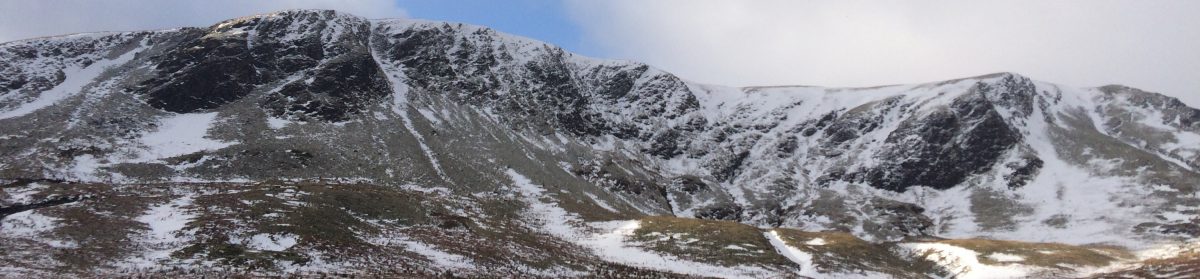
As you continue along the path beyond Blea Rigg and if visibility is good you should be able to see the rocky crags of Pavey Ark and the protuberance of Harrison Stickle ahead. Further progress will extend these views to include Stickle Tarn which is where we are heading.

Most paths lead to Stickle Tarn; the path you need to avoid is the one to the right which will take you up onto Sergeant Man.

Continue on the path to the edge of the tarn heading to the left and the outflow of Stickle Ghyll. You can go down either side of Stickle Ghyll, you can even change your mind part way along. My preference is to cross the river near to the tarn and travel all the way down on the western side. As I’ve mentioned earlier these paths are mostly rocky steps and require care.

The paths from Stickle Gyle emerge near to the Old Dungeon Ghyll Hotel from where your vehicle will be a short walk easterly along the road; assuming you’ve parked at this end of the valley. The walk back to Harry Place Farm will take a while longer.

Alternatives and Extensions

You should seriously consider doing this walk in reverse of what I have described, as mentioned earlier.

There are several ways to extend this walk but most of them would add several miles onto the route. It would also be possible to do the same ridge walk but from the Grasmere valley heading up to Silver How from the more common route and returning from Blea Rigg via Easedale Tarn.

Leaving the car park
Early view of the route down
The car park at Harry Place Farm
the start of the ascent
The first little gate
Early views to the south of Langdale
The path does get narrow in places
The cairn at the summit of Silver How
A glimpse of Grasmere
Unnamed Tarn on the route to Lang How
Cairn at Lang How
Views down to Easedlae
Reaching the top of Blea Rigg
First view of Stickle Tarn
The route down Stickle Ghyll
Continuing the route down
Looking back on the ridge walked

Loughrigg Fell Circular from Ambleside | Birkett LAN 2 | Graham’s Guides

This walk gives a lot of views for just 300m of ascent across a little over 6 miles.

Graham’s Walks📌
Distance6.3 miles/10.1km
Ascent1391ft/423m
DifficultyModerate
Map🗺
GPX📁
Graham’s CafeParking is in Ambleside where there are several cafe options.
ClassificationBirketts LAN 2

The Area

Loughrigg Fell sits as a viewing platform at the junction of several valleys giving it views across much of the southern Lake District. On a good visibility day the walk starts with views of Windermere, Coniston, Coniston Old Man, and the Lancashire Fells to the south. As you ascend the vista opens out to the Langdales, Loughrigg Tarn and Elterwater. Nearer the top the panorama adds in Grasmere and the surrounding hills including Helm Crag and Fairfield. If you are really fortunate you can view some of the northern lakeland fells through Dunmail Raise with the Helvellyn massif standing alongside. The later stages of the walk add in Rydal and Nab Scar.

There are so many hills visible on this route that it can be difficult to distinguish all of them; an App I find particularly useful for this is PeakFinder which allows you to point at a panorama and see the hill names above each peak.

Loughrigg Fell has been heavily quarried over many years making it pitted and potholed especially at the top. This has removed any straightforward ridge to the top, near to the top the available paths can feel a bit like a maze, up and down. Bill Birkett notes: “A proliferation of paths makes route finding rather tricky along the top.”

This walk follows quite closely the route described in Bill Birkett’s Complete Lakeland Fells as LAN 2. Loughrigg Fell is also a Wainwright.

The Walk

This walk starts from the main carpark in Ambleside, the one on Rydal Road near to Bridge House. There’s a Public Toilet in the car park.

The route starts with a little bit of navigation. Head back to Rydal Road and head to the left out of Ambleside past the Fire Station. Just beyond the Fire Station head left down Storey Lane. At the end of the lane is a paved path that leads alongside Stock Ghyll as it flows towards its confluence with the Rothay. There’s a stone footbridge over the River Rothay onto Under Loughrigg road.

Turn right over the bridge and after a short while left onto a paved lane that heads up the hill. There’s currently a post at the end of the lane indicating it’s a public bridleway. The lane heads pretty much straight up until it turns to the left and then switches back to the right. At the right-hand switch there’s a footpath off the bridleway to the left. There’s a small wooden footbridge at this point. There’s also a gate before you get to the tarn.

Beyond this point the path winds its way up to Lily Tarn where it’s worth a bit of an explore. There are some glorious views from the various hillocks that surround it. Lily Tarn is apparently good for a swim, but quite shallow.

With the tarn on your left follow the path up the hill towards the sheepfold.

The path is well defined at this point and continues until it intersects the path from Skelwith Bridge. Continue uphill on the other side as the path fringes Loughrigg Fell to the top. The top is defined by a stone built trig-point.

There are several path away from the top, picking the right one can be a challenge. The one you want is directly opposite the one you walked in on. You should be able to see Grasmere, where you are heading, which will help you get your bearings.

The path down is well used and in the latter stages becomes stepped until it reaches Loughrigg Terrace above Grasmere. Turn right onto the path along the terrace with the mere on your left.

The walk here is the popular walk to Rydal Caves which you will reach by following the contour around. On most days you’ll be able to see the path without any problems as it will be dotted with people.

At Rydal Caves take the path down until it reaches the lane that leads down to Pelter Bridge past the small car park. Before the bridge take Under Loughrigg which is the road to the right. This road will take you alongside the River Rothay all the way back to the footbridge and the path alongside Stocks Ghyll, Rydal Road and into Ambleside.

Alternatives and Extensions

It’s difficult to know where to start on the alternative routes for this one, there are many. I’ll give a few.

On your way back from Grasmere you can choose to take the lakeside route back along Grasmere, via the river Rothay alongside Rydal. That’s straightforward enough.

From the top you can miss out Grasmere and head straight across the top to the caves. It’s probably quicker, but misses out several views.

There are a set of stepping stones part way along Under Loughrigh which, given the right conditions, would allow you to cross over to the A591 a little earlier. It’s fun, but not with the payback of walking down the busy A591. There are several places where you can cross to the A591 if the need arises.

You can take a swim in Grasmere or Rydal joining someone most days. There’s also the option of descending to Loughrigg Tarn before reascending to the summit. Loughrigg Tarn is one of the best swimming spots in the lakes, but it’s a lot of down and then back up. Probably better to plan that for another day.

Parking at the main carpark in Ambleside can get busy. There are various options in Ambleside itself probably the best alternative is Miller Bridge Car Park which is only just the other side of Rothay Park. Also, it’s not too much further to walk from Waterhead via the Rothay Bridge and onto Under Loughrigg from the other end. Another alternative is to use the Rydal car parks, but they are often busier than the ones in Ambleside.

Although it might look like it can be done, please don’t expect to be able to drive the length on Under Loughrigg it’s closed part way along.

The Bridge Across the Rothay
Under Loughrigg
The Footbridge on the way to Lily Tarn
There’s a gate on the way to Lily Tarn
This is Lily Tarn
The view across Windermere from near to Lily Tarn
Loughrigg Tarn and Elterwater beyond
The top is in sight
The view from the top toward Grasmere
On the way down to Loughrigg Terrace
Along Loughrigg Terrace
Looking back towards Rydal
The stepping stones

Top o’ Selside Circular from High Nibthwaite | Birkett OUT 3 | Graham’s Guides

Taking a walk on the quieter side of the Lake District. This route crosses open moorland where you are likely to be on your own with the fabulous views across the fells and over to Morecambe Bay.

Graham’s Walks📌
Distance4.8 miles
DifficultyDifficult
Map🗺
GPX📁
Graham’s CafeNearest is Bakehouse Born and Bread

The Area

If areas of the Lake District had a league table this one would be somewhere in the second or third tier, and it’s all the better for it.

I’ve covered several walks that are in premier league areas like Grasmere which are beautiful, but also visited by lots of people. These areas define most people’s perspective of the Lake District, and I’m happy for them, but there are significant areas of Cumbria that don’t get this treatment and today’s walk is in one of those areas.

High Nibthwaite is at the southern end of Coniston and on the less visited eastern shore.

There isn’t really anywhere to park in the hamlet, but there is a small unmarked car park just outside to the north. There is also a field opposite this small car park which occasionally gets recommissioned as a place to leave your car, although on the day I last visited the field was full of impressive white cows. You will need the RingGo app for the field, the small carpark is free. When I say that the small car park is unmarked I mean that there are no signs at its entrance, you can’t see where the cars are parked from the road, and the entrance is down a rough track which immediately makes you doubt that a car park could be at the end of it. There is a grey metal post, but it doesn’t have any signs on it and it is shown on the OS Map. Here’s the link to the location of the small car park, if you zoom in close on Google Maps satellite view you’ll see a car parked in it.

High Nibthwaite has its own artistic connections with Antony Gormley of Angel of the North and Another Place fame. At the edge of the hamlet is a house called The Stable at Lake End where Anthony visited in the 1980’s and where, in a field next to the boat house and quay he has left one of his famous iron sculptures looking out towards the Old Man of Coniston. It’s worth a visit to the sculpture and to take in the view at the quay by taking the footpath across the field (The footpath doesn’t go anywhere other than to the quay).

Much of this walk is across Bethecar Moor which is mostly trackless so you will need you map reading skills for this walk. The moor is a mixture of small rambling hills, gullies and bogs. There are marked paths on the map, but they aren’t as clearly defined on the ground. Don’t be fooled into thinking of this as a natural landscape though, like much of the Lake District this area has been shaped by people over a long time with some mining, coppicing, peat extraction and charcoal burning.

Near to the summit of the walk is Arnsbarrow Tarn which is a beautiful peaceful glacial tarn. The name “barrow” hints as the Bronze Age burial mounds nearby. People have been shaping this landscape for a very long time indeed.

This walk includes three Birketts – Stang Hill, Arnsbarrow Hill, and Top o’ Selside.

The name Top o’ Selside is a combination of Norse and English meanings. The Norse part Selside means seasonal pasture on a hillside, more Viking influence. The English part Top o’ says that it’s the highest point of.

The Walk

This is a medium length walk but I’ve marked it as difficult because of the need to navigate open moorland where the tracks are few and far between. In good weather the features are distinct, but in poor visibility it would be easy to become confused. Also, walking in this kind of open moorland is more tiring and slower going than on defined well marked tracks. The lack of tracks does give lots of opportunity to explore though.

We start this walk from the small unmarked carpark to the north of Coniston which is here. We are going to do this circular in an anti-clockwise direction, but you could do it the other way around. My choice of direction is solely down to a preference for coming down through the woods at the end rather than working my way up them at the beginning.

From the car park we head south along the road back into High Nibthwaite taking a short detour to visit the Gormley statue and to take in the views along the lake from the quay.

In the middle of the hamlet is a track off to left. This track is often used by off-road enthusiasts and mountain bikers, it forms part of our route down later on. For now, though, we are only following it for a short distance before heading along the path to the right along following route of a drystone wall to our right.

This path will take us along the route of Caws Beck which is in the woodland, to our right, and below the crags of Brock Barrow, on our left, to the farm at High Bethecar. This farm has fabulous views across the fells and Morecambe Bay but feels very isolated.

From High Bethecar we head out onto the moorland through a gate and along a track that steadily diminishes. We are looking for a fork in the path that takes us off to Stang Moss to the right. This is where you will need your map reading skills because it isn’t very clear on the ground where this fork is.

The route from Stang Moss to Arnsbarrow Hill is along a small ridge. If you are fortunate you can see the top of Arnsbarrow from Stang Moss and the route is almost straight there.

When we are picking our way along a route it’s easy to get engrossed in the few metres in front of us, be sure to lift your head and take a look around, this route has fabulous views.

Onward to Arnsbarrow Tarn which is worth a visit to take in the tranquility of it. You should be able to see the tarn from Arnsbarrow Hill. Work your way around the eastern side of the tarm up onto the Top o’ Selside.

The track down from the Top o’ Selside is probably the clearest part of this moorland part of the walk. The views across to the Old Man of Coniston are glorious on a good weather day. Part way along this part of our bimble you will start to see the bridleway that will form the next part of our exploring.

Once you’ve reached the bridleway turn left along it as it descends.

The last time I did this route there were two groups of off-road vehicles making their way up the hill. The noisy engines and tires felt like an invasion of privacy having been on my own in the quiet moorland. I can see why people would choose this route though, the views are fabulous.

The bridleway will eventually draw alongside a wood on the right and then a little further along there is a gate into the wood. There’s only really one path down through the woods back to the carpark. This wood is nicely isolated and you should watch out for wildlife, when I last visited I saw a woodcock, a bird I’m not sure I’ve ever seen before.

Extensions and Variations

This route is mostly across moorland and this makes for infinite possibilities and variations.

Near the beginning of the walk you can choose to branch off and climb Brock Barrow which would be quite steep. Even if you don’t climb up the front you can branch off the defined path to the left to get some early views of the surrounding hills. From there you can cross moor to High Light Haws before branching off to Stang Moss.

If you were really wanting to maximise the number of Birketts that you covered on this walk you would take the route from Top o’ Selside to Carron Crag which is the only other Birkett in the area. Doing this would more than double the length of the walk and I’m not sure would add much more interest.

The entrance to the small carpark
It’s a small carpark
Initial views across Coniston and the White Cows, this is the field which sometimes becomes a carpark
Antony Gormley was here
The view from the quay
High Bethecar
Out on the moors, managed to find a bit of a path
Arnbarrow Tarn
Arnbarrow Tarn
Top o’ Selside with Morecambe Bay glowing in the background
The views along Coniston and the Bridleway
The gate into the woods