Humans and Robots: Augmented Productivity

For a few million years we’ve been augmenting our productivity with tools. Those tools helped us to catch more meat and to fight our enemies, in other words they made us productive. We continue to augment our productivity with new tools that help us achieve modern day productivity needs. Whilst productivity itself is a simple measure of input, added value and output it’s not always easy to define what the added value is. How people add value is going to be a key question as we transform the meaning of productivity in the coming years as the tools available change dramatically.

There have been a number of items highlighting these new tools over the last few days:

  • The MIT Technology Review is reporting on the impact of augmented reality on healthcare and the Operating Room in particular. The key thing here is that the information is augmenting the operating environment within the context of the operating environment.
  • Improbable has secured a $500m investment to help it continue to develop it’s simulation technologies. As Virtual Reality and Augmented Reality devices become more mainstream there’s the potential for a huge market in creating the simulations that bring those devices to life.
  • Cisco, Google and Microsoft have all made announcements aimed at augmenting today’s office productivity environment with various uses of AI.
  • And someone decided to make a robot that looks and moves like a spider (but only 6 legs so no needs to worry) 🙂

AR Is Making Its Way into the OR via MIT Technology Review

Doctors may soon be able to augment their view of your body, but it will be some time before it’s commonplace.

“Scalpel. Forceps. Suction. Oh, and nurse, pass me the HoloLens.”


If we’re living in a simulation, this UK startup probably built it via Wired

Improbable’s platform, SpatialOS, is designed to let anyone build massive agent-based simulations, running in the cloud: imagine Minecraft with thousands of players in the same space, or researchers creating simulated cities to model the behaviour of millions. Its ultimate goal: to create totally immersive, persistent virtual worlds, and in doing so, change how we make decisions.

Or more simply, as Narula often jokes, “Basically, we want to build the Matrix.”


How machine learning in G Suite makes people more productive via Google Enterprise Blog

According to a Google study in 2015, the average worker spends only about 5 percent of his or her time actually coming up with the next big idea. The rest of our time is caught in the quicksand of formatting, tracking, analysis or other mundane tasks. That’s where machine learning can help.


Transforming Collaboration Through Artificial Intelligence with Cisco’s Acquisition of MindMeld

Artificial Intelligence represents a tremendous opportunity to expand the reach and enhance the capabilities of enterprise technology. At Cisco, we have already been introducing AI into our solutions across security, orchestration, application performance and collaboration. Today, I’m excited to share Cisco’s intent to acquire MindMeld Inc., a San Francisco-based company that has developed a conversational platform based on natural language understanding (NLU). This acquisition, Cisco’s third in two weeks, represents how the buy pillar of our innovation strategy continues to impact our strategic shift to become more of a software company.


Microsoft’s Presentation Translator translates presentations in real time via TechCrunch

The Presentation Translator can automatically provide real-time translated subtitles or translate the text of their actual PowerPoint presentation while still preserving the original formatting.

In its current iteration, the service supports Arabic, Chinese, English, French, German, Italian, Japanese, Portuguese, Russian and Spanish. While the focus here is on translation, you also could use the same service to caption a presentation for audience members who are deaf or hard of hearing.


Man’s homemade robot spider looks real and we are sufficiently freaked out via Mashable

Humans and Robots: AI, AI, AI, AI

There have been several Artificial Intelligence (AI) articles over the last couple of days.

A number of these have been commentaries on some research put out by Gartner. The simplified story within the Gartner research is that things that professionals do today will be done by AI at a significantly lower cost at some point in the future. Once that happens those things can be regarded as utilities like electricity. I don’t think that there is any news in this that’s been the general trajectory for some time, the unknown is the speed and nature of that shift. Gartner is going for 2022 by which they are really saying is something like “within around 5 years”.

(One of the things that you need to understand about Gartner is that people listen to them, so when they report something it’s worth taking note even if it’s just to understand where a Gartner reader like CIOs and CTOs may be coming from in the future.)

Interestingly that electricity utility thought is also one of the key points raised by Stowe Boyd in A Q&A with Erica Morphy where he quotes Andrew Ng as saying “AI is the new electricity”.

To further underline that thought both ServiceNow and Grammerly made AI related announcements. ServiceNow are focusing their AI attentions on the automation of work. Grammerly is raising money to help augment our language skills.

Oh, and also, Amazon released another personal assistant based on Alexa, the Echo Show. This time Echo has been given a screen.


Gartner Says Artificial Intelligence Could Turn Some Skilled Practices Into Utilities

“The economics of AI and machine learning will lead to many tasks performed by professionals today becoming low-cost utilities,” said Stephen Prentice, vice president and Gartner Fellow. “AI’s effects on different industries will force the enterprise to adjust its business strategy. Many competitive, high-margin industries will become more like utilities as AI turns complex work into a metered service that the enterprise pays for, like electricity.”


A Q&A with Erica Morphy

“we have to learn to dance with the robots, not to run away from them. But that means we have to develop AI that is dance-withable, and not unrunnable-away-from.”


ServiceNow launches machine learning, AI automation engine

The four main use cases for ServiceNow’s automation efforts include:

  1. Anomaly detection to prevent outages in IT departments. ServiceNow will apply algorithms to find patterns and outliers that can lead to an outage. Anomalies can also be correlated with past events and workflows.
  2. Routing and categorizing of work. Learning algorithms will automatically route work based on past patterns. Tasks such as assessing risk, assigning owners, and categorizing work will be automated.
  3. Performance predictions. The Intelligent Automation Engine can be used to set a performance goal and data profile and get predictive analytics on hitting goals.
  4. Benchmarks vs. peers. ServiceNow is using the automation engine to compare companies to their industries and peers to gauge efficiency and make recommendations.

Grammarly raises $110 million in its first ever funding round

The company’s pitch centers on its machine learning capabilities. It claims this technology can dig into the substance of users’ writing in a way that’s not possible with Microsoft Word or other autocorrect programs.

Grammarly says it can advise not only on proper grammatical structure but on tone and word selection as well.


Amazon’s ‘Echo Show’ Gives Alexa the Touchscreen It Needed

Humans and Robots: Large Scale Changes from Many Smaller Scale Changes

The Institute for Public Policy Research Scotland has been looking at the impact of automation on employment in Scotland. Their estimate is that 46% of jobs are at high risk of automation. They also identify the primary challenge with this shift as being people’s ability to gain new skills whilst in employment, mid-career.

It’s not at all clear whether human skills can change at a rate that will allow us to outpace AI skills. There are differing views (see also Humans and Robots: Skills, Manufacturing and Construction) on this but I’m not sure we’ve got any choice but to try.

Many societies has been through these changes before, but not at this scale or this pace.

Whilst large changes are being predicted, the big shift will be made up of millions of smaller changes. One example of this are the Artificial Intelligence integrations that Microsoft are making in Microsoft Office. From design advice in PowerPoint to the Focused Inbox in Outlook these automations will soon become second nature to how we work. You’re already dependent upon the AI in the spelling and grammar capabilities. Driving all of these enhancements is AI that Microsoft is training with the data from over 100 million Office 365 users.

Also, there’s a little word from Dilbert at the end.


Automation poses a high risk to 1.2m Scottish jobs, report says

It put forward the recommendations in its Scotland’s Skills 2030 report, which said: “The world of work in 2030 will be very different to that in 2017. People are more likely to be working longer, and will often have multiple jobs, with multiple employers and in multiple careers.

“Over 2.5 million adults in Scotland (nearly 80%) will still be of working age by 2030. At the same time, over 46% of jobs (1.2 million) in Scotland are at high risk of automation.

“We will therefore need a skills system ready to work with people throughout their careers.


Microsoft and Artificial Intelligence’s long relationship is about to deepen


Humans and Robots: Skills, Manufacturing and Construction

At humans we are pretty good at falling into the trap of believing that what is has always been. We simplify the complexity around us by treating as many things as possible as permanent. Many of the macro systems which define our lives every day are not as permanent or historic as we treat them.

The idea of going out to a job is only a couple of hundred years old.

While Capitalism has been around since the 14th century; industrial capitalism has only been around since the 18th century.

People’s skills, and the way that they gain those skills, changed dramatically through that time. The skills we are going to need for the Robot future are likely to be very different to the skills we need today, that almost certainly means that the way we gain the skills will change dramatically also. But the big question is, will the Humans be able to keep up? In today’s Humans and Robots we look at some research by the Pew Research Centre debating the skills future.

We’ll also look at some of the areas already being impacted by the rise of the Robot:


The Future of Jobs and Jobs Training

As robots, automation and artificial intelligence perform more tasks and there is massive disruption of jobs, experts say a wider array of education and skills-building programs will be created to meet new demands. There are two uncertainties: Will well-prepared workers be able to keep up in the race with AI tools? And will market capitalism survive?

This report picks up on five major themes for skills and training in the emerging technology age:

  • Theme 1: The training ecosystem will evolve, with a mix of innovation in all education formats
  • Theme 2: Learners must cultivate 21st‑century skills, capabilities and attributes
  • Theme 3: New credentialing systems will arise as self-directed learning expands
  • Theme 4: Training and learning systems will not meet 21st‑century needs by 2026
  • Theme 5: Jobs? What jobs? Technological forces will fundamentally change work and the economic landscape

There’s a phrase that I’ve used a number of time on this blog: “Learning is work, work is learning” Harold Jarche. This is going to remain true for the present, and ever more so into the future, but it’s not clear that we will keep up, I’ll leave you with this thought:

About a third of respondents expressed no confidence in training and education evolving quickly enough to match demands by 2026.

Via Stowe Boyd – Forty Acres and a Bot


Apple’s $1 Billion Manufacturing Boost Will Likely Bring Robots, Not Factory Jobs

As we’ve explained in the past, advanced manufacturing—with all of its automation and super-efficiencies—can certainly bring productivity gains. But it won’t bring back manufacturing jobs. Just last month we finally got some hard numbers on the impact of automation on the labor force in our factories and warehouses: more robots bring with them decreased employment and lower wages. So if Apple’s focus is indeed going to be on using robotics, it’s not going to be good for the workforce.


MIT’s giant mobile 3D printer can build a building in 14 hours, and some day it may be headed to Mars

It might be targeted at Mars, but why not on Earth?

Humans and Robots: Automating the Buses

We are, apparently, entering a new era of automation and robotics.

For some this new era is one of opportunity where we explore new horizons with the help of robots.

For others the new horizon is one where we are beholden to our robot overlords.

I’m not sure anyone really knows the answer to where it will all end up predicting the future is notoriously tricky to do. So, I’ve decided to start curating some of the content I am seeing coming through and providing my own perspective on that content as a learning activity for me, and hopefully for you also.

I’m using the term robots to encompass anything that automates something that a human currently does, hence the title Humans and Robots.

As an example, from today:


The wheels on the self-driving bus go wherever they’re programmed to

Proterra, an electric bus manufacturer, just announced its three-phase plan to create the self-driving public transit system of the future, filled with autonomous, emission-free electric buses. The company says the move to autonomy should make mass transit safer and more efficient than ever before.

The automation of transportation is picking up pace with lots of very large organisations already committing significant investment budget. We have become used to autonomous trains in various situations, moving to autonomous buses is a significantly more complicated if those buses are to use the same road infrastructure as human drivers.

The days of driverless buses aren’t that far away, Proterra estimate 2019. That would have a significant impact on UK employment figures; Transport for London operates over 8,000 buses, as an example, I suspect that means that they employ over 16,000 drivers but I couldn’t find any definitive numbers. That’s a significant resource to redeploy in a transitional period that could be as short as 10 years. There will be some residual work for these drivers in cities like London where the tourists will pay for a heritage experience, but that’s a very small number compared to the needs for mass transport.

Whilst the impact on human employability is significant, so is the impact of safer emission-free mass transit. Many cities are struggling with air quality and what’s not to like about improved safety.

Outsourcing our Brain and the impact of SatNav

On Tuesday this week the Guardian wrote an article with the title: “All mapped out? Using satnav ‘switches off’ parts of the brain, study suggests”

This article was reporting on a study that was investigating the processes that the brain uses when mapping our environment and planning routes. The headlines emphasises that when we are receiving instructions our brain turns off many of these processes:

The study found that characteristic brain activity linked to simulating the different possible routes for a journey appears to be entirely absent when a person is following directions rather than independently planning a route.

The brain is quite good at not doing things it doesn’t need to do, but that has consequences.

Having read through the article I thought to myself that this would make a really interesting extension to an article that I had previously written on outsourcing our brain functions.

The basic idea of the post was that we use tools to outsource our brain functions and in so doing we risk reducing our brain function. By not exercising the brain capabilities we find ourselves in the place where we are dependent upon the tools and struggle to function without them. A basic example of this is the ability to do mental maths which, on my own unscientific assessment, is completely missing from the younger generation that has always had a machine to do this arithmetic for them. Another example is the memory of phone numbers which people no longer need to do; if you’ve given me your phone number in the last 5 years I probably don’t know it, I still know numbers prior to that time. This time coincides with increased use of mobile phones and no longer needing to know the number to call someone.

So where is the link to the post that I wrote?

I searched this blog for the post.

I searched Google for the post.

I searched my Evernote for this post.

I couldn’t find the post.

Without one of these tools telling me where this post is I’m stuck. Having outsourced that part of my memory I’m completely dependent upon them.

The irony wasn’t lost on me.

Consumer technology in the business world – today’s example

Today I was at a relatives house who needed to get their heating boiler fixed, so we called them a service engineer from one of the large utility companies here in the UK.

Due to the particular circumstances they came out quickly and started to take the boiler apart.

Unfortunately the boiler needed a part which the service engineer didn’t have.

The corporate ordering system would get him one by the next day, but he wanted to get it fixed before that, so what could he do?

That’s where the consumer technology came in.

The service engineers who work in this particular area of the UK had a WhatApp group so they could help each other out: “Give me a few minutes and I’ll check the group to see if anyone else has one of these parts so we can get it fixed today.”

In just a few minutes it was clear that no-one else had the part and we’d have to wait for the morning, but at least he tried.

I have no idea whether this was a company sanctioned way of working or whether this was something the engineers had decided to do, but it showed how deeply consumer technology has ingrained itself into the way that we work and play.

We talk about Shadow IT which I recently heard someone describe as “an abomination”, I don’t see it that way. Consumer technology will always move ahead of what a corporate IT organisation can, and should, do. Corporate IT needs to move to be the broker that enables people to get access to the tools they need to best do their job, where that needs to be something regulated then fine, but when there’s no value to be added corporate IT organisations should get out of the way.

Working with the Double Negative – Is my microphone on, or not?

I’m in a Skype for Business call and I’m getting confused by the blue button in this screen:

Skype for Business Microphone

In maths and in the English language it’s quite clear that a double-negative is a positive:

“I can’t not smile when she does that”

Means:

“I smile when she does that”

Or in maths:

0-(-1) = 1

likewise

0+(-1)= -1

The icon on this screen is the mute icon – so that’s (-1) and the icon is highlighted so that’s + resulting in -1 which means that the sound isn’t flowing therefore I’m on mute?

That’s makes sense, and that it exactly what happens.

mute icon highlighted = on mute

But, I can’t help thinking that this is all more complicated that it needs to be. It would be far less confusing to use a microphone icon rather than a mute icon. Then icon selected would mean microphone on and icon not selected would mean microphone off. I wouldn’t have to run an logic equation in my head to be confident that I wasn’t that annoying person on the call who’s disrupting everyone else by the high levels of background noise.

For me it’s just not intuitive for it to be a mute button.

I suppose it’s back to Norman and his doors.

Walking with Free Ears – What happened when I left my headphones at home

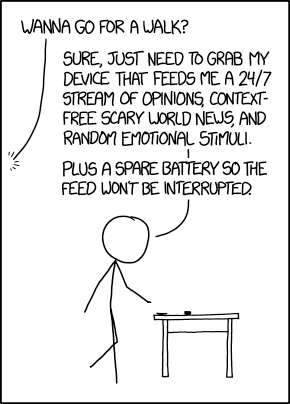
When was the last time you walked with free ears?

I nearly always walk with my headphones in. The introvert in me quite enjoys the feeling of escape that it gives me. Most of the time I’m listening to podcasts so it’s also a great way of keeping up-to-date.

On Saturday I went walking and I forgot my headphones.

I was immediately frustrated that I couldn’t enjoy my normal experience and a long day of walking ahead. There were a couple of podcasts that I was really looking forward to listening to and now a change of plan had been thrust open me by my own foolishness.

As the frustration subsided I started to realise something – the experience of walking with free ears was invigorating.

As I walked up the hill I marvelled at the peace and quiet of that particular day.

Higher up the clouds were down and the visibility was reduced to a few metres, the wind was blowing and my hood was up. The forcefulness of the wind was awesome and I was back in my introverted cocoon.

As a descended later I relished the opportunity to fling off my hood and open my ears to the outside world again.

I think I need to leave my ears free a bit more often.

When Algorithms Trump

The other day I was sent this as an Amazon recommendation:

ed-miliband

For those outside the UK I think it’s worth explaining two things:

  1. Ed Miliband is a former leader of a political party, he’s a former leader because he wasn’t very successful and lost to David Cameron (who you may have heard of).
  2. To “trump” has a number of meanings over here, one of which is to break wind usually audibly, I’ve not suddenly taken to politics on this site.

I am pretty sure that Amazon recommendations are created by algorithms without any intervention from a person. They must send millions of these emails every day, so there is no way that people get involved. A set of machines operate a recommendation engine and squirt out the emails.

The aim of recommendation engines is to suggest something that you are likely to buy, they do this via correlation of buying habits, demographics, connections, etc. Thus, somewhere in the middle of that algorithm is a correlation between my buying habits, demographics, etc. and someone who purchased a signed autographed photo of a former leader of the Labour Party. In this case the recommendation engine has produced a trump, is slightly humorous noise. I don’t have anything against Ed, but I don’t want a signed autograph picture of him on my wall, this recommendation is a passing of wind.

We recently purchased some new cooking utensils and the other recommendations in this email are all to do with that purchase, so perhaps Ed Miliband supporters are people who like good quality stainless steel also. I’m not sure that’s enough of a correlation to be of value.

This is a frivolous example of an algorithm trump but as algorithms come to run more of our lives the consequences become more significant.

Facebook and Google dominate the 2016 Top 10 US Smartphone Apps List

According to data from nielsen the most popular smartphone application in the US in 2016 was Facebook, but that’s not the only Facebook asset in the top 10 – Messenger is #2 and Instagram is #8.

The Facebook number is impressive at over 146 million average unique users per month. The US population now stands at around 324 million which means that over 45% of the US population uses Facebook on a smartphone every month.

The other dominant force on the list is Google who take places #3 to #7 with YouTube at the top of the list at over 113 million average unique users.

The two remaining spots on the list go to Apple and Amazon.

The Amazon app is also the fastest growing application in percentage terms with Google Search and Google Play in the slower growth lane:

Personal "temperature bubbles" – Yes please

Like many people who sit in open plan offices one of the most contentious issues is temperature. I’m always hot; that’s who I am. Others are always cold; that’s who they are. It’s difficult to do anything about that in a place where we all share the same air.

Comfort in a working space is greatly influenced by temperature and comfort greatly influences people’s productivity.

I’ve always wondered whether there was a better, more personal, way of dealing with different people’s temperature preferences.

Design firm Carlo Ratti Associati are try a better way at the Agnelli Foundation headquarters in Torino, Italy. By combining sensors and IoT technology with the air-conditioning system they are aiming to create personal “temperature bubbles”:

It will also add an important layer of personalisation through so-called “temperature bubbles” that workers will be able to set with a smartphone app that speaks to fan units in the ceiling. “Your own personal [temperature] setting will follow you through the building,” he said.

Mashable: This high tech office will give everyone their own thermal bubble

Yes, please! That’s all I’d like to say.