Let’s talk about Multitasking again!

Confessions of a multitasker

I am a multitasker; I’m doing it now.

There are a group of people sat around me discussing something, it’s a discussion that I could contribute too, but I’m also writing this blog post, I’m also allowing my iPhone to interrupt me. I’ve done this on many occasions and every time I do it I tell myself that I’m not going to do it again, so why am I doing it? The lie that I am telling myself is that the discussion doesn’t need all of my attention and I would be better spending my time doing something useful. I am kidding myself and every time you do something similar you are kidding yourself.

(I’ve been writing this blog post for over 40 minutes now and written 104 words. If I’d gone off to a quiet corner and really engaged I would have finished this post already. I’ll leave you to judge, but I suspect the quality of the words would be better as well.)

A recent report from the World Economic Forum based on some research from Stanford University, University of London and Sussex University highlighting the consequences of all of this multitasking which is probably more damaging than we might imagine.

Some of the report states what has been known for some time:

Multitasking reduces your efficiency and performance because your brain can only focus on one thing at a time. When you try to do two things at once, your brain lacks the capacity to perform both tasks successfully.

Repeat those words to yourself a few times: “your brain can only focus on one thing as a time”.

The report goes further, not only are you being less productive in the moment, the research is starting to point towards the impact being longer term:

It was long believed that cognitive impairment from multitasking was temporary, but new research suggests otherwise. Researchers at the University of Sussex in the UK compared the amount of time people spend on multiple devices (such as texting while watching TV) to MRI scans of their brains. They found that high multitaskers had less brain density in the anterior cingulate cortex, a region responsible for empathy as well as cognitive and emotional control.

While more research is needed to determine if multitasking is physically damaging the brain (versus existing brain damage that predisposes people to multitask), it’s clear that multitasking has negative effects.

So there you have it, there’s no advantage to be gained from multitasking, yet, we continue to tell ourselves that we are gaining something from trying to do two things at once. This isn’t the only situation where we behave illogically, but it is a growing madness as screens continue to proliferate.

Personally, I’ve been trying to build a set of practices which insulate me from the temptation to multitask. When i get home I’m trying to leave my iPhone somewhere out of reach and preferably out of view. I’m trying to take notes on paper in meetings, leaving the screens in my bag. When I have screen time I’m practising closing all applications apart from the one I’m focused on. I’m practising scheduling my days on a piece of paper. Another practice is to spend time in each day in silence or with quiet music without screens giving my brain time to calm down. What are your practises?

(It eventually took me two hours to write this post while multitasking which I did as a bit of an experiment to highlight the challenge. Hopefully the practices will reduce the time I’m multitasking and hopefully there isn’t any lasting damage to my brain.)
I'm reading…Steve Denning

Steve Denning’s bio on Forbes, where he writes, says:

I write about radical management, leadership, innovation & narrative.

I consult with organizations around the world on leadership, innovation, management and business narrative. For many years I worked at the World Bank, where I held many management positions, including director of knowledge management (1996-2000). I am currently a director of the Scrum Alliance, an Amazon Affiliate and a fellow of the Lean Software Society. I am the author of the Leader’s Guide to Radical Management, The Leader’s Guide to Storytelling and The Secret Language of Leadership.

I really enjoy most of what Steve writes, but there are two areas where I especially appreciate his thought provoking articles:

The World’s Dumbest Idea

The title of these posts come from a quote by Jack Welsh in which he refers to the idea of maximising shareholder value as “the world’s dumbest idea”.

The original quote come from the FT in which Welch says:

“On the face of it, shareholder value is the dumbest idea in the world,” he said. “Shareholder value is a result, not a strategy … Your main constituencies are your employees, your customers and your products.”

So why is it such a dumb idea? To radically over-simplify Denning’s writing the answer is that is reduces innovation and ultimately reduces the value of an organisation by bleeding it dry. An example of where this occurs is share buybacks:

The resources spent on share buybacks are resources that could otherwise be spent by the organization on innovation or compensating workers for their gains in productivity.

What’s the alternative? That’s summarised by another quote from Peter Drucker:

“There is only one valid definition of a business purpose: to create a customer.”

I’ll leave you to read if your interested.

Some posts:

Agile

I work in IT and the Agile movement has had a massive impact on the way that we now work.

We used to work on massive projects that regularly resulted in failure. These projects were managed through waterfall plans that were regularly late and over budget. We needed a different way of working and in 2001 a group got together in Snowbird, Utah. The result of this gathering was the Manifesto of Agile Development and the ignition of a massive change across the industry that it still, in many ways, in its infancy.

Denning isn’t a software developer, he approaches Agile, as a mindset, from the perspective of leadership and management. In 2012 he called Agile “the best-kept management secret on the planet”.

The following video is the best summary that I’ve seen, it even starts with a summary of the talk itself:

Some posts:

New Series – "I'm reading…"

I’ve thought that I need a new series to give my writing some structure but couldn’t decide on what it should be. Series are a great way of creating a rhythm to writing, they also give people something to look forward to (hopefully).

I have toyed with a number of series ideas and finally settled on “I’m Reading…” where I plan to highlight some of the many things that I read. This will focus on people who write longer format blogs and articles that influence the way that I think about things and authors who think through things. Many of these are business and technology focused, but there’s also writing on science, art, sociology and other interesting subjects.

If you’d missed the earlier series and those that are still ongoing here are some links for you:

  • Acronyms – we use them all the time, but what do they mean.
  • Axioms – where I look at things that people take to be true and check whether there is any evidence to support them.
  • Concept of the Day – where we look at a concept the I’ve read about or used.
  • Office Speak – every office has its own language, this is my attempt to explain that language.
  • My Changing Workplace – a bit of history about my working life (I must update this as the last one covered the 2000’s).
  • My Tools – I use all sorts of tools and this is my overview of what they are.
  • The Productive Workplace – a series from 2014 were I looked at the skills that would be required by 2020, which is only 39 months away!

There’s also the My Stories series over on my Blessings site.

My Stories: The Boy with the Sword

There once was a boy who loved swords.He wasn’t old enough for a metal sword wooden ones were more than adequate. They would be swung around his head. He’d spin and thrust. He’d leap forward, twist and swing the sword. His wrist would twist and push the sword forward. He’d jump and reach upwards. He’d land and position.

Combing moves up and down the lawn he would dance. This way and that, backwards, forwards and sideways

In a world of his own he was entranced by the motion and the movement.

There was a gardener who would watch as he choreographed his moves, smiling at the pleasure dance.

The gardener had been trying to grow a particular flower, a tall slender flower with a multi-floral bloom at the top, an Agapanthus known romantically as the African Lily. The gardener had seen others grow these floral delights but had only managed to grow leaves until this particular year. This year one of the plants decided that it liked it’s location enough to burst into bloom. Upwards it pushed it’s long stem and moved it’s buds into position. The gardener watched as the buds steadily filled out ready to blossom.

Then one day, as you’ve probably already guessed, the boy with the sword walked up to the gardener and handed him the decapitated stem and buds. They were close to bursting, but they wouldn’t get the opportunity, this was not to be their year.

The gardener looked at the stem and looked at the boy and thought about all of the enjoyment that the boy had gained from his dancing and considered it a small price to pay. He looked at the boy and he laughed. African Lily would have to wait for another year.

Many years would pass and the boy would no longer dance around the lawn with his sword. The gardener would, eventually, grow another tall slender stem and watch the buds move into position. Maybe, just maybe he’ll watch them bloom but even if they don’t he’ll think about that boy with his sword and laugh.

My Tools: Moment – how much do I use my phone?

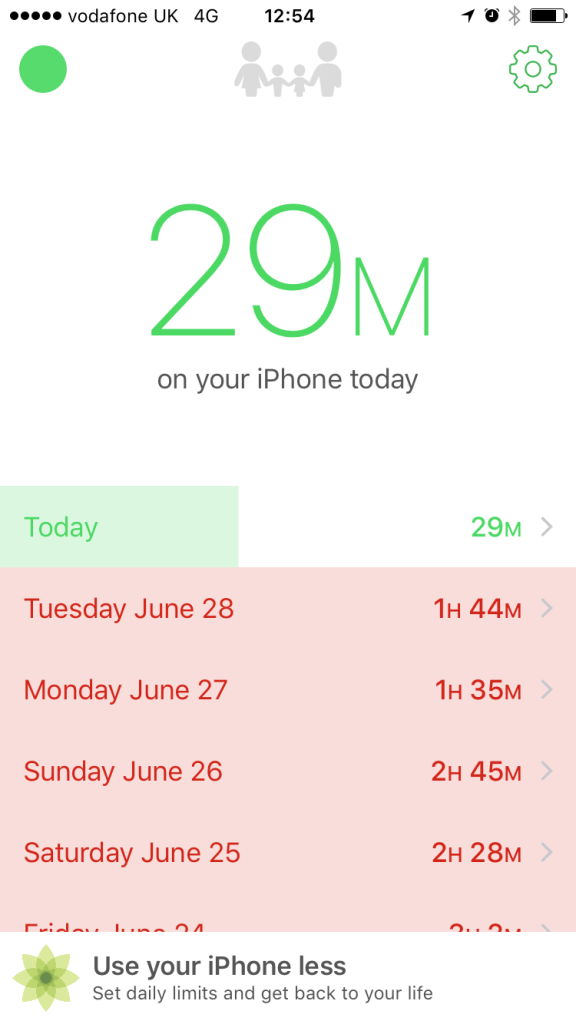
Most of us are inseparable from our smartphones and spend much of our life gazing into screens small and large. I’ve often wondered how much time I spend looking into my iPhone screen and now I know – a lot.

Moment is an iOS application that tracks how much time I am spending on my iPhone and how many times I pick it up.

If you had asked me before running Moment I would have told you that I probably used my iPhone for about an hour a day. You can see from the image below that I use it more than that, especially at a weekend. Much of this time is spent multi-screening when I’m also watching the television, but it’s still a lot of time, particularly as I didn’t think that I watched that much television.

I tend not to wear a watch so I was interested by how many times I pick up my iPhone. The answer appears to be somewhere between 30 and 50 times which is a few times an hour for the waking day (assuming I don’t pick it up in my sleep) which doesn’t seem too unreasonable.

What these image don’t tell you is that I also have an iPhone I use for work, so this isn’t all of my iPhone screen time. I also run Moment on that phone and was surprised by how little I use that phone in a normal working day.

There’s an axiom that says that you have to be able to measure things to manage them. Having measured my iPhone usage I think it’s time to manage it down to a more sensible number. An extra hour a day is a lot of time to recover that could be invested in more useful activities.

You need to leave the application running for it to take measurements, but that doesn’t seem to be a problem. The impact on battery life seems to be minimal also.

20160629_115413000_ios

On this day in 2005 – my blog birthday

11 years ago today I wrote a couple of posts on a typepad blog site which began the journey that has become this blog site.

Today is this blog’s birthday.

The first post was titled Welcome which did exactly that. In those early days the blog was called Oak Grove which is related to the origins of my surname.

The second post was titled Aspirations which outlined a number of personal observations. It’s quite a ramble, I hope my writing has improved since then.

On the 8th April I wrote a post titled The always-on social impacts which set a theme that has reappeared in various forms across the 11 years. Since that time we have become ever more connected and now travel everywhere with a smartphone and access Facebook, Twitter, Instagram, etc. every waking hour. I suspect that this is a theme we will come back to again.

My Tools: Wunderlist

Managing my tasks my way with a bit of help from technology

Benjamin Franklin once said:

In this world nothing can be said to be certain, except death and taxes.

There’s another things that’s quite certain and that’s lists and in particular to-do lists.

The lists always exist, it’s our choice how we manage them. There are many-many choices for methods of managing to-do lists and a correspondingly long list of applications that support the methods. My personal choice of application for the management of to-do lists is Wunderlist.

I’ve used Wunderlist for a while now and initially chose it because I liked the user interface on my iPhone. Some people are very particular about their to-do lists and adhere to them strictly throughout each day, I’m not very particular. There are two reason for a to-do list as far as I am concerned:

  • To remind me of things I’m likely to forget.
  • To get things out of my head so that I can think about other things.

This means that my to-do list regime is not highly structured.

I have a number of lists and items are placed on those lists as I remember them. The lists are structured around various areas of my life:

  • Work
  • Family and Home
  • Blogging

The items within each list are then prioritised in a very simple structure with the important ones being starred and the time critical ones having a due date defined. The ones with a due date assigned normally also have a reminder defined depending upon how long I need to get the item completed.

Wunderlist allows me to live within this structure and prioritisation regime very easily and that’s why I like it.

As well as the list views Wunderlist gives a number of useful views:

  • Starred – which shows all the starred items separated by the list titles.
  • Today – which shows all the items with a due-date of today (or earlier)

My primary usage of Wunderlist is still on my iPhone because that tends to be the device that I’m using when I’m thinking about my activities. I also use the Chrome application. I sometimes use the Chrome extension to quickly add a web page to a to-do, but that doesn’t happy very often.

I only use Wunderlist as my personal to-do list manager, so there are a number of features that I don’t use. I’ve never used shared to-do and hence never used chat or had anyone put a task in my inbox. I don’t normally add files to tasks, rarely use sub-tasks within an item, nor changed the background so never had a need to upgrade to Pro. I haven’t used folders either because that’s a layer of complexity in the structure that I don’t need.

The biggest challenge, I find, with to-do lists is not managing the list it’s doing what’s on them. This isn’t an application issue, this is a Graham issue and I don’t see any application ever being able to do that for me.

(Off now to click the task in my blogging list titled My Tools: Wunderlist)

My Stories: Driftwood Toast

In a previous story I told you about an experience with large waves at Hornsea. I also told you, in another story, about my Dad’s less than stereotypical approach to cars. This story brings those two threads together again.

When I was younger we lived in a house that still had an open fire. This type of fire were, at that time, being replaced with gas stoves across the UK. There’s something magical about a proper fire though. There are environmental concerns also, but there’s something primal about our connection with fire.

In this particular house the open fire wasn’t the main form of heating we had, as I remember, central heating. This left the open fire for special occasions and when it was very cold. The only thing I remember being burnt on the fire were logs. The logs were stored outside in a semi-neat pile at the back of the concrete garage. The logs got to the pile in one of two ways; they were extracted from people’s gardens (with their permission of course, another story for another day) or they were picked up as driftwood on the beach. I don’t know whether he did but I can’t imagine my Dad ever buying logs.

Collecting driftwood was something we would do on winter weekends. Summer weekends were spent at the allotment, but once the weather had changed it was time to walk the beaches and bring back whatever we found. This was mostly an opportunistic activity, we weren’t at the beach to fill a quota of wood, we were going to see what we could see.

On these adventures the car always had a trusty bow-saw deposited in the boot and we would go combing.

In the particular area of the east coast of England where I was raised there are miles and miles of beaches, the North sea is also a significant shipping route and the two together made for lots of discoveries. There were five of us on these excursions and we could carry pretty much anything we found. I have in my mind carrying a large log on our shoulders, my Dad, my brother and me. In my imagination this piece of wood is a broad tree-trunk and over 2 metres long. As I think about it now, I’m not sure how that worked because we would have been radically different heights, so perhaps that’s not quite how it was.

Having recovered our spoils we would stand at the back of the car sawing up pieces of wood so that they would fit in the boot. These eccentricities always gained us a certain amount of attention from others on the beach, some of it admiring, some more scornful.

Once back at home the bounty would be cut up into fire sized logs and placed onto the log-pile to dry.

Once the days work had been completed, but only on certain occasions, one of my parents (my Dad mostly I think) would lay the fire and we’d all sit around and watch it burn. We knew which of the logs were driftwood because they would burn in different colours, magical greens and blues, because of the sea-salt in them. Sometimes the fire would struggle to get going and my Dad would place a piece of newspaper over the fireplace, covering the fire, to get the draw going. He’d do this with his forehead on the newspaper against the top of the fireplace and his arms outstretched to the sides to spread the newspaper out. My Mum never seemed happy about this course of actions. I remember being fascinated by the way the flames would start to grow and and eventually roar as the air swept passed them up the chimney.

Normally the time would come for toast, or crumpets, which we would toast over the firewood with a long brass toasting fork. We would argue about who’s turn it was to go first because we were so eager for that unique flavour of wood-fire toasted bread, melted butter and home-made jam.

I still love to sit and watch an open fire.

For those of you who can’t imagine me as a small person I thought I would include a picture that I recently came across. I’m the one with the arms crossed (not looking at my sister):

Chastney Family

My Tools: Buffer

In my post How I process information (2015 update) one of the changes I highlighted was that I’d started using Buffer.

What Buffer does is relatively simple, but no less useful for its simplicity, and it’s elegantly done.

When I read through information in a morning I find things that I’d like to share with other people, primarily on Twitter. As I come to these items I could just share each one as I go through them. The problem with this approach is that it would turn me into that annoying kid who is constantly saying “have you seen this”, “have you seen this”, “have you seen this”. What Buffer allows me to do is to spread these posts across the day in a way that’s, hopefully, less annoying.

The way Buffer works is that you define a standard set of time slots for your normal day. When you add something to the Buffer queue it picks the next slot and then sends the tweet (or updates Facebook) at that time slot. If you fill the slots for one day it will flow over into the next day.

Setting up the slots is easy. You tell Buffer how many time slots you want, it can then analyse your twitter statistics and propose a set of slots for you, which is what I did.

With time slots set up I use the Buffer integrations with TweetDeck, Feedly and Chrome (and on my iPhone) to add to the queue. The TweetDeck (and Twitter) integration is smart enough to use Quote Tweets, the other integrations create a tweet with the title of the item and a url with the option to update the text and to add a picture.

Most things only get posted to Twitter, but I can also post the same content directly to Facebook using the same integrations.

Once added to the queue items are posted as they reach the front of the queue. As a Brit there is something very satisfying about adding things to a queue. You can reorder the queue if you want to, but that feels very un-British.

New theme for 2016

From time to time I decide that this little piece of internet real-estate needs a bit of a makeover.

As we move further into 2016 I’ve decided that it is again time to do some tinkering. That tinkering isn’t finished, by any measure. These changes are always a bit of a journey where I start with a blank-sheet and customise until I’m happy. What you see now is the blank-sheet which will be tinkered with until I’m happy.

This year’s blank-sheet is the current default WordPress theme – twentysixteen.

The tinkering helps me to remember some of my coding skills and also challenges my aesthetic eye. The eye is uncomfortable at the moment due to the number of anomalies in the blank-sheet, they will be tinkered out.

Top posts for 2015 – Blessings and My Stories

There hasn’t been much new content on this site this year, there are many reasons for that, but I have to admit that the primary one is that I just didn’t get around to it.

For Blessings posts the top 10 have looked like this:

  1. Count Your Blessings #120 – Short Stories
  2. Blessings #183 – Counting the thing I have that money can’t buy
  3. Blessing #203 – High-Mileage Songs
  4. Blessing #205 – A Bit of Nonsense
  5. Count Your Blessings #64 – Stories, Fables and Parables
  6. Blessings #176 – Hovis Digestives
  7. Blessings #198 – Personal Proverbs
  8. Blessings #196 – A Full Notebook
  9. Blessing #204 – Clearing Out
  10. Blessings #202 – Home

It’s worth noting that the top 2 are by far the most popular posts.

For My Stories there’s only a top 8, because I’ve only written 9 of them:

  1. My Stories: Concussion
  2. My Stories: Mr Smith
  3. My Stories: Two Allotments
  4. My Stories: Hornsea Waves
  5. My Stories: £9 or £10
  6. My Stories: Jet Planes, Helicopters and Army Vehicles
  7. My Stories: “Y’alright Wack”
  8. My Stories: Sitting in the Corner

I have a list of ideas for the My Stories posts in my to-do list, I just need to get the words typed, so hopefully some more to follow in 2016.

Top 40 Posts for 2015

The year isn’t yet concluded, but I’m planning a bit of a technology fast towards the end of the year and the few days that are remaining aren’t going to make a huge difference to the overall outcome of this year’s Top 40 Posts.

It’s interesting to note that many of this years top posts were written in earlier years. Number 1 was written 2010, number 2 in 2012 and number 3 in 2013.

Many of these posts were also at the top of last year’s list.

Not sure what that says about my current writing?

  1. A Lack Of Planning On Your Part Does Not Constitute An Emergency On Mine
  2. The Bergen Facebook Addiction Scale (BFAS)
  3. Axiom: People join companies, but leave managers
  4. BYOD and Productivity Statistics
  5. “One road leads home and a thousand roads lead into the…
  6. AWS Config now with ServiceNow Integration
  7. Rich Pictures
  8. The Productive Workplace: The Novel and Adaptive Thinking Space
  9. Microsoft – Productivity Future Vision (2015)
  10. “Vision is a picture of the future that produces…
  11. Windows 10: Long Term Servicing Branches
  12. Windows Live LifeCam
  13. “If everyone has to think outside the box, maybe…
  14. I love what I do – because – I’m good at what I do – because…
  15. My Tools: IFTTT – Automating Your Life
  16. Exchange 2016 Architecture Update – a few highlights from Ignite 2015
  17. “The man who does things makes many mistakes, but he never makes the biggest mistake…
  18. “In 10 years, it’s predicted that 40% of Fortune 500 companie…
  19. How to Measure Knowledge Worker Output? Metrics?
  20. Office Speak: “Can you please go on mute” – “PLEASE GO ON MUTE”
  21. “Only three things happen naturally in organisations…
  22. Concept of the Day: Cultural Plasticity
  23. I’m being a bit less social
  24. How I Process Information (Normally)
  25. Office Speak: One Throat to Choke
  26. Rant Over
  27. Productive Workplace: Cognitive Load Management Spaces
  28. Because it’s Friday: Wonderful Geometric Animated GIFs
  29. On the train in 2015
  30. “The Rise of Dynamic Teams” – Alan Lepofsky and Bryan Goode