Today's interesting customer experience – the challenge is integrated experiences

I’m expecting a delivery today – it’s the delivery of a new mobile phone.

The delivery company has sent me an email to tell  me that they have sent me a text message stating the one hour slot when my new mobile phone will be delivered.

Unfortunately the mobile phone company have already processed the change and have disconnected my current SIM card.

The delivery company’s web site allows me to track the order, but does not tell me when they are planning on making the delivery.

Each of the components of this process have done what they were asked to do. Where this process has become broken is integration. It’s integration where most experiences break.

In technology we have a complexity problem. While the devices that we use may be getting simpler to use, we are using more of them and the integration between them is driving up the complexity. Some people think that the complexity is so severe that we are heading for a technology crash, maybe, I’m not sure. What do you think?

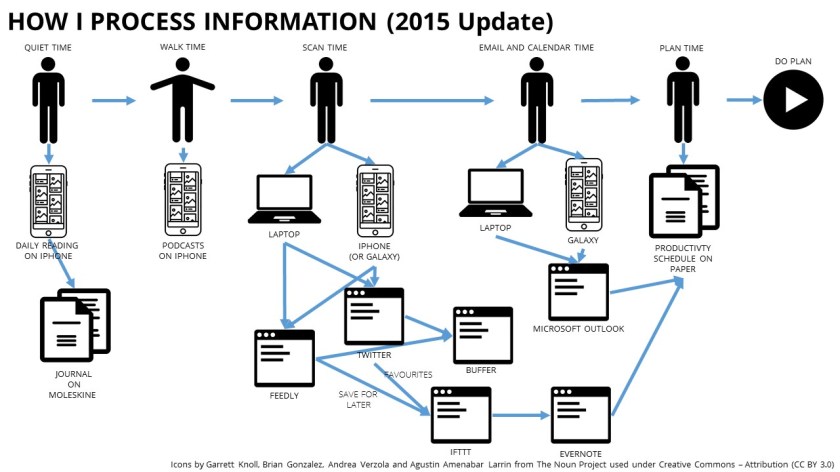
How I process information (2015 update)

Back in February I wrote a post called How I process information (normally). This is an update to that post with a few tool changes and a few activity changes. I tinker around with my own personal productivity on a regular basis constantly seeking something that fits the demands being placed on me and my personal style, this is the latest iteration of that tinkering. Updates are in italics.


One part of my job is to stay current with the ever-changing technology and business landscapes. This means that I process hundreds (probably thousands) of items of information every day.

I don’t read all of them, but I try to process all of them on a normal day. It should be noted here that I try to have normal days as often as possible, but there are many days when that’s not possible. On those many days I do what I can to keep the framework working.

how-i-process-information-2015-update

The normal way that I process information focusses on mornings. I’m mostly a morning person so that’s the best time for me to be alert because processing lots of information you should do when half asleep.

The morning is also the best time, for me, to establish and work through a routine. My morning routine works in six phases:

  • Quiet Time – when I read something that is meaningful normally using an application on my iPhone. I’ll then journal about this into a moleskine notebook.
  • Walk Time – I try to start each day with at least 40 minutes walking. During this time I’ll listen to a podcast on my iPhone. I’ve moved from using the inbuilt podcast application to using overcast it has a few nice features that I like (specifically an easy skip forward capability), but also the inbuilt podcast application ran into a problem and I couldn’t get it working..
  • Scan Time – I will work my way through the overnight deluge of blogs via Feedly and all the interesting updates from Twitter. My focus on Twitter is a set of people I have in a list called Interesting, I am likely to scan through the first few tweets from the rest of the people who I follow but not always. In Feedly I’ll mark some items as Save for Later; in Twitter I’ll Favourite some tweets. Both the favourited tweets and the saved Feedly posts will get copied into Evernote via IFTTT. During scan time I’ll also add a few things to a Buffer queue to get posted on Twitter (and Facebook) during the day, or the next day. Buffer allows me to space out posts so that they don’t all get blurted out in the first hours of the day.
  • Email and Calendar Time – I try to limit the time I spend on work emails. The part that I do in the morning routine is to get to inbox-zero by moving items into one of two folders – Actioned or To ActionIn 2015 we have moved our email services over to Outlook based on Office 365. After more years than I care to mention on Lotus Notes I’ve found the change over to Outlook relatively painless, but I have used Outlook in other aspects of life and for some customer projects so it wasn’t completely alien.
  • Plan Time – I have a physical folder with pre-printed Productivity Schedules in it. I’ll fill one of these out for each day. This becomes my plan for the day, it isn’t a task list it’s more than that, I’ll write about it some time.

It’s worth noting that there is only one application in these phases that is provided by my employer; the rest are either free, or I pay for them, this is my personal productivity regime.

Having written this post I realise that I’m still a bit delinquent on posts for the My Tools series; time to do some catching up.

A number of colleagues have written something similar:

Icons by Garrett Knoll, Brian Gonzalez, Andrea Verzola and Agustin Amenabar Larrin from The Noun Project used under Creative Commons – Attribution (CC BY 3.0)

The fall and rise of Accidental Empires

I have been re-reading Accidental Empires by Robert X. Cringley which was written in 1992 and then updated in 1996.

(The full text is available online)

The book charts the changing technology landscape at a time when it was the PC that was rising to be the dominant computing platform much to the surprise of the established computing companies like IBM.

Apart from taking me back to a time when I was relatively new in the business I was reading the book for contrasts and parallels to today’s changing market. The IT market was going through a turbulent time with organisations making strategic moves to grow their businesses and others having a terrible time trying to defend their dominance in another part of the market, sound familiar? Dell has just purchased EMC for $67B; is this a strategic attack or defensive move? Time will tell.

What is clear from re-reading Accidental Empires is that things have changed a lot. I thought I would look up the Fortune 500 list for 1992 and have a look through the IT companies then, and the IT companies in the current Fortune 500 list. There is no perfect list for such things, so I’ll also comment on current Market Cap for some of the organisation.

IBM

Back in 1992 the largest IT company on the Fortune 500 was IBM coming in at Number 4 with a revenue of over $65B but already showing challenges in a loss of over $2.8B. IBM were the biggest IT company on the planet, I say were, because today they come in at #24 with a significant cohort of organisation ahead of them. IBM’s place in the Fortune 500 could also be regarded as flattering when you consider the current Market Cap which would put them behind an even broader cohort including Apple, Alphabet (Google), Microsoft, Amazon, Facebook, Oracle, Intel and Cisco.

Other Strugglers

Other organisations have struggled also:

  • Eastman Kodak were at #18 and is now at #966. Revenue of $19.6B down to $2.1B.
  • Xerox were at #22 and is now at #143
  • Motorola were at #39 and is now #363

Kodak has long been regarded as the primary example of missed opportunity, they had everything they needed to dominate the digital photo business but failed to make strategic moves at the right time.

The Departed

There’s also a set of organisation from the 1992 list that no longer exist:

The Risers

There’s also a group of organisations on the current list that didn’t exist in 1992. Many of them are renowned for their use of technology, but technology isn’t necessarily the business they are in:

  • #29 – Amazon
  • #40 – Google
  • #172 – ebay
  • #242 – Facebook
  • #458 – Expedia
  • #474 – Netflix
  • #483 – saleforce.com

Not only did these organisations not exist in 1992, their type didn’t either. Amazon, Google, ebay, Facebook wouldn’t exist without technology, but they’re not really a technology organisation they are selling experiences that happen to use technology.

There are also some thoroughbred technology companies on the current list that weren’t there in 1992:

  • #60 – Cisco
  • #81 – Oracle
  • #121 – EMC
  • #405 – Symantec
  • #408 – SanDisk
  • #428 – NetApp

It’s worth noting that this list was compiled before Symantec split into two organisations and EMC was engulfed by Dell. The winds of change are blowing around these organisations.

The Others

Apple and Microsoft, who both existed, weren’t on the Fortune 500 list in 1992, today they are #5 and #31 respectively.

Dell was on the 1992 list at #490, but isn’t on the current list because it’s now a privately owned organisation and doesn’t declare it’s revenue or profit numbers.

Intel and Advanced Micro Devices (AMD) are unusual because they are on both lists. Intel has progressed from #106 in 1992 to #52 currently, AMD has moved from #295 down to #473.

HP appears on both list: #26 in 1992 – #19 now; this was before their split into two organisations.

The Rest of the World and China

I wanted to use the Global 500 for this post, but I couldn’t find an archive of that from 1992; I don’t even know whether it existed. The Fortune 500 only focusses on US listed organisations and that’s only a part of the story.

Looking at the current Global 500 shows us that whilst Silicon Valley has been the dominant innovation engine for the IT industry since before 1992 it no longer has it all its own way.

Some observations from the Global 500:

  • #13 – Samsung Electronics (Apple is at #15)
  • #31 – Hon Hai Precisions Industries – owner of Foxconn Technology (#32 is Allianz which is Europe’s largest insurer).
  • #55 – China Mobile Communications (#56 is BMW)
  • #160 – China Telecommunications (Intel is at #182)
  • #231 – Lenovo (#232 is Coca-Cola)

Alibaba Holding isn’t on the Global 500, but currently has a Market Capitalisation higher than Oracle, Intel and Cisco.

What I’ve Overlooked

I haven’t reflected much in this post on the massive change in telecommunication organisation, primarily because it’s not my field and it would need a whole post in its own right.

I’ve also chosen to overlook the increasing use of technology by companies such as Boeing, General Electric, JCB, Rolls Royce, Walmart and United Technologies. Technology is no longer a peripheral on the side of most organisation, it’s core to how they do what they do.

Concluding

It’s been great to look back and see what has changed.

I’ve not got much foresight to give other than the observation that things are continuing to change, making the right moves at the right time will define whether an organisation becomes Silicon Graphics, Xerox, Intel or Alibaba.

We always overestimate the change that will occur in the next two years and underestimate the change that will occur in the next ten. Don’t let yourself be lulled into inaction.

Bill Gates

Handle it once! Getting back to Inbox Zero.

Like many people I get a significant amount of junk-mail through the letterbox every week. Most of the time the junk-mail goes straight from the floor below the letterbox into a dedicated rubbish box near the door where it rests temporarily before going outside into the recycling bin. There is minimum effort expended on these pieces of brightly coloured paper.

The useful items of post will get filtered out and go onto a desk in a room near to the letterbox. Quite often these pieces of post will get opened and quickly looked at during the filtering process, sometimes they’ll even get taken out of the envelope before they get put onto the desk. At some point someone will sit down with the various items of correspondence and make a decision on the next step they should take.

Nearly all the post that isn’t junk-mail will get handled twice, some of it will get handled multiple times. Sometimes it’s inevitable that things get handled more than once, but the reality is, most of it only needed to be handled once and then dealt with.

Last week I looked at my email inbox and realised that it was a mess, but I couldn’t understand why, so I watched what I was doing. Once I became aware of it I realised what was causing the mess – I was opening emails, skim reading them and then closing them, leaving them in my inbox.  My normal method of processing information (I need to update that post because it’s changed) had lapsed and my inbox-zero routine had fallen by the wayside.

My inbox-zero approach goes as follows:

  • On a periodic basis (avoiding continuous sorting)
  • Start at the top of the inbox
  • Open the first email start to read through it and spend 10 to 15 seconds understanding it.
  • If the email can be responded to in less than a couple of minutes, respond and file under done.
  • If the email is going to take longer file under to-do.
  • Open the next email.
  • Repeat until mailbox is empty.

I have a set of keyboard short-cuts set up to do the filing. In this way most email is only handled once and it’s only the items that need a longer activity that are handled multiple times. The items that need to be worked on are visible and the clutter is reduced.

This week I will be re-instigating my inbox-zero approach to handle things as few times as possible.

The Return of the Artisans

When we have a Saturday with nothing in the diary (which doesn’t happen very often) there are a few things we like to do as a treat. One of them is to travel to nearby Lancaster; once there we will stroll through the market and visit a favourite Indian food stall where they make the most fabulous Samosa. The lady behind the stall, Sanah, is a character and greets everyone with a smile and a vigorous welcome. Having collected our Samosa we walk a little further to the nearby bread stall with wonderful smells wafting up from the selection of home-made speciality breads. We’ll wander a little further and look in other places, but these two stalls are a must. Having completed our shopping we’ll head back towards the car, stopping at a local speciality coffee shop along the way.  There we’ll choose a particular coffee from a particular country, we’ll watch the Barista weigh out just the right quantity of beans, see them ground to the correct coarseness for the particular method of coffee brewing that we’ve chosen. The coffee will be expertly made and presented with a smile.

Each of these traders are artisans – they are skilled in their craft, they produce high quality outcomes and use high quality ingredient. They’re not part of huge corporate machines, they are small businesses selling to other small businesses and individuals. They aren’t constantly driving to produce the cheapest goods they can, there is a standard to what they produce that comes at a price and in its time. Each of these artisans has a passion for what they do. These businesses are anchored in a historic way of trading – these businesses are the future.

You might think that the future is going to be dominated by large corporations turning us into ever more homogeneous versions of each other, but there’s another trend building and it’s a much more human one.

It’s worth taking a detour into a quick history lesson for a short while. Back in the 18th Century we Brits birthed an industrial revolution named after the transition to mechanized manufacturing and the rise of the factory system that was taking place. Prior to this time production had mostly been done in small workshops environments but now people had to attend to the machines in large factories. This industrialization of production completely revolutionized the way we live and resulted in a mass migration from a rural society to a primarily urban one. There are towns in the UK that only exist because someone decided to build a factory or a mill there.

The initial phases of the information age also relied upon the centralization of people to enable access to expensive machinery. Over the last five to ten years the need for people to attend to gain access to information systems has all but vanished in many industries. Large scale production environments have become largely automated. Another way of working is emerging – the artisans are being reborn. The artisans aren’t just baking bread or creating crafts they are also doing data science, designing, developing application, producing films and many other roles.

These people no longer need to go to a centralized facility to do their work, they can work wherever they are and sell their good to the whole world. That doesn’t mean that they won’t travel, just that they don’t need to travel.

In 2013 I highlighted the move to sole-traders and small businesses that was occurring in the UK at that time, since then the transformation has accelerated.

“Overall the number of SMEs has increased by 1.8 million (up 51%) since 2000.”

bpe_2014_statistics_growth

We are in the midst of another significant change in working habits, I struggle with the word revolution because it’s so often over-used, but perhaps it’s applicable to this change. The impact of automation and robotics on this world is still being worked out, but that’s another subject for another day.

I'm being a bit less social

I suspect that I’m like most people when I say that my on-line social activity has gone through a number of phases of evolution.

If you were to look through my Twitter feed or Facebook newsfeed from a few years ago you will see that they are much more active than today. One measure of this activity would be frequency of posts, which has dropped significantly. Another measure would be the number of direct posts where I write something directly in Twitter or Facebook, which has all but stopped. If you could measure openness you’d also notice that I’m less revealing about my emotions, my location, my family, my faith even. I’ve made a conscious choice to be less publicly social.

There are a number of reasons for this, some of them are about simplicity and basic privacy. One of the major reasons, though, has been the realisation that we are all public figures now and I’m not sure I’m ready for that.

At first I thought that being publicly social would in turn give the opportunity to be famous, I’m not talking about global fame just recognisable-in-my-own-little-world famous.

Then I started to see some people become social-media famous and it wasn’t a good thing to witness.

At one end I saw situations where people were trying to make a serious point only to be misunderstood and ridiculed. This isn’t a new phenomena, fame has always been like that, Francis Bacon put it like this:

Fame is like a river, that beareth up things light and swollen, and drowns things weighty and solid.

At the other end of the spectrum I saw people’s lives torn apart by being exposed to the shouting-mob. Jon Ronson researched the experience of many people including  Justine Sacco who he highlighted in this TED talk (below). The research resulted in him writing a book with the title: So You’ve Been Publicly Shamed.

There are many cases of ‘ordinary’ people being thrust into the public glare and shamed:

I’m not condoning any of these actions, personally I wouldn’t do any of them. What is scary is to see that these are ‘ordinary’ people thrust into the public glare with a few clicks on a screen and the amplification of the social platforms.

I’ve never liked mobs and I certainly don’t want to be part of one, or even associated with one. So, for now, I’ve decided to be a bit less public.

I did wonder about going far more private on my settings, but I’ve decided against that for now.

Chris Milk: How virtual reality can create the ultimate empathy machine

One of the methods that I use to keep up-to-date with technology is to listen to all sorts of podcasts and then to look into some of the people that they highlight.

Today I was listening to a TED Radio Hour episode where they highlighted the work of Chris Milk and his use of Virtual Reality as a way of deepening the connections between people.

The films are beautiful and moving, even without a VR headset:

"Performance ratings data within companies is all bogus"

Most of my exercise is accompanied by podcasts. Whether I’m out for a walk or in the gym I’m likely to have someone speaking in my ears.

This morning something went “YES!!!” in my head when I heard these words:

“Performance ratings data inside companies is all bogus. It doesn’t actually measure what it says it’s measuring. Which, of course, is hugely problematic because we end up promoting people, and paying people, and training people, and deploying people based on those rating data and they’re invalid.  “

These are the words of Marcus Buckingham speaking on The Future of Work Podcast in which Jacob Morgan.

Sometimes you hear something and you know intuitively that there’s something significant about it, and that’s what happened to me this morning.

I’ve been subject to a number of rating systems in my time, some of them with forced bell curves others not; some of them have had a few points of assessment others with many areas of assessment. These assessments have always been done on an annual basis with the occasional mid-term review. None of them have made a significant difference to what I’ve done day-to-day and they’ve all felt like they were being done to tick-a-box for the corporation. I’ve always been diligent in ticking that box because the numbers in the assessment have made a difference to the money in my pocket but little else.

There have been a number of high profile organisations switching away from these systems:

Marcus’ own article also cited Deloitte – Reinventing Performance Management.

The Performance Review systems that I’ve experienced tend to link together development and reward. Often they are the only conversation about development and reward that an employee has with their manager. Everyone knows that this shouldn’t be the case, but it’s what happens.  I can’t remember a time when a Performance Review has resulted in a change of my Development Priorities. The times that I’ve developed the most have always been whilst working for an effective team leader, hence some other words from the podcast resonated:

“I strongly suggest the future of work should be built around the practices of what the best team leaders do anyway, and they do not do a one every six-week conversation…what they do do is check in with each person each week about the work, it starts with the work.” Marcus Buckingham

We may not be in a position to change the performance rating system, but we can all make a different to people’s development in the places where we lead.

I like Marcus’ principle of 5 minutes to tell me about 5 things for the next 5 days.

Attention Management – 'Being “always on” hurts results'

Early in my career I was sent on a time management course. In it I was shown how to draw up to-do lists and how to priorities them against two criteria – importance and urgency. Further coaching was given on how to review the to-do list at the end of every day in order to set the correct activities for the following day.

At that time the constraint was perceived to be time, you started work at a set time in the morning (8:00am for me) and you finished at a set time (17:00 for me), your job was to get the important (and urgent) things done in that time. Time was the constraint, so it was time that needed managing.

Then along came the internet, email and the blackberry. Time was no longer the constraint, but we failed to recognise it and we still work as if it was.

Attention became the new constraint and we completely missed it. We thought we had been liberated from time and that we could now work in the Martini advert (any-time, any-place, anywhere), but we were kidding ourselves.

As we spread our attention across the 24 hours of each day we failed to notice that we were laying it down in ever thinning layers. The speed increased, but the quality decreased.

The late-night email culture is the primary example of this. In a recent HBR article Maura Thomas highlights the risks of the phenomena – Your Late-Night Emails Are Hurting Your Team.

Around 11 p.m. one night, you realize there’s a key step your team needs to take on a current project. So, you dash off an email to the team members while you’re thinking about it.

No time like the present, right?

Wrong. As a productivity trainer specializing in attention management, I’ve seen over the past decade how after-hours emails speed up corporate cultures — and that, in turn, chips away at creativity, innovation, and true productivity.

If this is a common behavior for you, you’re missing the opportunity to get some distance from work — distance that’s critical to the fresh perspective you need as the leader. And, when the boss is working, the team feels like they should be working.

Now that time is not the primary constraint, and attention is, we need to start developing a new set of working protocols to manage this precious resource.

Do you have any techniques you use to manage your attention?

"the average office chair is 7.2 years old…

On average, employees spend 5.3 hours per day sitting, which means the chair is the foundation of a healthy office environment. Because the average office chair is 7.2 years old, the integrity of the chair’s support and functionality might be jeopardized due to its age.

From Everything You Need to Know About Ergonomics

What's your "productivity style"?

Carson Tate thinks that there are 4 Types of Productivity Style:

The Prioritizer – A Prioritizer is that guy or gal who will always defer to logical, analytical, fact-based, critical, and realistic thinking…

The Planner – The Planner is the team member who thrives on organized, sequential, planned, and detailed thinking…

The Arranger – An Arranger prefers supportive, expressive, and emotional thinking…

The Visualizer – A Visualizer prefers holistic, intuitive, integrating, and synthesizing thinking…

For each of these styles Tate gives a more detail explanation including a definition of their contribution to a team and set of tools that support their productivity style. A Prioritizer might like 42Goals or Wunderlist whereas a Visualizer might like Lifetick or iThoughts HD.

The main focus of Tate’s post, I think, is to highlight that different people are productive in different way, which is something I would wholly agree with. Four styles of productivity feels a bit too restrictive though. Personally, I think I can be all four of the above and sometimes all of them at the same time. I don’t think that I fit any of them as a primary style (perhaps those of you who know me a bit better can let me know which one they think I am?)

The thought that different productivity styles mean that people prefer different tools to support their style is logical, but demonstrates a problem for teams. Teams are best when they are made up of different personality (and productivity) types. Creating the appropriate tooling for a team is, therefore, a challenge. How do you coordinate when one person is using Wunderlist, another 42Goals and yet another Lifetick? I’ve seen many teams where they have tried to mandate a particular tool for collaboration, this has generally resulted in low levels of engagement with the tool. People prefer different things and if you want the best out of them then perhaps you should let them use those tools.

On a different topic, four seems to be a popular number of this kind of assessment and aligns quite closely with many of the personality type assessments. How many of you know your Myers-Briggs personality type, which is also a set of four characteristics? Do we use four because we like quadrants because that’s how we think?

Is my job going to be computerised? Another view: The 'Jobless Future' Is A Myth

I’ve written a few post now on the impact of computerisation and automation on the jobs market:

Both of these posts highlight the jobs that are likely to be replaced by computers and/or robots.

Steve Denning adds another viewpoint: The ‘Jobless Future’ Is A Myth.

This article is primarily a response to the book The Rise of the Robots: Technology and the Threat of Mass Unemployment (May 2015) by Martin Ford.

As you may have guessed Martin Ford’s view is that the robots will take over and that Steve Denning is taking issue with this viewpoint. I’ve not read the book so can’t comment on it, but I was intrigued by Steve’s viewpoint as a counter-point to the other articles the I have read.

Denning outlines what he regards as a number of flaws in Ford’s reasoning (extracts):

One flaw is the underlying assumption that whatever is feasible will occur…

A second flaw in the reasoning is the implicit assumption that computers with miraculous performance capabilities can be developed, built, marketed, sold, operated and replicated at practically zero cost and that they will have zero secondary employment effects…

A third flaw is the failure to consider how the marketplace will react to the computer as a new market entrant…

A fourth flaw in the reasoning is to assume that when machines replace human capabilities, as they have been doing for thousands of years, nothing else changes…

As a technologist myself it’s great to hear a viewpoint from someone who isn’t. Denning’s perspective is that many of the symptoms that are being assigned to computerisation are also effects that would result from other challenges in the employment marketplace.  He list seven different issues including shareholder value theory on which he has written extensively.

Denning concludes like this:

We need to stop agonizing about an apocryphal vision of a “jobless future” and to focus on the pressing real issues that we can actually fix.

There have been many technologists commenting recently:

My gut feeling is that we are going through a significant shift in employment and what it means to be in a job, but I’ve never felt comfortable with a dystopian view that the machines are going to completely take over. History and experience tells me that we humans will muddle our way through and use our incredible adaptability to find something else to do.