INSTA, TWIT and BOOK say goodbye to PLUS

Many gangs have people who hang around trying to join them; wanting to be part of the inner circle, INSTA, TWIT and BOOK‘s gang was no exception. PLUS has tried to become a full member of the gang for some time now but they’ve never made the grade.

Recently PLUS has reluctantly decided to stop trying and has decided to make its own way in the world.

Fortunately for PLUS they retained a shape-shifting ability in their DNA. Enacting this ability they have started the morph into STREAM and PHOTO whilst giving birth to a new child HANG. I suspect HANG will get adopted by the DRIVE gang leaving STREAM and PHOTO to go their own way.

INSTA, TWIT and BOOK noticed that PLUS had left, but they didn’t have a party. PLUS was one of many trying cement a place in the gang; PLUS may have been one of the noisiest but it’s not always noise that makes the difference.

The thing about being at the top of the tree, as INSTA TWIT and BOOK are, is the constant fear that someone is going to chop your tree down or build a bigger one right next to you.

Is Facebook making you glum?

Interesting conclusions to some research from August 2013:

On the surface, Facebook provides an invaluable resource for fulfilling the basic human need for social connection. Rather than enhancing well-being, however, these findings suggest that Facebook may undermine it.

Facebook Use Predicts Declines in Subjective Well-Being in Young Adults

The important term in the title of this research is Subject Well-Being which is referring to how people experience well-being. In other words the research is assessing how people perceive their thoughts and emotions.

The way that the research did this was to send people text messages to survey how they were feeling over a 14 day period. The responses lead to the following conclusion:

The more people used Facebook at one time point, the worse they felt the next time we text-messaged them; the more they used Facebook over two-weeks, the more their life satisfaction levels declined over time. Interacting with other people “directly” did not predict these negative outcomes. They were also not moderated by the size of people’s Facebook networks, their perceived supportiveness, motivation for using Facebook, gender, loneliness, self-esteem, or depression.

Personally I think that we are conducting a huge psychology experiment on the human race without too much in the way of risk assessment or training for those involved. As the evidence builds I suspect that our attitude to participating in these experiments will shift to be far more cautious.

INSTA, TWIT and BOOK – The Fellowship of the Recipe

INSTA, TWIT and BOOK were sisters. They weren’t biological sisters, they were sisters in a fellowship.

This fellowship of sisters held a secret recipe.

This was a powerful recipe that once mixed had the power to create and alter emotions. Sometimes it would produce delight, at other times it produced anger. The recipe regularly had the power to create temporary stupidity; less often displayed was its ability to produce wisdom and wonder.

The recipe wasn’t absolutely specific in some areas and each of the sisters mixed their particular version of the recipe in different ways. The different mixes produced differing results; INSTA’s recipe produced visual results, TWIT’s recipe produced short succinct results, BOOK’s recipe produced a different result every time.

Different people preferred the results of one recipe to another, but many people liked to sample the recipe from each of the sisters. Once experienced most people found the recipe very difficult to resist. The flavour in the recipe, once tasted would draw people back time and again. The demand for the recipe was so great that it was constantly being mixed. It flowed constantly out of INSTA, TWIT and BOOK’s kitchens. Sometimes they changed their recipes a little causing people to complain at the change in flavour.

There was no monetary charge for the recipe but to get a portion people were expected to contribute to the next mix, without their contribution the mix would die. Many people had wonderful things to add to the recipe, but there were also many who were so desperate to contribute that they would contribute anything. Some people’s contributions became valued above those of others for the way that they added to the flavour of the recipe, but the recipe itself was always owned by INSTA, TWIT and BOOK.

The more people contributed to the recipe the more it flowed, soon it was flowing across the whole world and it began to feel like it was impossible to get away from the clamour of people contributing to and consuming the recipe.

INSTA, TWIT and BOOK weren’t biologically sisters, but INSTA and BOOK were related by marriage. Day by day INSTA and BOOK become closer friend, this meant that sometimes TWIT felt a bit left out. TWIT worried that her recipe would get forgotten as the popularity of the other sisters increased so TWIT set about adjusting her recipe so that it too was more visual like that of INSTA’s. However they felt about each other, though, the sisters would never reveal the secret of the recipe, the secret itself was too valuable.

Other people would come along with a recipe of their own and tried to join the fellowship. PLUS, TUM and LINK each came to display their results but none of them made it into the fellowship. INSTA, TWIT and BOOK were the Fellowship of the Recipe and it was going to take a lot to let someone else join. If they were going to join they would have to show that they too understood the recipe.

People would question whether it was healthy to spend so much time consuming the recipe; others were concerned by the amount that was being contributed to the recipe. The recipe was so compelling that some people would let their life away from the recipe diminish into neglect. INSTA, TWIT and BOOK said that all they did was mix the recipe, what people contributed and how much time they spent consuming it was nothing to do with them.

The recipe remains strong. The Fellowship continues to be strained by the relationship between TWIT and the others, but the recipe stays secret – for now.

"You'll never believe what she did next?"

“Curiosity is lying in wait for every secret.”

Ralph Waldo Emerson

Have you seen any of these (they’re all real)?

  • You’ll Never Believe What She Did To Stop The Baby From Crying
  • You WON’T Believe What They Caught The Cashiers Doing
  • You’ll Never Believe What Happened When A Girl Did Gymnastics For A Dolphin.
  • You’ll Never Believe What The Parrot Did Next!
  • What This Man Did To His Attic is Unbelievable.
  • 8 Celebs Who Have Killed People
  • Wow! I can’t believe he just did that!
  • 10 Tips from the Pope for Becoming a Happier Person
  • Father is Shocked When He Discovers The Horrifying Letter from His Son
  • 15 Images You Won’t Believe Weren’t Photoshopped
  • Watch a Paddle Boarder’s Crazy Experience with Orcas in the Wild

YouTube has nearly half a million videos with “You Won’t Believe” in the title!

Each title is deliberately structured to poke your curiosity, many intend to turn you into clickbait.

George Loewenstein defined curiosity as a function of information gaps and our need to fill those gaps. A gap in the information that we know produces a feeling of deprivation that we label curiosity. That feeling of deprivation motivates us to fill the gap. The feeling of deprivation is created by the most basic inner workings of the brain. To be asked “did you see what she did?” is a powerful motivator because everyone wants to know what she did. The information gap can’t be too large though because that would be too much work to fill and our curiosity would slip away, it needs to be easily attainable. To be asked “did you see what she did?” is a relatively small gap for us and the addition of a link to a video that shows what she did makes for a very powerful motivator.

Type curiosity gaps into any search engine and you’ll get thousands of helpful articles telling you how to create post titles that will result in people clicking on your page (most of these articles also use the theory of curiosity gaps in their titles).

You are on the receiving end of all of this curiosity manipulation. Curiosity is a powerful thing, we can use it usefully, or we can spend our life clicking on pictures of cats.

“Curiosity is the most superficial of all the affections, it changes its object perpetually; it has an appetite which is very sharp, but very easily satisfied; and it has always an appearance of giddiness, restfulness and anxiety”

Edmund Burke

What are you doing at the restaurant?

This is a great example of the impact that technology is having on our social interactions (from The Meta Picture):

Social Media and Social Change

Flicking through the news today I read these words:

Complaints originating from social media make up “at least half” of a front-line police officer’s work, a senior officer has told the BBC.

Chief Constable Alex Marshall, head of the College of Policing, said the number of crimes arising from social media represented “a real problem”.

He said the police and public were still trying to understand when online insults became a crime.

About 6,000 officers were being trained to deal with online offences, he said.

Mr Marshall told BBC Radio 4’s Law in Action: “As people have moved their shopping online and their communications online, they’ve also moved their insults, their abuse and their threats online, so I see that it won’t be long before pretty much every investigation that the police conduct will have an online element to it.

“It’s a real problem for people working on the front line of policing, and they deal with this every day.

“So in a typical day where perhaps they deal with a dozen calls, they might expect that at least half of them, whether around antisocial behaviour or abuse or threats of assault may well relate to social media, Facebook, Twitter or other forms.”

Social media crimes ‘at least half’ of front-line policing

That’s a lot of policing we are needing.

The real challenge here isn’t the social media, it’s the social change that it enables and we haven’t been trained for that new society; nor do we have the control mechanisms for that new society.

The report goes on to explain that many of the offences are the same as they ever were, it’s the medium that has change. There are also  a lot of people contacting the police because they don’t know what else to do.

One of the conclusions of the article is this:

Mr Marshall said a combination of police training, public education and enforcement by social media companies was required to combat the problem.

I’d agree, policing on it’s own is not a good way of dealing with social change, it requires education as much as it requires control.

Office Speak and Buzzword Density

A few things came together the other day:

I was looking at some of the statistics on this site and found that a post I created back in 2009 on Buzzword Density had recently become popular again. This post contains a cartoon that goes like this: “Mashups are SOA in the Cloud” – “3 out of 6 not bad”. It made me smile to realise that two of the buzzwords in this illustration had lived there life and were now mostly superseded by other terms.

This was followed by an email in which there was a sentence that had 32 words in it which is a problem in its own right but 13 of the words were buzzword. In a Gunning Fog Index this sentence scores 23 (for reading by a wide audience you’d normally aim for an index of less than 12, and less than 8 for universal reading).

In my normal reading I came across this article in the Atlantic: The Origins of Office Speak subtitled What corporate buzzwords reveal about the history of work (and what a corporate-buzzword quiz reveals about you).

The article starts by highlighting the famous Dilbert Buzzword Bingo cartoon from 1994.

According to this article there are a number of classification of buzzwords that have grown up through our history since the war and the influence of different groups:

  • The Self Actualizers
  • The Optimisers
  • The Financiers
  • The Marketers
  • The Disruptors
  • The Creatives
  • The Life Hackers

It’s interesting to see the history behind some of the phrases that we take as axiomatic.

Like most people I know I have had a love-hate relationship with buzzwords and office speak for most of my working life. The Atlantic article concludes like this:

But this seems to be the irony of office speak: Everyone makes fun of it, but managers love it, companies depend on it, and regular people willingly absorb it. As Nunberg said, “You can get people to think it’s nonsense at the same time that you buy into it.” In a workplace that’s fundamentally indifferent to your life and its meaning, office speak can help you figure out how you relate to your work—and how your work defines who you are.

I’m off now to sync-up in a disruptively agile way as part of a scrum of innovative thought leading passionate entrepreneurs, circling back and downloading so we can drill down and mind-meld about an ideation event looking for low-hanging-fruit (Gunning Fog index = 22).

It’s not just in offices where cliché becomes a problem though:

Dilbert on Facebook Friends

The 7 Habits of Serious Procrastinators

Anyone like to raise their hand in agreement?

This picture reminded me of this post: I could spend hours doing this…

The power of sharing

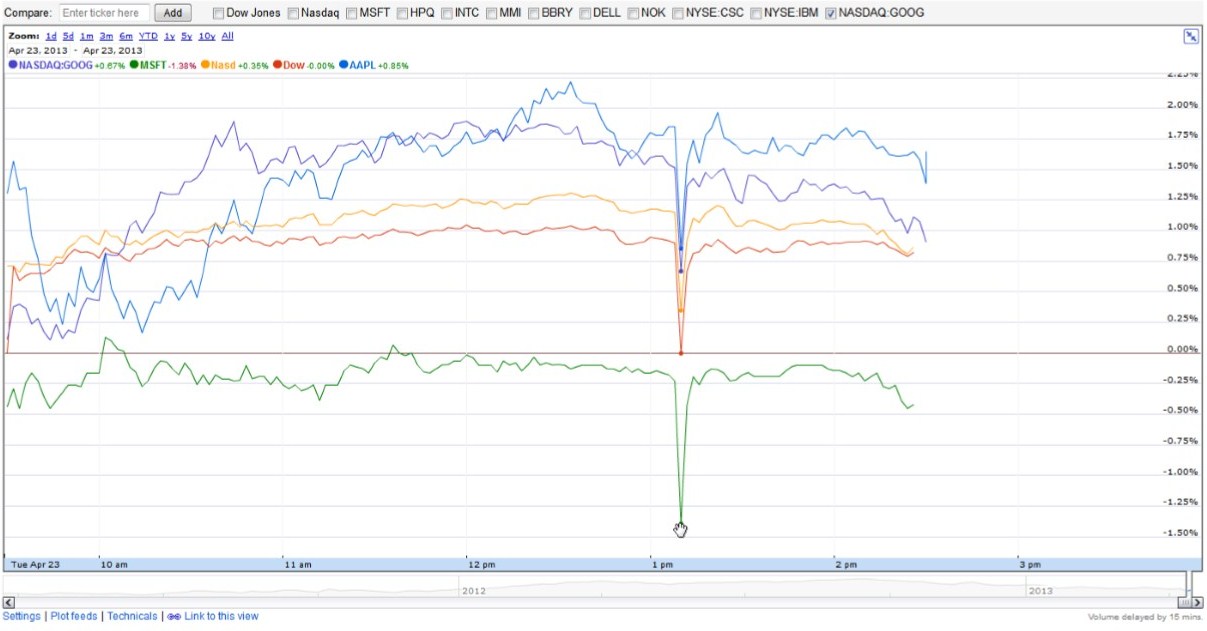
Just as I was writing my post yesterday – Did you really share that online? – another incident was playing out on the US stock market:

Associated Press Tweet

The chart above shows the impact of a single tweet from the Associated Press twitter account on the stock of Apple, Google and Microsoft as well as the NASDAQ and Dow Jones indexes. That dip right in the middle was all caused by a single tweet.

The tweet reported, falsely as it turns out:”Breaking: Two Explosions in the White House and Barack Obama is injured.”

This wasn’t news at all, it was a hack, and Associated Press had to move quickly to quash the false information.

What this demonstrates, again, is the power of the tools that we have available to us to communicate information rapidly. The real power that caused the impact wasn’t, however, with Twitter, it’s with Associated Press as a trusted source of news. The tweet only had an impact because of where it appeared to come from, but it only had an immediate impact because of Twitter’s ability to communicate broadly and quickly.

The problem for Associated Press now is that the level of trust in its Twitter feed has been diminished and the current embarrassment is in danger of having a last impact. It’s the same for us as individuals. If our Twitter (or Facebook, or any other site you’d like to choose) gets hacked the level of trust from others goes down. Associated Press responded decisively and with clarity, it’s a good strategy. We will have to do the same if we are ever in that situation our reputation may depend upon it.

It takes 20 years to build a reputation and five minutes to ruin it. If you think about that, you’ll do things differently.

Warren Buffett

Cisco Connected World Techology Report

Over the last few years Cisco have produced a report on the changing attitude of people to being permanently connected.

This years report – 2012 Cisco Connected World Technology Report – has just been released. The report is based on two surveys, one looking into the attitudes of Gen Y, and the other looking at the attitude of IT Professionals.

At the heart of this year’s study is the smartphone and the constant connectivity it provides to work, entertainment, shopping, and friends. There are 206 bones in the human body, and the smartphone should be considered the 207th bone for Generation Y. They view smartphones as an appendage to their beings — an indispensable part of their lives, and yet they are concerned about data management and Internet security.

http://www.youtube.com/watch?v=CDyl3PS6u3g

Who knew that 43% of British Gen Y always check there smart-phone as part of their morning ritual alongside brushing there teeth? It wasn’t much of a surprise to me having seen how many of them check their smart phone while stood at the latrine at work! The French are far less bothered about such things with only 29% always checking. It’s interesting that women are significantly more driven to be connected with 85% of them being compulsive checkers; it’s only 63% of men.

There’s a fun visualisation that enables you to calculate your data footprint, I apparently have a highly connected lifestyle. As you might expect there’s also a report highlighting some of the statistics and drawing some conclusions along with the seemingly mandatory set of Infographics including an interactive one showing the results for the different countries that took part.

The world is changing fast, there are a lot of people who don’t realise how fast.

A bit too social?

A wonderful cartoon from the New Yorker today. I know some people who would think that this cartoon was a good idea:

Speaking personally, there are some things that should remain private.