Concept Entropy

I’ve witnessed the entropy of many a fine concept in my time.

For those of you who have forgotten your schoolboy physics a quick reminder on what entropy is – and there are a lot of fine definitions, but I want to focus on a simple illustration. Entropy is what happen to your kettle after you have turned it off – it cools down until it is at room temperature. All of the heat dissipates until the temperature of the kettle is no different to everything else around it – well almost.

Within the IT arena we come up with all sorts of good ideas, but I’ve seen many of these ideas go through the same entropy cycle.

  • The cycle starts with an idea.
  • The idea warms up things around it as people subscribe to the idea and see it’s relevance.
  • The idea gets developed into a concept and a way of thinking beyond the first idea.
  • Thought leaders start to understand how the concept could be applied within their context – whether that’s a business, an organisation, or from a personal viewpoint. These thought leaders make the best use of the concept and it makes a real difference to their context.

At this point the system is still being heated up – the concept is still cooking, but entropy is about to kick in.

  • The concept starts to enter the mainstream.
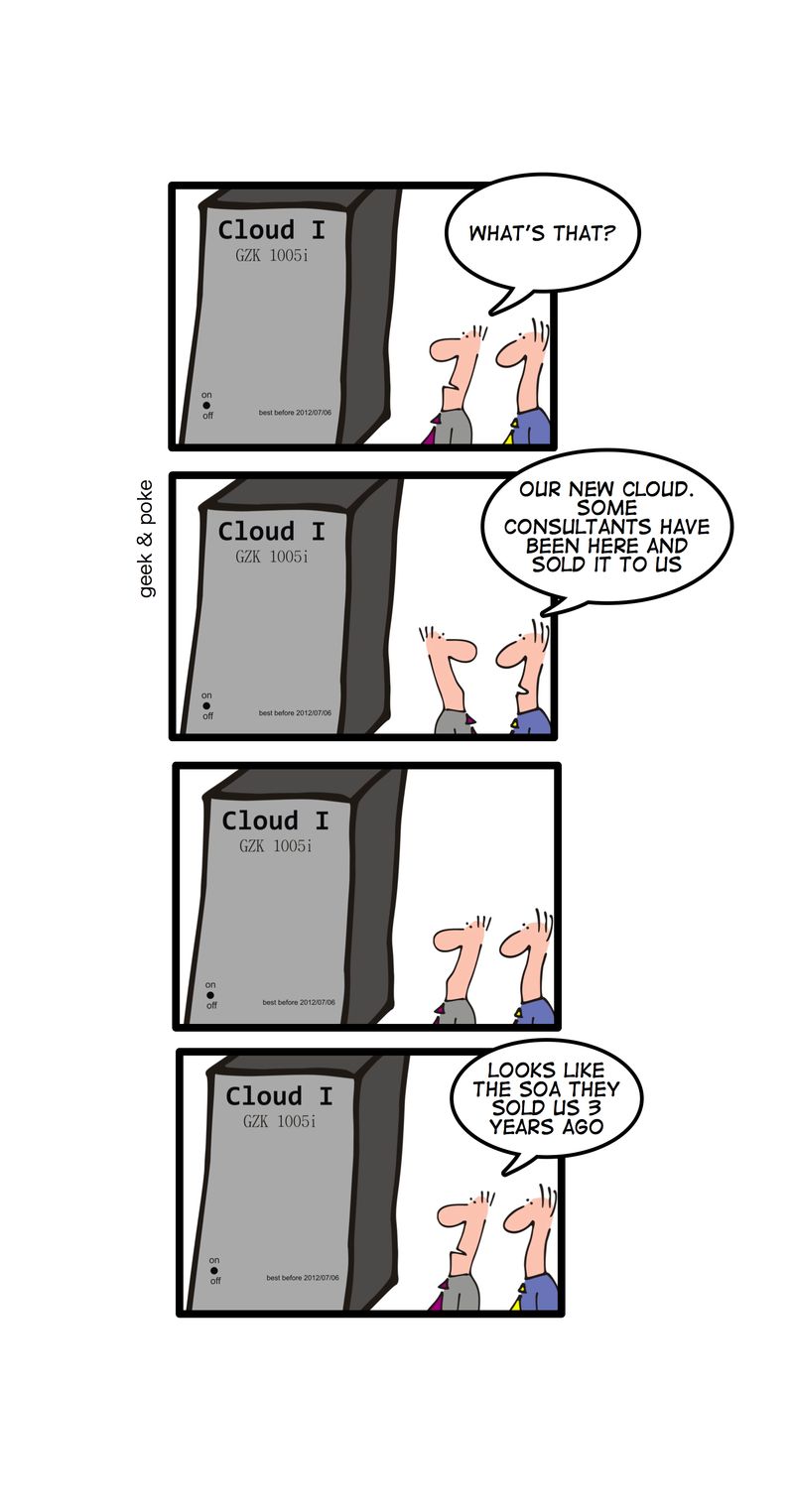
  • Consultants start to see the concept as a way of generating more work by helping organisations to apply the concept to their environment.
  • Product companies see a whole new revenue stream from delivering products targeted at delivering the concept.
  • Because it is something tangible the products become synonymous with the concept in the minds of those that use the product.
  • The products enter the mainstream and become the concept and consulting review from the concept starts to decline.
  • At this point the consultants start to look for the next concept to jump onto leaving the old concept to the product providers.
  • The concept entropy is complete.

SOA is the last years concept, Cloud is this years. SOA has just finished the cycle, Cloud is on it’s way through the products phase.

I said at the beginning that a kettle cools down until it is just like everything else around it – well almost – and it’s that well almost that is important. The extra heat that the concept has generated doesn’t die – it’s just been dissipated throughout the other systems. The products that get delivered to enable a concept still live on making a difference to the way that organisations work. The products aren’t delivering the concept, but the residue of the concept that lives in the products is making a difference to systems around them.
Relationship is power

Once upon a time man roamed the earth looking for food in those days the ability to find food was power.

Jimmy and Granddad Explore the Lake DistrictThen we learned how to cultivate crops and farm animals. Land became power.

As the land became used up we needed to protect our land so weapons became power.

Then the industrial revolution happened making facilities and factories power.

Then we saw the dawn of the Information Age and facilities became less important because we didn’t need them to process information. Information became power.

Then an interesting thing happened – information became FREE. If information is free it can’t be power.

All along people were connecting with people, making deals, giving the inside track, offering advice, ignoring organisational structures, giving and receiving favours, dining together. People were making relationships.

Then along came the start of something new, it got fancy new names like “social media”,“social networking” and even “business networking”, but really it was just another way of making relationships.

It’s those relationships that make things happen. Relationship is power.

Concept of the Day: Cognitive Surplus

Today I watched Clay Shirky presenting at TED (via their excellent podcasts). Clay outlines a number of challenges to the way that we imagine people’s motivation. He explodes the premise that we all love to be “couch potatoes” and highlight a number of examples that demonstrate that as he says:

We like to create and like to share

Jimmy and Granddad Explore the Lake DistrictPeople don’t just contribute when there is payment at the end, they contribute when they are creating, and with the currently available technology the opportunities for creating are becoming ever broader.

This effect creates a global surplus of cognitive ability of “a trillion hours a year”. There’s a lot you can do with a trillion hours of creativity if only we treat it in the right way. he calls this Cognitive Surplus.

Not only is this concept a huge challenge to the way we approach social projects, but it’s also a challenge to the way we approach business projects.

My perception of many business projects is that they are constructed with the assumption that people won’t want the change, and hence a stick is required to get them to change. If people truly do" “like to create and like to share” then engaging people in a creative constructing way in the change process will turn them from blockers to enablers. It might even get them to invest some of their own cognitive surplus.

The latest example of this, for me, is the location tagging of a Glastonbury picture that is underway. Thousands of people are tagging themselves in a picture taken at Glastonbury. The reward for this is little more than the feeling that you have been part of something. They’re all using their cognitive surplus to create a shared experience.

Coming to think of it – why is it that I write this blog?

 http://video.ted.com/assets/player/swf/EmbedPlayer.swf

Stories in Business

I seem to be surrounded by long documents and large spreadsheets again. People have spent hours on these pieces of work, but I’m unlikely to read them. It’s a shame, but it’s the reality.

Trying to push a mouse aroundThe other day Shel Israel wrote in “Story Telling VS 10,0000 years of PowerPoint” about the challenge of the bullet-point culture that we are in and the stories that are deep within our human nature.

If you’ve been reading this blog, and my twitter updates for any length of time, I am not a fan of large documents or bullet-points, but I am a huge fan of stories (here)

The following story is a caricature of a real meeting:

“Oh no, It’s that Tuesday in the month again, that one when Bill gets to talk us through the standard 84 page bullet-point fest that he loves so much.” I think to myself as I look at my diary and the day that is ahead.

I know that this two hour green block in my diary means that I will be entering into a form of torture chamber once again. A torture chamber where I want to stand up and say “who cares”, but know that I will, as always, sit there like a good boy and say nothing. I will start the meeting determined to focus and to be constructive, but I know that over time the BlackBerry will get more and more attention, and the meeting will slip steadily into the background.

Sure enough that is exactly what happens. After reading through the contents of the first 10 slides I’m almost 100% focussed on anything other than the never ending stream of bullet-points set out before me.

My BlackBerry flashes, I know what it is going to be before I even look at it, it’s from Mike who’s sat across from me. His phone is getting a similar amount of attention to mine and he has sent me a text – it’s not complementary. My reply isn’t exactly constructive.

I know that I will never get back the seconds, minutes and hours that are passing before me. I set there ashamed by my lack of courage – “why don’t I say something? Anything?” – but I don’t. I let the time tick on and drip away.

And then someone does say something, out of the blue they ask a question. They break right in – mid-bullet-point.

But what difference does all this stuff make to Mary?”

Mary? Why Mary?” says Bill

Because she’s the person who complains the most to me about all of this. There isn’t a week goes by when she isn’t telling me how useless it all is? The other day I could see how stressed and frustrated she was. It’s not like her so I asked her what was wrong, and she told me. She told me about the time it takes to get things done. She told me about the lack of answers she gets from the people running the service. She told me about how no-one else will use the system because it’s so bad, but she doesn’t have a choice. What difference is this going to make to her?”

Well I don’t know?” said Bill looking a bit flustered

“She’s just in the next office why don’t a get her and she can tell us”

Mary joined us and tells us about her challenges, her problems, her frustrations, her annoyances. She has some great ideas about how it could be so much better too.

At first Bill tries to get us back to the slides that he is determined that we should get through, but he soon realised that he has lost. We wanted to hear Mary’s story, we wanted to know how we could make her life better, we want to hear her ideas.

We had our story and we were going to get as much out of it as we could.

There are all sorts of techniques for introducing stories into business, and in particular, into the system architecture and design business where I find myself. These stories are far more powerful than a slide deck of bullet-points could ever be. I think I’ve said it before, but it’s worth saying again, one of the reasons I love Rich Pictures is because done well they tell a story.

People stand around gossiping and will happily do it for hours, but I can’t imagine people spending the same amount of time discussing the contents of page 46 paragraph 4 of the latest technical tome.

Tell the story.

Technology is making us rude

Another day, another conference call, another set of instant messages, some SMS messages and lots of rudeness.

When the Music StopsI would like to confess that today I have:

  • Joined a conference call without introducing myself.
  • Had an Instant Message conversation with someone I have never met and not even said “hello”.
  • Looked at my BlackBerry while talking to someone, to check an email.
  • Left a conference call to speak to someone else, while the call was still running, and not said anything. I just walked away.
  • Created a slide deck while on the same call – for a completely different project. I nearly had to confess to this rudeness and say “I’m sorry, can you say that again”.
  • Sent an SMS text message to someone without any pleasantries at all.
  • Ignored a phone call – because I knew who was phoning.
  • Stopped listening to someone sat next too me, because I was giving more attention to the PC screen in front of me.
  • Turned up late to a conference call and didn’t apologised for my lateness. These calls never start on time, do they?
  • Ignored a whole set of Instant Message conversations that people are wanting to have with me.

In short – very rude, but very normal.

You might argue that some of this is not really rudeness at all, but that would be putting a gloss onto something that is becoming an endemic issue.

Anyone else like to confess?

Story, Biography and Metaphor

I’m looking through a document today that is 744 pages long and i know one thing for sure, I’m never going to read this document.

Surveying the landAt home I have another book that I am reading, it’s quite a long document. I am definitely going to read this document.

What’s the difference between the two: story.

One is a business document talking about repositories, artefacts, entities, capability and continuum.

The other is a biography of Guinness, that’s right a biography of the Dublin based brew. It’s a story of the founder Arthur Guinness, about his children and their impact on an organisation and the broader Irish society.

I’ll wrestle with one of these documents to get to the valuable lessons that it needs to teach me; the other book will teach me things without me even knowing it.

I was watching Griff Rhys Jones in Hong Kong on ITV’s “Griff’s Greatest Cities” last night (before turning over for “Outnumbered”). He was sitting in a class doing complicated mental maths in the blink of an eye. He was staggered by the speed that these kids could add and subtract complex number strings. What was the secret of their success, it was the teaching method. Their teacher had brought them up to use a special kind of abacus. Over time the teacher had removed the abacus and told the kids to imagine it. When doing their maths the kinds just pictured the abacus and read out the answer that it gave them. He had found a very powerful metaphor and the kids were exploiting it to great effect.

The other night I noticed a book on the bookshelf that I hadn’t read in a long time. It was a set of stories about a bear. This bear has taught me a number of lessons about life. This is a bear who says that he has very little brain, but there is wisdom to be found in his dealings with the other characters.

I spend most of my life simplifying things so that people can comprehend the essence of them and sometimes it’s to help them to subscribe to the vision that is being painted. I try my hardest to find a a story, a biography or a metaphor to communicate. These analogies have two very powerful results, they allow people to comprehend, but they also live on in peoples thoughts, they allow people to explore beyond the simple into the more complex. They can venture to the end of the metaphor, even if it breaks at that point, they’ve learnt something, if it doesn’t they can venture further. It’s a bit like a seed starting to germinate, as the leaves grow skyward, so the roots grow down into the ground.

I have one simple request, lets stop writing 744 page documents of business speak, let’s tell more stories.

Adding more people won’t fix the problem!!!

Dilbert picks up on what is still a surprisingly common issue:

Dilbert.com

We’ve known this for generations, quite often, if your project is in trouble, the last thing you need is some help. The promised help rarely turns into help, it nearly always turns into more problems.

The issue here is simple, people aren’t like RAM, they can’t just be plugged in and put to work instantaneously. People need to be brought up to speed, they need to be managed, they need somewhere to sit, they need access to things. They come with an overhead that is higher than their value at the beginning.

There are things that you can do to make each of these things easier, but they need building in from the start.

If you add a number of people then you are likely to have to go through the whole forming, storming, norming, performing team development cycle all over again.

Even if people were like RAM, you still don’t come for free, adding one person to a team doesn’t add one person’s worth of value, it adds more overhead to the management processes taking away value elsewhere.

Then there is the final, and probably the most significant issue, people are all different – different skills, different capabilities, different relationships. Adding the right person can make things better, but it’s unlikely that you have access to this person, if you did they would already be working on it. More often than not, the people you are talking about adding are the spare people. The spare people are definitely not the ones you want, they are likely to be spare for a reason.

If you still don’t believe me read The Mythical Man Month it was first published in 1975, but the wisdom contained within it still applies today.

(For those of you know me, yes this book is why I keep going on and on about Conceptual Integrity)

Designed on the back of an envelope

We are in the middle of a general election here in the UK, and one of the criticisms that gets banded around is that certain politicians have created their policies on the ”back of an envelope”.

SienaThe phrase used to be “back of a fag packet”, but we seem to have gone all politically correct on that.

This phrase is always used as an insult, but for me it’s actually a badge of honour, and I see Rich Pictures as the tool to do that.

My experience after many years of solution design is that the best ones start with a simple diagram, or set of diagrams.

I’m not saying that the detailed work doesn’t need to be done, or that long lists of requirements aren’t needed. The problem with starting there is that you start in the detail and miss out on the reason why you are doing something.

The simple diagram enables you to communicate and understand the vision and the overall approach.

Whether it’s a whiteboard, a flipchart, a notebook, a blank sheet of paper, or even the back of an envelope simple diagrams are the place to start.

Friday is no longer the end of the working week

Once upon a time office workers would go to work on Monday morning, do their hours in a set pattern each day ( to 5) through to Friday. On a set time on Friday the weekend would begin and no work would be done until the appropriate time on Monday morning.

San Francisco Bay in the MistFor myself and many others  this is no longer the case. 9 to 5 is dead and Friday is no longer the end of the working week.

The problem with this situation is that for many people there is no break at all – work just carries on.  With the office no longer working as the barrier to work, work can carry on anywhere, work creeps into every corner of our lives.

Whether we like it, or not, we each have the responsibility for creating the boundaries that all of us need to allow us to live a healthy and fulfilling life. Very few employers are going to do that for us, they’ve moved that responsibility down to the individual.

So I’ve decided that I am going to reinforce some boundaries to keep the work at bay.

As part of my own boundary creation I’ve recently set my BlackBerry to turn off in the early evening, and I’ve been trying my hardest to leave it turned off. I’m about to invest in a personal mobile phone to make it even less likely for me to need to turn it on.

I’ve also made it a rule that unless absolutely necessary I will not work on a Saturday or Sunday. “Absolutely necessary” is not something I have defined in too much detail, but I think I know what it is. I know that other colleagues work weekends, because they send me emails. Sometimes they expect a response, but they are learning that it’s not likely to come from me unless they manage to get my attention and communicate it as “absolutely necessary”. Sometimes I worry that I might be regarded in some way as not pulling my weight, but I remind myself that it’s about quality and quantity of output, it’s not about the hours spent on the job.

My next boundary creation project is to define what my evening demarcation is.

Caffe Business Observations

I’ve spent this afternoon working in a Caffe and it’s been an incredibly interesting experiment in people observations.

PisaMy seat is in the corner of the room so I can see most of what is going on and I’ve been here for a couple of hours so far.

It’s a weekday in one of the UK’s larger cities and it has been busy in here all afternoon. There was a slight lull about 14:00 but other than that every table has had someone sitting at it.

Of the 13 tables I can currently see, four of them are occupied by single people (mine included). Only one of these people is doing anything “social”, everyone else is typing on a keyboard or writing in a report, or something similar. At least four other tables are occupied by groups of people having business meetings; some of them more overt than others.

The first thing I notice about this working environment is how insecure it is.

I know something about this city and something that is going to happen here that is all “hush hush” as the advertising executive said to the sales person he was dealing with. I also know how much it costs to advertise in the sales person’s magazine.

I know when the two people in the table opposite are next going to meet and where.

I haven’t had to do anything special to gain this information, I’ve just sat here and overheard.

The other thing I’ve noticed is how essential the mobile business device has become.

I’m the only person using a fully fledged laptop, everyone else is making arrangements and taking notes on either an iPhone or a BlackBerry. Contacts are being exchange, meeting arranged, even sales figures discussed, all on the small screen.

Another observation is how attentive people are.

I attend lots of business meetings where people look as if they would rather be sat on the toilet. That’s not the case for most of these meetings, people are talking, interacting, negotiating, illustrating, gesticulating even.  They are engaged in their business. It could be that the type of people who come to such a place are the type of people who are naturally engaged, but I suspect it’s more likely that the atmosphere in here is more conducive to debate and discussion.

The final observations is that I haven’t seen a single tie all afternoon.

All of the business is taking place in casual dress, some smarter than others.

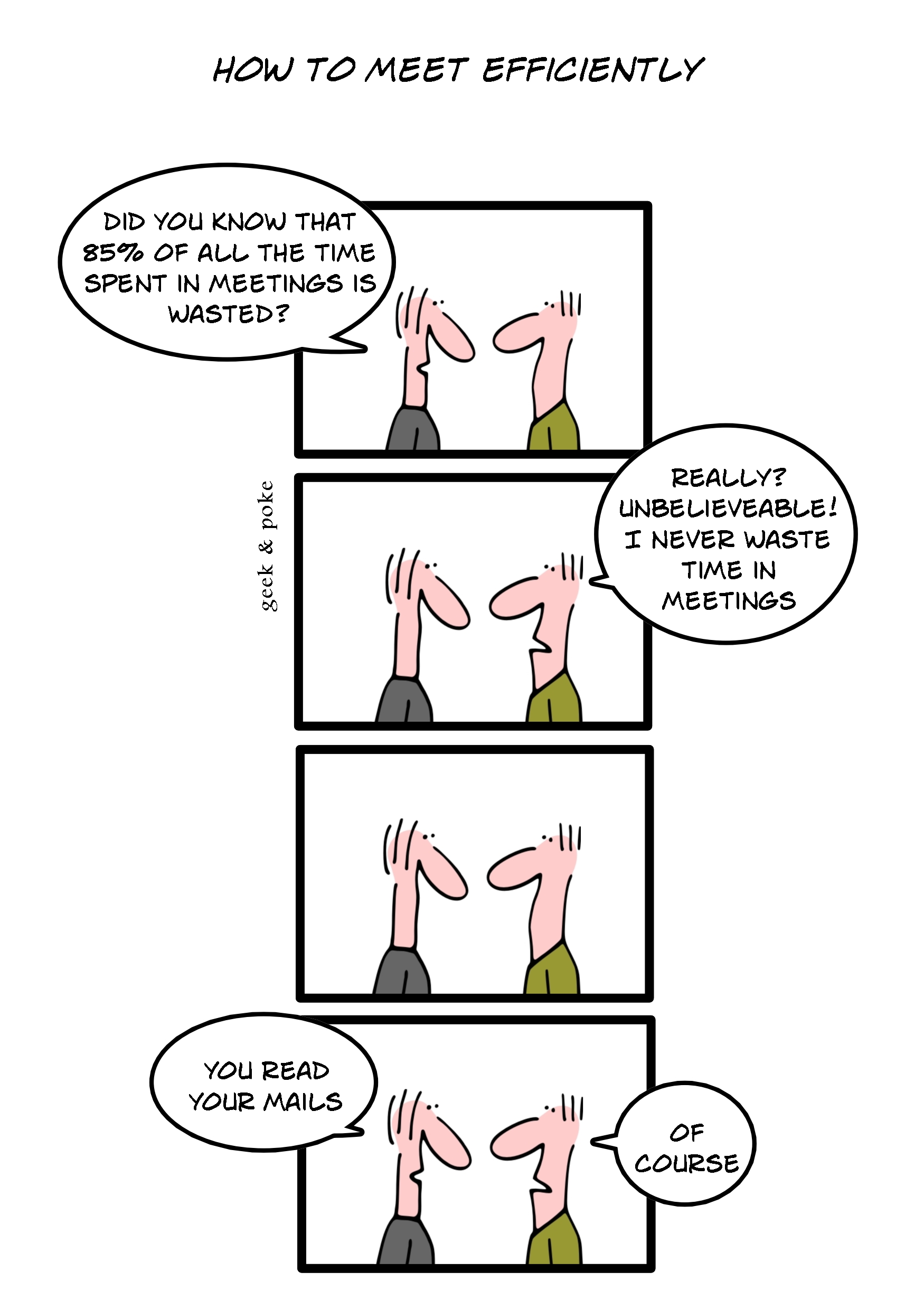
Meeting Efficiency: Oh how true

I hate to think how many meetings I have sat in that have basically been people catching up on email with the odd nod to the presenter.

We have a presentations style at work just for this occurrence – it’s the non-stop meeting style. We present at breakneck speed without any stops and without any time for questions. At the end we say “so is that agreed then?” and in many instances the answer from the non-listening participants is “yes”.

Found In Translation: The Case for Pictures in Business

One of the most popular blogs on this site is the one on Rich Pictures. I think that pictures are fabulous, so I really liked Dan Roam’s article on ChangeThis called Found In Translation: The Case for Pictures in Business.

Tower Bridge - Freshly PaintedIn this article Dan tells a simple story about getting directions in Moscow and the four different ways in which he could have been given the directions.

  • The Narrative
  • The Checklist
  • The Map
  • The Landmark Sketch

and Dan describes each one of them:

All four of these sets of directions are correct. Following any one of them should in theory get us to the Gagarin Museum in the same amount of time. But here’s my question: I’d like you to look over the four options again, really think about it for a moment, and then ask yourself this: if we actually were in Moscow, which option would you prefer?

The powerful communication methods are the map and the landmark sketch – without a doubt. We all know it’s true, so why do we use so many words in business?

I believe that for practical, business-oriented problem solving—when you and your team need to address something right in front of you right now, the visual options—the map and the landmark sketch are without question the way to go. The fact that we so rarely see these kinds of pictures used in business is why I write my books.

Over the last two days I’ve filled sheet after sheet of flipchart paper with diagrams. We’ve been talking through a solution with a customer, a solution that takes thousands of words to document. The documents don’t communicate, they just document. I had presentation slides and charts, but I knew that they wouldn’t communicate either. Simple blocks and lines on a chart with a commentary – that’s what communicated.

There’s something very powerful about a conversation held over a piece of paper, and I think it’s something intrinsic in who we are, but something that we suppress as adults. My reason for saying this is the difference that I see in the way that children react to paper table-cloths and the reaction of adults. What do children do with paper table-cloths? They write and draw on them, they get creative. What do adults do? They protect them, even though we know that paper table-cloth is going straight in the bin as soon as we have left. Why is that? One of the reasons, I think, is that the children’s  need to be creative is fresh and unimpaired, as adults we’ve come to suppress it so much that we don’t even think about it.

If you haven’t come across ChangeThis before then you really are missing out on a treat. I really like their manifesto.