A Lack Of Planning On Your Part Does Not Constitute An Emergency On Mine

This is also one of my sayings so thought I would share it:

Unfortunately in the job that I do saying these words rarely makes a difference to the outcome – and the effort that I have to put in to help someone with their “lack of planning”.

The thing is, I feel like I know the gentleman in the picture, but can’t place him?

Blogging – 5 years on (well nearly)

I’ve been blogging for nearly 5 years now. It will be 5 years proper in April, but I’m likely to forget then, so I’m commemorating this event now.

A Trip to Hadrian's WallActually my first post was on 04/04/05 and sometimes I wished I’d posted a day earlier so it could have been 03/04/05, but I wasn’t that fortunate.

The first words weren’t very profound, but we’ve been on a long journey since then:

Welcome to my new home for Oak Grove.

This site will continue to focus on my work-type related stuff. I’m also planning something new for more general information and musings.

Graham

The description of “work-type related stuff” has probably been quite fair. My work is quite broad and increasingly focussed on concept and ideas rather than on technology products. The change in post topics has reflected this – I don’t think I’ve written about a technology product for some time, and the most popular posts at the moment are on team dynamics and rich pictures.

I continue to be hugely interested in how technology can add value to peoples day to working life – and the massive void between the technology available and the technology being exploited. Businesses move at a pace that is a mystery to me and I have to admit that I am still perplexed by what it takes to influence people to change. Someone once said “when the pain of staying the same is greater than the pain of change – you will change” but that seems a bit negative.

Writing about concepts is much more difficult than writing about products, the audience is smaller too, but I’ve always written about things that I find interesting and will continue to do so.

The work on rich pictures has lead to some great conversations with my peers and customers. Much of this conversation has been carried out behind the firewall, as we move forward with our own internal social and enterprise networking exploitation, something that wouldn’t have happened 5 years ago.

Over these last 5 years my working life has changed massively, but there are yet more massive changes ahead. I think I’ll leave that for another post though. One of the things that I do intend to do in the coming months is to revisit the subject of the brain mainly to assess how this changed the way that I think personally.

Castle CragBack then I wrote under the name “oak grove”, there’s some history to that name, but I’m not going to get into that today. One thing that has changed has been the lack of Jimmy and Grandad. I’m not sure why that happened, it just seemed to come to a natural end. Perhaps it’s time to bring them back. What do you think?

I’ve also been writing my Blessings posts for most of that time too; these posts come less often mainly because I find they need a bit more work and for me to have the time to be creative. Some of the responses that I receive to these posts are wonderfully profound and often a privilege to receive.

To those of you who have been with me on this journey – thank you for your input. To those of you who are a little newer on the road – welcome.

We all have a perspective

Whatever we are looking at, whether we are near to it, or a long way away from it, we have a perspective on it. We can’t see the back of it, we might not even be able to see the side of it. We are limited to our perspective.

Giardelli'sThe same issue of perspective can also apply to our attitudes and ideas.

I know of people who write off an application or web site after only a few minutes of looking at it. I know other people who regard everything from a particular company as being the best at whatever it is that the product is doing. I myself would prefer never to see a product from certain companies ever again.

Each one of these opinions is formed from a perspective built up from an experience.

Whether this perspective is a good one, or not, is difficult to assess, particularly by ourselves. We can’t see what we can’t see.

Some of these perspectives are formed from our irrationality. Even when we know something that would change our perspective we don’t.

Standing at the bottom of a cliff our perspective towards the cliff could be completely different. We could see it as an adventure to overcome, we could also see it as a dangerous place to move quickly away from.

In many work situations we try to gain the perspective of others, but often we choose people who will reinforce our perspective to review our understanding. We need to do a better job of valuing diverse views and opinions.

Sometimes perspectives are called “experience” because they’ve been held for some time. But often this type of perspective isn’t built from experience at all, it’s built from an experience.

We use statistics to support our perspectives and reinforce the words of Einstein: “Not everything that counts can be counted, and not everything that can be counted counts.” Spend any time at all looking at the statistics that surround the issue of global warming and you will find people who people who’s perspective, no matter what it is, is supported by one statistic or another.

When I am reversing my car into a tight parking spot my perspective is very limited. Sometimes someone will off to show me the way in. These people don’t sit next to me an use the same perspective that I have, they stand outside the car to give the situation another perspective.

Many of the words innovations have happened by someone taking what already existed and seeing it in a different perspective. One example is this video from Ikea:

I quite like this quote, it seems to sum up what I’m trying to say:

Every man takes the limits of his own field of vision for the limits of the world.

There’s lots of power in connecting with the field of vision of someone else.

CSC and Collaboration 2.0

You might be interested to see what CSC is up to internally with Enterprise 2.0 type technologies:

Well done Simon and Charlie.

We all get frustrated!

We all get frustrated and that’s often a good thing.

Now I’m not talking here about the depressive kind of frustration that can gnaw away at us, day after day. I’m talking about the kind of frustration that pushes us into action. There can be a fine line between the two, and often that difference is found within our attitude towards them, but sometimes the difference is found in the situation itself.

Tuscany 2009There are things that frustrate me about which I can do absolutely nothing, but that is the exception. In most situations I have some power to do something. Often the cost of change is higher that I am willing to pay, but sometimes, just sometimes, frustration drives me to make a change.

As I look at the innovations that I have been involved in I can’t think of a single one that has come out of a grand idea. By a “grand idea” I am talking about those situations where someone, unprovoked, has a good idea, as if from nowhere, that makes a difference. I am sure that this kind of “grand idea” does happen, but I can’t think of a situation in my experience. I can, however, think of lots of situations where an innovation has happened because someone got well and truly fed-up something and decided to do something about it.

Sometimes we need the pain of frustration to spur us into a change. Without the frustration there wouldn’t have been the innovation.

The danger for many businesses is that they suppress frustration and miss out on the innovation. I would be interested to know how many employees regard themselves as disengaged simply because they could not find an answer to their frustration, there’s certainly lots written about it. Perhaps your frustration makes you a high “flight potential”.

There are a new generation of employees entering the workplace for whom frustration manifests itself very differently to my own generation. These individuals are going to cause all sorts of problems for traditional organisations that are not willing to embrace change.

One of the reasons I like the job that I am currently doing is that it gives me huge potential to change things, that doesn’t mean that I don’t get frustrated, it just means that I have an outlet for it. That’s what makes it so interesting.

As for the situations where I have absolutely no power to change the frustration – then I need to change my attitude towards the situation.

We’re all journalists!

Yesterday Jonathan was involved in a bit of a news incident. One of the buses at his college exploded into flames as it was sitting waiting to leave the college where he studies.

This happened around 4:30pm. According to the local press the fire services were called at 4:26.

By 17:44 the first comments were being added to a Facebook group.

A bit later than this an article was being written on the local newspaper’s site featuring photos and videos taken by students on their mobile phones. The article was posted to Twitter at 18:17.

By 18:44 one of the students (Sam Pratt) posted:

Within two hours and 10 mins since the Runshaw bus fire, a Facebook group was created, 4 videos and 12 photos were on it and the LEP had already covered it on their website. How’s THAT for social media?

By 20:48 it was in the BBC web site with what looks like a security camera picture.

The BBC site has a single 150 word article with a single picture.

The Lancashire Evening Post site has a 650 word article a single video and 7 photographs. There’s also 8 comments (mostly pointing people to the Facebook group)

This morning there are nearly 1200 members of the Facebook group. There are 30 photographs and 8 videos. There are are over 180 different comment threads as well as comments on lots of the photos and videos. Some videos have also been posted to YouTube.

I’m sure that this scenario is being played out all over the world right now because we’re all reporters of the news now.

The Lancashire Evening Post sites say: “See The Evening Post on Friday for exclusive pictures and comments from eyewitnesses", why should I? I’ve already read the eyewitness reports from hundreds of students and seen more than enough photographic evidence.

I’m sure that there is still a need for journalists, but it needs to be about adding value.

We’re all irrational!

How many rational decisions do you make? Do you think that most of your decisions are rational? Coke

Do you worry about anything?

Did you know that people feel less safe in a highly guarded airport than they do in a less well guarded one?

Have you ever worried about illness? Do your worries reflect the reality of the risk?

Do your death worries reflect the size of the bars in this chart?

Are you twice as worried about cardiovascular issues compared to cancer, or over 1000 times more worried about cancer than swine flu?

I work in IT and I see irrationality everywhere I look.

On a weekly basis I see projects that people expect to “revolutionise” the way that they work. This is a completely irrational expectation. Tell me the last thing that completely “revolutionised” anything? No I can’t think of anything either. I can think of things that have made a positive contribution, and some thing that have made a negative contribution but nothing that on its own could be regarded as truly revolutionary.  There is a cumulative effect that could be regarded as revolutionary but that comes over time and it the outcome is normally unexpected.

Another area of IT irrationality is the area of cost control. The only factor that seems to influence whether something is worried about as a cost is it’s size. You might say that that was a rational response, but it isn’t – the real measure should be value. Microsoft software, as an example, gets managed quite tightly because it’s a big number, but this software is used all day, every day, by most organisations. Very little control is normally placed upon the thousands of other bits of software that most organisations use and that’s because the software tends to go out in small chunks, for a project here and a project there. The overall cost of the little bits is itself a big number, but the amount of value that is being generated from it is quite low. I see many of these applications, that get delivered as “vital”, ending up dormant and waiting to be used.

Another area of IT irrationality is how few of the capabilities that people have available to them get used, even when they could add value. I’m becoming very intolerant of the people I see using an application like PowerPoint who draw a box and then put on top of the box a text box and then put the words into the text box. I want to scream – “just right click and add the words straight into the box” (and I must admit that sometimes I do).

I’m not immune from this irrationality. One of my irrational acts is checking my Blackberry at completely inappropriate times. These are times when I know that I couldn’t, or wouldn’t, do anything with what I have just read. Why do I bother looking then?

How many organisations are there out there that are running business critical processes on platforms that are out-of-support, unsupported and unsupportable.  Why don’t they do the rational thing and replace them?

Having said all of that, I’m not sure that rationality is always a good thing. Most of the successful innovations I have seen have been a complete surprise to the people who created them. If they had been rational they wouldn’t have done what they did. We need some things to fail to know that they are failures. Perhaps we need to regard the next great thing as “revolutionary” to give it a fighting chance of being just that.

(Thanks to Information is Beautiful for the charts, I really like charts and visualisations, so much better than words)

We’re all lazy!

If someone is going to do something for us we are likely to let them, even if they don’t quite do as good a job of it as we would like. That’s the way we are wired.

There are, of course, exceptions to this situation, but in general we would rather be lazy.

Hyatt Regency San FranciscoIn IT our aim is to make things easier for people (I know it doesn’t always seem that way). The problem is, we often make it easier by taking away the responsibility from the consumer, making them lazy.

I was reminded of this again today by an article in Computerworld by Mathias Thurman. Mathias is talking about the creation of a policy within his organisation that enforces screen lock-out. Most people would regard this as good practice, and I’m not advocating that it’s not, my challenge and one that Mathias recognises is that the enforcement of this policy will make people lazy.

Some of the people within his organisation already have a setting that is more stringent than the policy that he is going to enforce. He says of these people:

They have shown the sort of awareness of security issues that I try to instill in the entire workforce, and now we’re rolling out a policy that seems to say that their security consciousness was unnecessary.

He’s right to be concerned, these people will start to see that the responsibility for security is no longer theirs and has shifted to be the responsibility of the policy set by the IT department.

There’s a greater challenge with this type of policy, and that is that all of the people will now rely upon the policy to lock their screens, including all of the people who used to manually lock their screens when they left their desks. For this group of people the security risk has actually increased, instead of the device being locked when not attended it will be left unlocked for a period of time until the policy kicks in.

This shift of responsibility means that people treat IT as something that is delivered to them, rather than something that they are responsible for.

Lack of responsibility has many facets to it that influence the behaviour of those consuming the services. These include:

  • Abuse of the services – “why should I look after this stuff it’s not my responsibility”
  • Working around the services – “if they won’t let me do it, I’ll just go and  do it somewhere else”
  • Apathy to the service – “I’ll just have to use this service because that’s all I’ve got available to me”

We need to find a new way of working that protects the business, but doesn’t remove the responsibility from those consuming the services. We need to do this recognise people’s innate laziness.

The IT Vendor – Pen League Table

I’ve been travelling a lot over the last few weeks visiting many IT vendors. One of the things that most of these vendors decided that we needed was a pen. Leaving aside the irony that IT vendors want to give us pens it was interesting to notice the difference in the pens that we were supplied with.

Do the pens say something about the companies? I’ll let you decide on that point.

Starting from the top of the picture:
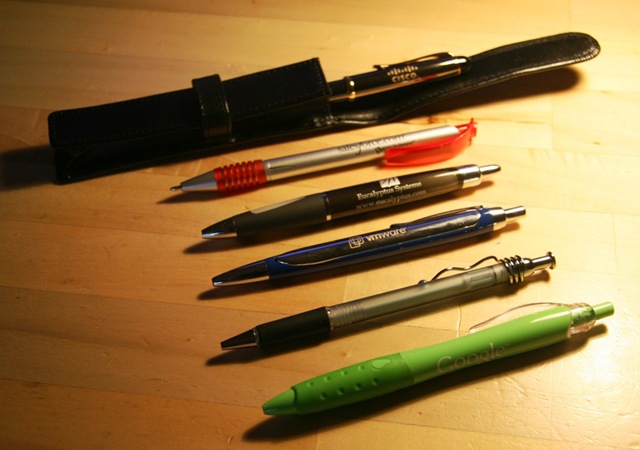
IT Pens League

Cisco

The only pen to come in a pouch. A very professional pen meant for serious people. An enterprise pen.

This is a heavy pen (but not the heaviest) which is going to be solid and reliable. It’s also the only pen with a lid meaning that is sits very nicely in the hand and is quite well balanced.

As for colour – it’s nearly black, so it’s conservative even in it’s colouring.

Writing Stars: ⭐ ⭐ ⭐ ⭐ ⭐

Salesforce.com

In complete contrast to the Cisco pen, the Salesforce.com pen is an incredibly cheap pen.

The pen I was given is actually broken. The reason it is the only pen pictured with the nib showing is that it won’t go back in and it has a crack down one side.

This pen did come in a kind of a sleeve, but it was really just a plastic wrapper. The side of the pen shows the logo, which is, of course, the name and the web site address.

Colouring – it’s silver and red which I take to be bold but not really funky or cool. It’s corporate, but not really corporate.

Writing Stars: ⭐

Eucalyptus

This is the only pen in the set to have a logo, a company name and a web site address. Perhaps this says more about Eucalyptus as a young organisation than anything else.

It’s a nicely weighted pen, on the light side, but with a good grip.

The pen itself is a Smokey black, but it writes blue. It might just be me, but there is something wrong about a pen that is coloured black, but writes blue.

It writes well and starts from the off, not requiring any warming up.

Writing Stars: ⭐ ⭐ ⭐

VMware

This is easily the heaviest pen in the set. I wouldn’t want to write with it for long, my fingers would drop off. It’s a proper metal pen and you definitely know if you drop it on the desk, actually the whole office knows if you drop it on the desk.

This time it’s a blue colour pen – that writes black (What are you guys trying to do to me?) Having said that, the blue does appear to be the standard VMware blue that they use in all of their material so works as a branding tool.

It writes well enough, but for such a heavy pen there is no grip to step it sliding around your fingers.

This pen also rattles a bit, I really dislike pens that rattle as I write.

Writing Stars: ⭐ ⭐

Appirio

Not sure quite what to say about this pen. There’s no logo on it, or any writing. It came with a notebook with the company name on it. I’m not sure whether putting the name, or logo, or web site address on the pen was too expensive for this relatively new organisation, but it’s certainly an opportunity missed.

I have hundreds of this type of pen and quite like them. The only think I don’t like about them is that I have a habit of twisting the clips off the top of them and it’s almost impossible to twist it back on.

It’s silvery see-through with a black grip. Not much to say really.

Writing Stars: ⭐ ⭐ ⭐

Google

I did have a couple of the Google pens in different colours. One of the things about having children is that pens quickly get appropriated to other purposes. On the colour front, as you’d expect, the pens were all in the colours from the Google logo.

No need to put a web site address on this pen.

It’s a perfectly adequate, functional, plastic, writing implement. The grip is good and it’s a good size for my hands.

A green pen that writes blue, but somehow I can cope with that more than a black pen that writes blue or vice versa.

The kids regarded this as the cool new pen to take into school.

Writing Stars: ⭐ ⭐ ⭐

Microsoft

We did go and see Microsoft, but they didn’t give us a pen – they gave us a drinks bottle.

Top 5 tips: Getting more done when you are busy

How do you get more done when you are busy? Here are my top 5 tips for overcoming busyness:

1. Productivity not activity

Tuscany 2009When busyness strikes people will often leap to the nearest activity in a hope that this will help them to get through the pile. This creates activity, but destroys productivity, and it’s really productivity that you need.

This might sound obvious but it’s just as important to prioritise when you are busy as it is when you aren’t. Having prioritised you can then get through the items productively.

2. Lists are your friend

One of the key lessons of the GTD methodology is that we can waste lots of effort managing the information in our head. Making lists help you to focus your brain on getting things done rather than on managing the information.

3. Learn to skim read

You can’t read all of the information available to you – after all if you printed-out the internet it would take you 57,000 years to read it all.

There is lots of stuff that you don’t need to read all of, you just need to understand what it is saying and that is what skim reading is all about.

It’s a skill that takes a little while to become confident in, but it’s well worth developing.

4. Take “Out” times

The productivity of your work times is defined, to a greater extent, by your “out” times. If you don’t take the “out” times your productivity in the “in” times will steadily diminish until all of the extra time that you are putting in is worthless.

Exercise in your “out” times is also very important because exercise is just as important for your brain as it is for your body.

5. Say “No”

The danger when you are busy is that you are venerable to being put upon. Not everything that everybody asks you to do is important. When you are busy it can feel easier to just accept things rather than go through the hassle of challenging them. This, of course, just adds to the problem.

I do this a lot and the result is that I just dig a deeper and deeper hole for myself.

(This idea for a blog came via twitter following my What would you like me to write about? post. Please fell free to add other ideas)

Concept of the Day: Cultural Plasticity

I’m not sure whether this counts as a real fully fledged concept, or just an idea, or actually even whether there is a difference.

PisaThe idea comes from Jonah Lehrer over on The Frontal Cortext blog where he reflects on the diversity of music that we enjoy (his pretext is the events at the MTV awards with Kanye West and Taylor Swift).

It got me thinking, in what other ways are we culturally plastic:

  • Food: The range of food available in the UK is incredible. Foods from every country in the world and even fusions of different food types. We skip between them without really thinking about it, something that my grandparents would never have done.
  • Video/Television/Films: I know a few people who will only go to the movies to see a certain type of film, but there aren’t many of them. And the range of film genre is increasing all of the time.
  • Reading: Looking at the book shelf beside me there is a huge variety of material. There’s no Mills and Boon, but apart from that there is practically every other type of writing.

So what impact does this plasticity have on the world of work?

Teams that accept diversity work better and produce stronger results. As people become more tolerant of, and learn to enjoy cultural differences hopefully this will be reflected in teams. This will be especially true for international teams which will become more prevalent as technology enables it.

I suspect, to, that people we start to choose the places where they work on the basis of the diversity of the culture. Places with a monolithic culture we be regarded  as stale and dull. Skilful business managers will be able to create diverse cultures that are highly productive.