Branding Colours – on the Web

I love inforgraphiics.The people over at colourlovers.com have done an assessment of the most powerful colours in the world, including the colours of the most powerful web presences. It’s really interesting to see the influence of reds and blues but also the power of multi-coloured approaches that focus on the primary colours (below). If you are thinking of launching a social networking site though, you need to make sure that your icon uses blue.

It’s also interesting to see how different this is to the spread of colour for corporate America overall.

Look out – the Millennial are coming

If you have children under the age of 30 and they use IT, you will notice that they do it in a radically different way to the way in which you started using it. These people are the Millennials, also known as Generation-Y.

Jimmy and Granddad visit Alnwick GardensThere has been a good deal of debate recently about the impact of the Millennial on the workplace.

These discussions are generally polarised between the people who believe that business practices, as we know them, will be completely and dramatically changed through to the people who believe that the Millennials who encounter the harsh reality of working life will conform to the business culture.

As with all things, it’s not likely that either of these polarised views will be overarching reality, although in some businesses one, or other, of the extremes is likely to prevail. But it’s interesting, to me anyway, to see the influence that this body of individuals is already have on the way that corporate IT people think.

As a starter it’s probably worth understanding the things that make a Millennial tick – 60 minutes put it this way:

They were raised by doting parents who told them they are special, played in little leagues with no winners or losers, or all winners. They are laden with trophies just for participating and they think your business-as-usual ethic is for the birds. And if you persist in the belief you can, take your job and shove it.

The workplace has become a psychological battlefield and the millennials have the upper hand, because they are tech savvy, with every gadget imaginable almost becoming an extension of their bodies. They multitask, talk, walk, listen and type, and text. And their priorities are simple: they come first.

A recent survey highlighted in CIO magazine defined four key lessons for CIO’s:

1. Millennials expect to use the technology and devices of their choice.

2. They either don’t care about or won’t obey corporate IT policies.

3. They have an entirely different view of privacy than previous generations.

4. They have little use for corporate email as a major collaboration tool.

The basic premise being that organisations need to behave differently if they are to get the desired outcome from this generation of workers. And how do they need to change:

1. Get Millennial employees involved at crucial points whenever key technology use and policy decisions are being

2. Make sure technology-related policies are written in plain language and do not sound overly punitive.

3. View corporate technologies through a Millennial lens.

4. Figure out how to work with Millennials who are not hierarchical in their teaming and collaboration approach.

5. Look closely at collaboration, much of which is technology-enabled.

In other words, Mr. CIO change the way you work or you are out of of synch with the business and ultimately out of a job.

That’s one way of looking at it.

Andrew McAfee writing for the Harvard Business Review reflects the other end of the spectrum in his article Millennials Won’t Change Work; Work Will Change Millennials. I suppose the title says it all, but to underline the point:

I absolutely buy that Millennials have different technology habits and preferences than us older workers. In short, they consider enterprise 2.0 the no-brainer default rather than something scary and weird. But that’s about the biggest difference I see.

I think that today’s workplaces will change Generation Y more than the reverse. I realize that this makes for a less splashy article. Good thing I’m not trying to sell magazines.

My personal view is that we will continue to see significant change in the workplace. Some organisations that are large and productive today will stagnate and die, others will evolve and grow. New business will be started with radically new business models, as well as new businesses doing things the way that they’ve always been done. New types of work will continue to be created, but we’ll still need a mechanic to fix the car. Information and knowledge will continue to be a significant factor in the effectiveness of many businesses, it’s use will be a key differentiator for them, but I’ll still have a window cleaner who puts a hand written note through the letterbox.

In other words – yes we’ll see change, no it won’t be as painful or as radical as some believe.

To pinch an idea from one of the comments on Andrew McAfee’s post – a lot of things that define the Millennials are just a result of being young.

The other thing I wonder about is whether the current downturn will have an effect upon the general mindset and birth a new type of generation? Speaking as someone who’s formative years included the impact of the last downturn I suspect that it will.

Why is IT changing? Why does it have to change?

One of the topics I repeatedly come back to on this site is that of change.

A Walk Aroud WrayPeople love it and hate it all at the same time, it all depends upon what the change is and where it’s come from. There are many people within the IT industry who regard it’s current construct – servers in data-centres – as being set in stone. But there are huge changes undergoing across the industry, changes that are so significant that it will radically change the way that we think about IT provision.

Some people predict change by applying well known trends and lifecycles to an existing situation. That’s exactly what Simon Wardley has done. If you really want to know what is driving change in the IT industry you should watch this video, but more than that, you should think about all of the other situations where these principles apply.

Having been in the position where people have wanted to drive an innovation process at me on more than one occasion I can definitely relate to the situations that Simon describes.

And, like Simon, I don’t see this change reducing the need for IT skills, or of making things cheaper. It’s just different – different skills, different cost profile. There is so much latent demand in every business that cost is still going to be a significant issue.

If that has got you thinking, perhaps you’d like to give some thought to the concept of Shadow ITthey already exist somewhere in your organisation. Are they a problem, or are they an opportunity?

Conference Call Meetings

This made me smile today – you definitely need the sound on.

I’ve had this experience so many times, but never quite been brave enough to go with the action at the end:

It’s advertising a new book called Rework by Jason Fried and Keith Heinemeier Hanson which looks like an interesting read.

I left for a while

I took a short sabbatical from twitter and facebook over the last two weeks – no updates and only the occasional message checks.

Jimmy and Granddad Explore the Lake DistrictIt was an experiment in focus. What would happen if I put it to one side and focussed those cycles on something else for a while?

When I started out on this experiment I was just going to ignore the updates, but I soon realised that I needed to be a bit more proactive because the lure was too great. This was particularly true when I was sat somewhere and my itchy fingers would get going on the BlackBerry. In the end I deleted all of the clients from all of my devices, this made the break much cleaner – and easier.

While two weeks isn’t long enough to really change habits it did help me to see areas of my life where things needed to get back into focus. One particular area was my abuse of thinking time. I hadn’t realised how much I had filled up all of the pondering time with stuff – checking twitter, reading facebook, etc..

You might have noticed that I’ve written more on this blog in the last two weeks than I have for a good while. It’s not the writing that takes the time when blogging, it’s the pondering. No pondering time meant no writing time. Creating pondering time resulted in a creation of the writing time.

My last two weeks have felt a bit like going on a nice long walk – time to think, and cogitate.

It also felt a bit like going through a form of detox.

I will be back, but I’m not sure in what form, and I may well leave again.

Concept Entropy

I’ve witnessed the entropy of many a fine concept in my time.

For those of you who have forgotten your schoolboy physics a quick reminder on what entropy is – and there are a lot of fine definitions, but I want to focus on a simple illustration. Entropy is what happen to your kettle after you have turned it off – it cools down until it is at room temperature. All of the heat dissipates until the temperature of the kettle is no different to everything else around it – well almost.

Within the IT arena we come up with all sorts of good ideas, but I’ve seen many of these ideas go through the same entropy cycle.

  • The cycle starts with an idea.
  • The idea warms up things around it as people subscribe to the idea and see it’s relevance.
  • The idea gets developed into a concept and a way of thinking beyond the first idea.
  • Thought leaders start to understand how the concept could be applied within their context – whether that’s a business, an organisation, or from a personal viewpoint. These thought leaders make the best use of the concept and it makes a real difference to their context.

At this point the system is still being heated up – the concept is still cooking, but entropy is about to kick in.

  • The concept starts to enter the mainstream.
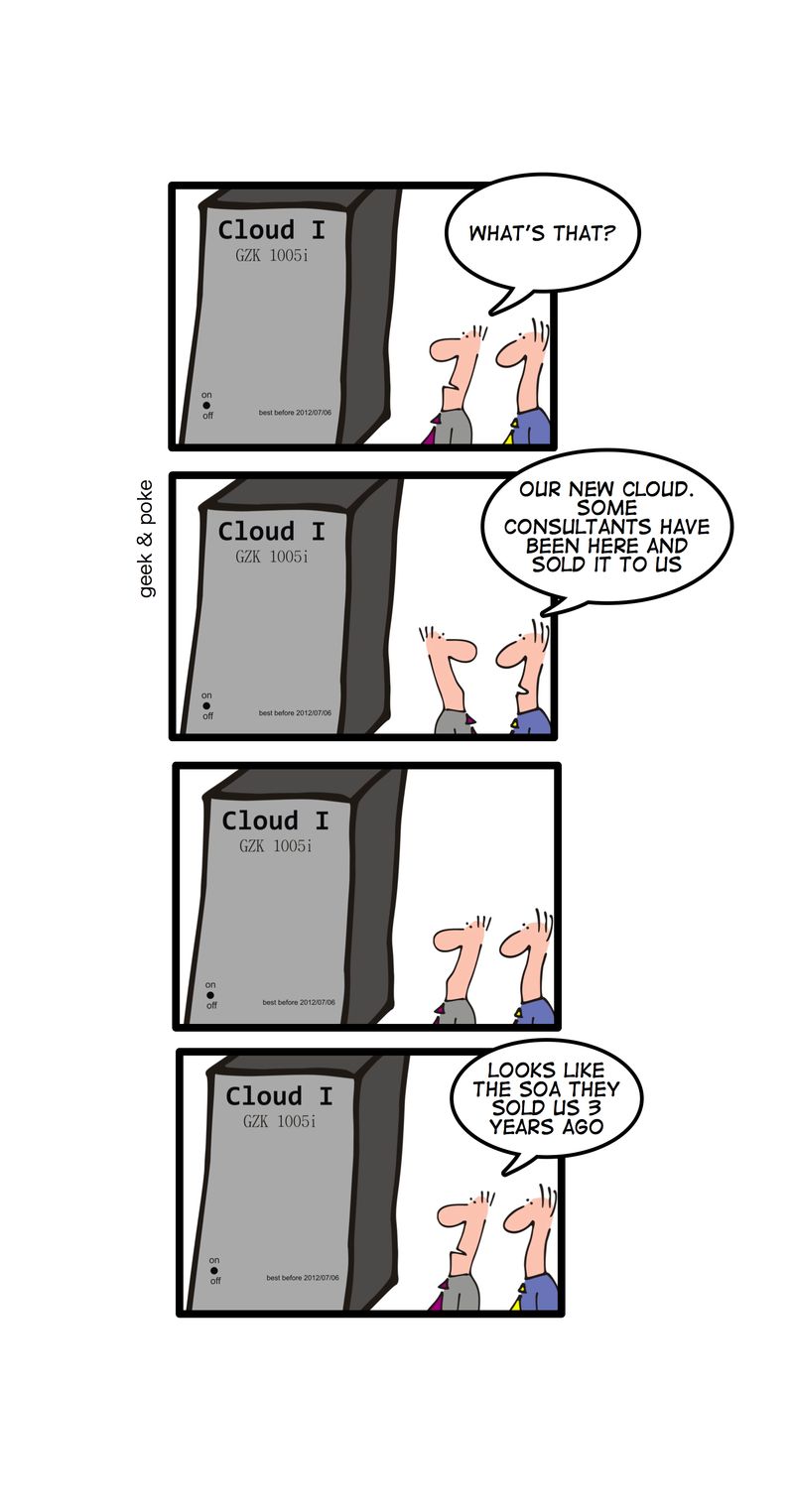
  • Consultants start to see the concept as a way of generating more work by helping organisations to apply the concept to their environment.
  • Product companies see a whole new revenue stream from delivering products targeted at delivering the concept.
  • Because it is something tangible the products become synonymous with the concept in the minds of those that use the product.
  • The products enter the mainstream and become the concept and consulting review from the concept starts to decline.
  • At this point the consultants start to look for the next concept to jump onto leaving the old concept to the product providers.
  • The concept entropy is complete.

SOA is the last years concept, Cloud is this years. SOA has just finished the cycle, Cloud is on it’s way through the products phase.

I said at the beginning that a kettle cools down until it is just like everything else around it – well almost – and it’s that well almost that is important. The extra heat that the concept has generated doesn’t die – it’s just been dissipated throughout the other systems. The products that get delivered to enable a concept still live on making a difference to the way that organisations work. The products aren’t delivering the concept, but the residue of the concept that lives in the products is making a difference to systems around them.

Relationship is power

Once upon a time man roamed the earth looking for food in those days the ability to find food was power.

Jimmy and Granddad Explore the Lake DistrictThen we learned how to cultivate crops and farm animals. Land became power.

As the land became used up we needed to protect our land so weapons became power.

Then the industrial revolution happened making facilities and factories power.

Then we saw the dawn of the Information Age and facilities became less important because we didn’t need them to process information. Information became power.

Then an interesting thing happened – information became FREE. If information is free it can’t be power.

All along people were connecting with people, making deals, giving the inside track, offering advice, ignoring organisational structures, giving and receiving favours, dining together. People were making relationships.

Then along came the start of something new, it got fancy new names like “social media”,“social networking” and even “business networking”, but really it was just another way of making relationships.

It’s those relationships that make things happen. Relationship is power.

Concept of the Day: Cognitive Surplus

Today I watched Clay Shirky presenting at TED (via their excellent podcasts). Clay outlines a number of challenges to the way that we imagine people’s motivation. He explodes the premise that we all love to be “couch potatoes” and highlight a number of examples that demonstrate that as he says:

We like to create and like to share

Jimmy and Granddad Explore the Lake DistrictPeople don’t just contribute when there is payment at the end, they contribute when they are creating, and with the currently available technology the opportunities for creating are becoming ever broader.

This effect creates a global surplus of cognitive ability of “a trillion hours a year”. There’s a lot you can do with a trillion hours of creativity if only we treat it in the right way. he calls this Cognitive Surplus.

Not only is this concept a huge challenge to the way we approach social projects, but it’s also a challenge to the way we approach business projects.

My perception of many business projects is that they are constructed with the assumption that people won’t want the change, and hence a stick is required to get them to change. If people truly do" “like to create and like to share” then engaging people in a creative constructing way in the change process will turn them from blockers to enablers. It might even get them to invest some of their own cognitive surplus.

The latest example of this, for me, is the location tagging of a Glastonbury picture that is underway. Thousands of people are tagging themselves in a picture taken at Glastonbury. The reward for this is little more than the feeling that you have been part of something. They’re all using their cognitive surplus to create a shared experience.

Coming to think of it – why is it that I write this blog?

 http://video.ted.com/assets/player/swf/EmbedPlayer.swf

What do I know?

There’s a saying that I use quite a lot, which apparently comes from Voltaire the French philosopher:

“Common sense is not so common”

Jimmy and Granddad Explore the Lake DistrictWhat I regard as obvious is likely to be different  to what you regard as obvious. What I know is likely not what you know. My experiences, my understanding, my perspective is always going to be different in some way to yours, sometimes it’s going to be radically different to yours.

This isn’t new information, and if you’ve been around a while I suspect that you read it as “common sense”, but that’s not the way that we behave.

Whenever I enter into a conversation I make an assumption that the person I am talking to knows certain things and sees some of those things in a similar way to me. The way that I communicate with that person is massively influenced by the assumptions that I have made about the person that I am talking with.

So why am I surprised when they understand the conversation differently to me?

Surely my expectation should be the reverse. It’s far more likely that someone will understand a situation in a different way to me because they see that situation from a different perspective. It’s highly unlikely that they will see it in the same way because it’s not likely that their perspective will be the same as mine.

In some ways it’s a miracle that we ever communicate at all.

How would changing our perspective change our communicating?

Business Networking – Twitter, Facebook, Linkedin and the Cigarette Shelter

I was reading  the Michael Sampson: Currents blog the other day when I read this:

Is Twitter / Yammer / Socialcast the "new cigarette?"

Your Minster in the SunshineHis question was based on a posting by Joel Stein in Business Week titled “The Secret Cult of Office Smokers

Joel observes the power of the meetings that occurring every day in the huddles of individuals sharing in the smoking habit.

One of my first bosses was a smoker and I used to marvel at his ability to know things – it didn’t take me long to work out the source of all of his inside information. If something was going to happen he always knew way before it actually occurred, sometimes he would tip us off, but on many occasions he would leave it as a surprise. He’s always be perfectly positioned to take advantage though.

I’ve worked alongside other smokers and without exception they have been well connected, and normally connected above their station in the organisation. There are times when I’ve joined them for the chat because I’ve seen the potential.

Back to Michael’s question: are the social media tools replacing this kind of interaction?

To a certain extent I have found that my connectedness has increased through the use of social media, twitter has connected me with all sorts of knowledgeable and influential people within the IT industry.

Internal connectedness is a bit different, but similar. We run a system based on Jive internally and my ability to connect across the organisational structure has been great. I’ve written more extensively on some of the topics I write about on this blog, on the internal system, resulting in a number of very valuable connections with highly connected people in the organisation.

I have to say, though, it’s still not the smoking corner. There’s still not the serendipitous moments that you get from a chat over some tobacco in a paper sleeve, and I’m not sure why. I’m sure some of it is because the level of honest and openness on the lies of twitter is nothing like the honest we’d display in a much smaller group. But I think there are other factors too.

Playing a new game

Some wisdom from Seth Godin today:

Spring Flowers 2010A car is not merely a faster horse.And email is not a faster fax. And online project management is not a bigger whiteboard. And Facebook is not an electronic rolodex.

Play a new game, not the older game but faster.

I work alongside IT organisations who are often so focussed on getting “more for less” they completely miss the game that is changing around them.

So often the question is focussed on upgrading rather than transitioning – “if I upgrade the corporate email system will it be cheaper” rather than “what opportunities do we have for delivering communications in a better way”. People don’t want corporate email they want communication, and while they are all looking at the corporate email system this thing called social networking comes up behind them and changes the game.

Stories in Business

I seem to be surrounded by long documents and large spreadsheets again. People have spent hours on these pieces of work, but I’m unlikely to read them. It’s a shame, but it’s the reality.

Trying to push a mouse aroundThe other day Shel Israel wrote in “Story Telling VS 10,0000 years of PowerPoint” about the challenge of the bullet-point culture that we are in and the stories that are deep within our human nature.

If you’ve been reading this blog, and my twitter updates for any length of time, I am not a fan of large documents or bullet-points, but I am a huge fan of stories (here)

The following story is a caricature of a real meeting:

“Oh no, It’s that Tuesday in the month again, that one when Bill gets to talk us through the standard 84 page bullet-point fest that he loves so much.” I think to myself as I look at my diary and the day that is ahead.

I know that this two hour green block in my diary means that I will be entering into a form of torture chamber once again. A torture chamber where I want to stand up and say “who cares”, but know that I will, as always, sit there like a good boy and say nothing. I will start the meeting determined to focus and to be constructive, but I know that over time the BlackBerry will get more and more attention, and the meeting will slip steadily into the background.

Sure enough that is exactly what happens. After reading through the contents of the first 10 slides I’m almost 100% focussed on anything other than the never ending stream of bullet-points set out before me.

My BlackBerry flashes, I know what it is going to be before I even look at it, it’s from Mike who’s sat across from me. His phone is getting a similar amount of attention to mine and he has sent me a text – it’s not complementary. My reply isn’t exactly constructive.

I know that I will never get back the seconds, minutes and hours that are passing before me. I set there ashamed by my lack of courage – “why don’t I say something? Anything?” – but I don’t. I let the time tick on and drip away.

And then someone does say something, out of the blue they ask a question. They break right in – mid-bullet-point.

But what difference does all this stuff make to Mary?”

Mary? Why Mary?” says Bill

Because she’s the person who complains the most to me about all of this. There isn’t a week goes by when she isn’t telling me how useless it all is? The other day I could see how stressed and frustrated she was. It’s not like her so I asked her what was wrong, and she told me. She told me about the time it takes to get things done. She told me about the lack of answers she gets from the people running the service. She told me about how no-one else will use the system because it’s so bad, but she doesn’t have a choice. What difference is this going to make to her?”

Well I don’t know?” said Bill looking a bit flustered

“She’s just in the next office why don’t a get her and she can tell us”

Mary joined us and tells us about her challenges, her problems, her frustrations, her annoyances. She has some great ideas about how it could be so much better too.

At first Bill tries to get us back to the slides that he is determined that we should get through, but he soon realised that he has lost. We wanted to hear Mary’s story, we wanted to know how we could make her life better, we want to hear her ideas.

We had our story and we were going to get as much out of it as we could.

There are all sorts of techniques for introducing stories into business, and in particular, into the system architecture and design business where I find myself. These stories are far more powerful than a slide deck of bullet-points could ever be. I think I’ve said it before, but it’s worth saying again, one of the reasons I love Rich Pictures is because done well they tell a story.

People stand around gossiping and will happily do it for hours, but I can’t imagine people spending the same amount of time discussing the contents of page 46 paragraph 4 of the latest technical tome.

Tell the story.