XBox 360 Team breaths a sigh of relief: Sony PS3 Delayed

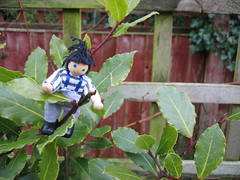
Jimmy climbs a tree

The XBox team took some stick for not including HD-DVD (or Blu-ray ) in the specification of the XBox 360. It now looks like Sony is regretting not making the same decision.

The Sony PS3 is delayed by 6 months a period in which half the world (roughly) will have a birthday and the XBox 360 envy increases. OK, they manage to make the important ‘holiday season’ but they manage to give Microsoft a whole year to establish the XBox 360 as the device to own with little competition from the PS2. More than that, all of those XBox 360’s continue to get embedded into the Windows Media Center and Windows Live eco-systems. Eco-systems that some people are finding even more compelling than the ‘games’.

It’s going to be very difficult for Sony to drag all of the XBox 360 fans back.

Helps me make my mind up anyway, all I need now is the XBox 360 prices to come down a shade.

Tags: ,,,

Goldilocks and the Origami

Jimmy plays in the puddles

(I’m still calling the Origami in the vain hope that sense will prevail and we won’t be calling these think UMPC’s in the future)

The Unofficial Microsoft Weblog has a great story about Goldilocks and the three devices today.

Just right .

Tags: ,,

The Shared File Server is Dead?

Jimmy is suprised to find that this hill has another one behind it

Is it time that the file server concept was finally killed off? Is the continued use of this most ancient of network concepts holding us all back? Are they so embedded that we shall never get rid of them?

Some assumptions taken early in the technology cycle continue to influence the current technology even though they are no longer relevant. There is a well told story which links the width of a horse through to size of a train. This is apparently only half-true but serves my purposes well here because it shows that once a standard is set it is built upon, and on, and on, and may never ever be changed. So it is with the file server.

I’m not suggesting that things need to be changed just because they have been around for a while, thought I could construct an argument to that effect. In the normal course of life though something happens which changes the basis for a standard in a disruptive way and the old standard is simply left behind. In the UK the cart used to be the way to move things around, and then along came the canal, but before the canal was even fully established along came the train. The old standard may still be around, but it is no longer the standard.

The shared file server concept has been alive and well since the creation of the first network. In simplistic terms, if you wanted to share a file with someone you put it on a file server so you can both get access to it. The first and simplest form of IT collaboration, even pre-dating email. We have moved between different variant but in essence they all allow us to store files and get them back again.

This simple centralisation concept has allowed us to build a whole set of working process and technologies that have little to do with file services but build on its bedrock. We ask people to store data on the file server so we don’t need to worry about backup on the clients. We ask people to store data centrally so we can protect it with RAID systems and other resilience techniques. We ask people to store their data on the file server so we can rebuild their client device without worrying about data.

At the same time we have realised and lived with the problems of data centralisation. Moving all of the data to the centre has meant that all of the growth is centralised too leaving many organisations with an impossible task trying to keep up with the growth. Centralisation of the data has established massively complex security structures making restructuring of the data practically impossible Centralising the data has moved, to a significant extent, ownership of the data to the centre to; but because the centre doesn’t actually own the data it doesn’t know what to do with it making policy definition impossible. Centralisation of the data has also enforced a single view of the data structure which serves the needs of only some members of the team who are using the data (some people think in applications rather than in process for instance).

People have come up with all sorts of ideas to resolve these problems. Most of these ideas have involved a movement of the data out of the file systems and into some application or database. While working in some niches they have done little to curtail the continued growth of the file server. has Oracle iFiles (as it used to be called) actually removed a significant percentage of the file servers out there, how about Documentum, or any other Document Management system. Even people’s reliance upon email hasn’t slowed the consumption of the file server all that happens is that people store the data in the email system and on the file service.

So why do I say that the file server is dead? What is the disruption that is coming that will remove our reliance upon it? What technology can this idiot be talking about?

Well it’s not a technology.

It’s not some new software.

It’s society – yes society.

Or more specifically, the changes in the modern work environment leading to more pervasive home and remote working.

I regard myself as a bit of a Edge Case when it comes to home working, but I’m only one of several million. I used to architect and deploy file servers by the bucket load; since working at home I haven’t touched a single one. The file service has changed from being a service to being a constraint. In order to use the file service I need to embed myself and my device wholly into the corporate IT from the outside and it’s just too difficult. If I want to use a file service I need to start a VPN into my corporate environment. If I want to access the Document Management system I don’t, if I want to use any of the LOB applications I don’t, if I want to use email I don’t. So why should I bother? What used to be the easiest place to store data has become one of the most difficult. Perhaps there are good reason for me to use the shared file services available to me, but I don’t. It’s easier for me to share data into the places that I should have been using all along, so I have changed a long established process and started using the Document Management system.

A couple of years ago I would have told you that you were bonkers if you told me that I would be writing this post.

Where I have come many will follow.

Count Your Blessings #55 – Seeing a Smile

Skiing in Bansko, Bulgaria

Is anyone’s life ever “a bed of roses”, I don’t think mine ever is. Having said that, I’m not sure I understand the phrase, it’s one that I have used all my life, but I’m not sure I would ever really want to lie down on a load of roses, especially ones with the thorns still attached. As the phrase comes from a poem I’m assuming they are talking about something more akin to a bed of rose petals, but perhaps I’ve completely missed the point.

Anyway, life isn’t “a bed of roses” it has its moments, but normally life has its highs and lows. In the middle of a high or a low seeing a smile is fantastic thing.

There’s an Irish saying which goes like this: “It is easy to be pleasant when life flows by like a song, but the man worth while is the one who will smile when everything goes dead wrong. For the test of the heart is trouble, and it always comes with years, and the smile that is worth the praises of earth is the smile that shines through the tears.”

When I was little someone once said something similar to this to me: “A smile is worth a million pounds, but costs nothing”. It’s stuck with me through the years.

Job said this, speaking from a place of desperation and commenting on how people’s attitude to him had changed: “When I smiled at them, they could hardly believe it; their faces lit up, their troubles took wing!”

There are thousands of quotations about a smile. The last one from me for now comes from William Shakespeare’s Othello: “The robbed that smiles, steals something from the thief.”

A smile is clearly a very powerful thing. They cost nothing. There is no limit on their use. The government doesn’t tax their use. They don’t require any special training or even a weekly work-out. Smiling takes some effort on our behalf, but not that much.

Smiles are also infectious, how many times do we give someone a smile and not get one in return? How many of you looked at the picture of Emily smiling in the snow and didn’t smile yourself?

Go on give a smile today and make someone’s day.

Knowing that you have made someone smile is a double blessing. I’ve recently had a number of people contact me saying how Jimmy and Grandad have made them smile. These comments come from all sorts of people in all sorts of places around the globe and that just makes the feeling better.

At the end of a business meeting someone smiled at me an thanked me for the smiles that these little wooden dolls had given them. It was a bit of a surreal experience where my work life and my private life intersected in a way I hadn’t expected.

Get over there and have a look, it will make you smile.

FolderShare at Chastney Towers

It's a bit too early for the deckchair Grandad

JK has written an article on the way that he uses FolderShare to synchronise a number of devices giving him the flexibility to pickup the device that he thinks will be appropriate and still have access to all of the data.

FolderShare has become so much a part of the Chastney family working process that I had forgotten about it – which is a great thing for a piece of software.

In the Chastney’s family household there are three family devices. There are other devices, but the family is limited to three. We don’t use FolderShare in the same way as JK though. Each device has its own FolderShare account because it’s used primarily by a different person. Having different accounts allows us to have different data go to different places, in a kind of matrix.

  • Sue primarily uses the PC in the study downstairs. She stores nearly everything in here ‘My Documents’ directory, with a few things going into ‘Shared’. Her ‘My Documents’ is backed-up to the Family Media Center (which I primarily use). Her ‘My Documents’ is stored in a sub-directory of a directory called ‘backup’ on one of the drives.
  • Jonathan has his own laptop. He puts everything into ‘My Documents’ except his music which goes into ‘Shared’. All of his music is ripped from CD, so we don’t back that up at all. His ‘My Documents’ goes into another sub-directory of ‘backup’ on the Media Center PC.
  • My ‘My Documents’ on the the Family Media Center is replicated to Sue’s PC in the study downstairs.
  • Family stuff, such as pictures are replicated between the ‘Shared Documents’ folders on the Media Center PC and the PC in the Study Downstairs.

Because Foldershare also has a ‘trash’ concept nothing that is deleted actually gets deleted from everywhere and we could recover it if we wanted to. I don’t use FolderShare as the only backup, but it does mean that I don’t do back-up that often. It all just happens and none of us think anything about it.

Actually, I say I had forgotten FolderShare but that was until this Sunday when I realised that I had got to church and forgotten to copy the Sermon presentation for the day onto my memory stick. What to do, well actually it’s really, really simple. Log-on to FolderShare access the files on my computer, download them. Worked a treat. Actually it worked so well I’m not sure I will copy stuff onto my memory stick ever again (actually I will because I’m paranoid about such things but I will at least do so knowing there is a back-up plan).

Tags: ,FolderShare

Steve: Microsoft FUD and IBM Customer Value

Grandad decides to sweep up

Steve has a really interesting post on Microsoft FUD and IBM Customer Value. He’s talking about a blog of the same name, and he’s not too impressed.

It would be nice to say that I don’t waste my time reading such things, but unfortunately it’s necessary. But I don’t spend much time on it because it tends not to be scratching where customers are itching. Following on from my last article the main point that people are interested in “Influential people hate the Notes client” I get loads and loads of hits for that page with almost exactly that phrase. Perhaps it’s something that people normally search the Internet for, or perhaps it’s an issue. It’s also the issue, though not the phrase, that The Guardian picked up on.

I’ll leave with Steve’s summing up:

“When I see the amazing hype and passion that is generated around Microsoft products and the huge amount of high quality information that gets pumped out by marketing but now more importantly bloggers IBM seems to really pale by comparison.  Of course Microsoft gets plenty of criticism, but they are out there in the open having the debate.

I personally am fortunate to have a great sales team supporting me and sending me some good quality information,  but to be frank I prefer to get content from blogs where I also get access to the discussion and debate!”

Tags: ,,,Microsoft

How would I use an Origami?

Jimmy is suprised to find that this hill has another one behind it

I’ve been a little intrigued by the reaction to the Origami or Ultra-Mobile Personal Computer.

I rather liked the Joy of Tech cartoon, even if they are getting way too Apple biased.

My first observation was the naming one – why on earth change from Origami to UMPC. I know that one is a development name and the other is the true grown-up business marketing name but come on.

My first point leads into my second point. The Origami needs a consumer name because I see it primarily as a consumer device. But I don’t think I see it as a consumer device in quite the same context as Microsoft Monitor. I know its new grown-up name is Ultra-Portable Personal Computer, but I don’t see me spending much time carrying this thing around.

The place I primarily see my Origami is in my lounge as an Internet and media access device.

As an example. I am getting increasingly fed-up with the way that news is reported (for instance) and would much rather cut the news the way I want to see it. Why should I get the mediocre news piped to me down the television, or even use the rather kludgey television interfaces when I can get onto numerous news sites and get just as rich a media experience with the level of detail I choose.

Another example. I would love to be able to get any of my media to any of the audio or video equipment in the house. The Origami could do the streaming, or just be a remote control, I don’t mind but it would be a much richer experience than the television interfaces we have today.

The other place I see my Origami is in my luggage, not in my work-bag, in my luggage. I regularly take a laptop on holiday because I want to capture memories by keeping a diary or by uploading my camera pictures for safe keeping. It’s also a nice way of carrying some of your own media with you for the evenings in the holiday accommodation. If, as they increasingly do, the accommodation has a reasonable Internet connection then, again, it would be nice to catch up on world events or even family and local events.

I’m not bothered by a keyboard for any of these contexts because I don’t see myself actually inputting very much.

For me it doesn’t help in any of my business contexts because my business context requires me to respond and response still requires a keyboard. Being someone in the middle order of things, my responses are rarely short commands to people. If I wanted something ultra-mobile in this context it would need a keyboard and the Sony VAIO TX would probably do just fine, but I tend to need the screen real-estate of a larger laptop.

The point that The Unofficial Microsoft Weblog makes about keyboard-less computing and voice commands is interesting but voice recognition software has still not broken out of its current context which is very small. I have a friend who has a voice activated control system in his car, he hardly ever uses it to initiate a phone call with someone, it’s easier to press the buttons. I have voice activation on my phone, it’s all set-up, it’s still easier to press the buttons.

That brings me back to the Joy of Tech cartoon, does the current devices look enough like a ‘gadget’ for people to rush out and buy them? Would Sue pick one up and see ‘technology’ or see ‘useful’? Clearly the name UMPC doesn’t help one bit, but perhaps the partners will be a little more creative.

Would I buy an Origami?

Jimmy and Grandad struggle to get back into the house

Would I buy a device in the form-factor of the Origami – yes, and probably will, but probably not yet.

Having watched the video is look like it will be a great piece of equipment for having around the house. The predominant view seems to be that we will want them in landscape format, but I think I would prefer it in portrait because I see myself doing a lot of reading that way. In portrait format it feels a lot more like a book.

(PS: Jimmy and Grandad eventually made it back into the house. They needed some assistance though.)

Count Your Blessings #54 – Sky Watching

Skiing in Bansko, BulgariaAs we look at a horizon we are looking at the end of the visible earth and the beginning of the visible sky. This isn’t the beginning of sky it’s just the beginning of our view of it.

If we drop our eyes from the horizon we see all the high-points of the lands laid out before us. Lots of different layers; trees, houses, hills, mountains even, all the things that stand above everything else between you and them. As we drop our eyes the number of layers that we see reduces until all we see is the layer we are standing on.

If we lift our eyes from the horizon we get a completely different experience. At any point as we lift our eyes we see another new set of layers and strata. It doesn’t matter how high we lift our eyes we still see a full set of strata. Sometimes the strata that we can see are a long, long, long way away. Sometimes the strata are very close indeed. The strata that we see are never the same there is always something new going on up there, especially in the UK where the weather changes by the minute, not by the season.

Just before we went on our skiing holiday it was so mild that Sue and I sat out in the garden and had lunch, a very surreal experience for February in Lancashire. We were already looking forward to our holiday and we sat there and watched the sky being criss-crossed by plane after plane. Some were obviously huge jumbos, others smaller. Each one housing people on a journey, each journey a story. We sat and imagined what those stories might be and looked forward to the story that our own planned flight would soon be creating. Every now and then a micro-light would fly over making us realise how high up those planes were and how far we could see.

Lyndon Johnson said “A clear stream, a long horizon, a forest wilderness and open sky—these are man’s most ancient possessions. In a modern society, they are his most priceless.”

Skiing in Bansko, Bulgaria

While we were on holiday we experienced the sky in many different ways. On the first couple of days it was blue and there was no wind. Para-gliders took people on trips around the mountain and again I imagined what it would be like to float up there with them. On the third day the sky changed, in the morning we again had glorious sunshine, by the evening though the sky had come down to meet us bringing snow. Skiing in Bansko, Bulgaria The two pictures are taken from the hotel in the morning as we left to ski and in the evening on our return. Our close encounter with the sky continued for another day, but was followed by another different sky with fluffy clouds but not above us, below us.

Ralph Waldo Emerson said that “The sky is the daily bread of the eyes”.

The sky is something we live under every day, we can ignore it if we choose, we can even choose to hide away from it in our houses, but for me the sky keeps calling. But what is is calling?

King David wrote these words in Psalm 19:

The heavens tell of the glory of God. The skies display his marvelous craftsmanship. 

Day after day they continue to speak; night after night they make him known. 

They speak without a sound or a word; their voice is silent in the skies; yet their message has gone out to all the earth, and their words to all the world.

Collaboration and Process (The Cracked Record Returns)

Half way down the mountain

When I started work I was given some advice about getting people to do things. My boss outlined to me a set of techniques, one of which was the cracked-record approach. In order to get someone to do something, sometimes, and only as a last resort, you have to ask them to do it, and then ask them again, and then ask them if they have done it, and then ask them again, and on, and on, until it is done. This metaphor needs updating somewhat because I realise there are a whole set of people out there who haven’t a clue what a cracked record sounded like, but I can’t say a scratched-CD because that does something radically different to what a cracked-record does (or did).


I feel like I have got into cracked record territory on two topics on this blog: meetings and process. Yesterday I was on meetings, today I am on process. Previous postings on process are here, here, here and here.


Today’s post is prompted by reading an article on collaboration loop about a collaboration success at HP. This article demonstrates how to do collaboration right:


Although collaborating on sales guides within HP presented challenges, the issues were far more complex when HP partner companies became involved. Typically, the process involved sending large documents attached to e-mail messages back and forth. Fulkerson felt there had to be a better way.  


Since HP already used Microsoft SharePoint Server (SPS) in some areas of the company, Fulkerson leveraged that experience in creating a Collaborative Business Environment for his process. To bring outside partners into the collaborative process, he paired SPS and InfoPath with Groove Workplace, which gave non-HP users a synchronized collaborative environment in which to work. According to Fulkerson “just making a collaborative environment and asking people to use it instead of e-mail doesn’t work. People live and die by e-mail. It’s just so hard to switch.”  What made the difference for HP is that they got the Groove and SPS people to spend time watching and learning how the HP process worked.


Now what have I been trying to say to you, it’s not about the technology, it’s about the process!


The results: first the sales collateral process has been sped up at almost every step. Fulkerson estimates that, with the new system in place, HP was able to shorten the overall process from ca. 39 days to ca. 21 days, a 46% improvement. The implications for HP, on an enterprise-wide basis, for this kind of collaboration, are vast, as is the potential for lowering costs, speeding time to market, and increasing productivity.


They didn’t say “lets do collaboration because I believe it can make a difference”, they said “lets apply technology to this existing collaboration process”. It’s simple to say, but it’s a radically different approach which gets and radically different outcome.

Count Your Blessings #53 – Passing Milestones

Skiing in Bansko, Bulgaria

I’m not sure whether a ‘milestone’ has the same meaning the world over so here’s the definition from www.dictionary.com.

“milestone”

  • A stone marker set up on a roadside to indicate the distance in miles from a given point.
  • An important event, as in a person’s career, the history of a nation, or the advancement of knowledge in a field; a turning point.

We still see milestones dotted around the UK countryside and within some towns. Many of them have fallen into disrepair but some are maintained by communities as beloved objects, but I’m not talking about that type of milestone.

The life milestones have come thick and fast in the Chastney family over the last few weeks, and there are a number still to come. There is phrase from Shakespeare’s Twelfth Night that goes like this:

Some are born great, some achieve greatness, and some have greatness thrust upon ’em.

I feel that milestones deserve a similar saying:

We are born into some milestone, some milestones we achieve, and some milestones are thrust upon us.

We all have birthdays, we are born into them. Three of us in this household have birthdays within a month. Jonathan is the first, followed by Emily and then myself. Birthdays are always milestones because they demonstrate the end of one year and highlight the start of another one. Jonathan is moving through his teens and is going through rapid change that will see him transform from a boy to a man. The young man who had his birthday last week was significantly different to the one who had a birthday twelve months ago.

Being a man I am in nature oriented to achieving goals; aiming for a target; seeking to pass a milestone. The other week we chose to go on a skiing holiday. Part of making that choice was subscribing to a goal of taking the first steps in being an accomplished skier. I can’t speak for the others in the party, but for me there was a level of competency which had to be achieved.

As parents Sue and I have our children’s milestones thrust upon us. As Jonathan transitions through adolescence we have to face our own milestones. We are no longer the parents of child, our role has changed. Sometimes life contrives to thrust other milestones upon us, because that’s life.

Every milestone brings an opportunity to look both ways. We have an opportunity to look back at how we have reached this milestone. We also have the opportunity to look forward to the next milestone. Sometimes a milestone is so big that looking forward from it is difficult, even painful. If all we do is stand at a milestone and look back we can’t move on to the next one. A milestone is meant to mark a point on a journey which is not yet complete, it’s not there to tell you that you have arrived.

As a Christian I see my faith as a journey, with milestones. Sometimes I manage to reach the milestones, sometimes I fall short. It doesn’t stop me trying to reach the next one. The Apostle Paul said it like this:

I’m not saying that I have this all together, that I have it made. But I am well on my way, reaching out for Christ, who has so wondrously reached out for me. Friends, don’t get me wrong: By no means do I count myself an expert in all of this, but I’ve got my eye on the goal, where God is beckoning us onward–to Jesus. I’m off and running, and I’m not turning back.

Philippians 3:12–14

More on meetings

Jeffrey Philips joins me on the meeting high-horse.

Meetings are one of the few activities where a person can require the participation and attendance of others without a real justification or value proposition.  It has become almost de riguer to attend a meeting once invited, so few people miss a meeting they’ve been invited to, even if there’s little or no value for them.  The cost of these meetings is astronomical and the benefit in many cases unproven or non-existent.

I like his idea of:

We should create a tool which allows people invited to a meeting to express their 1) interest in the meeting 2) the value they think they can add to the meeting 3) whether or not they think a meeting is necessary (could this be handled some other way) 4) what their expectations are to receive from the meeting in terms of benefits.  It might be possible to do away with some meetings, hold smaller, more topical and specific meetings in some cases, and improve the definition and expected results of other meetings.

Remember:

“A meeting moves at the speed of the slowest mind in the room. (In other words, all but one participant will be bored, all but one mind underused.)”

Dale Dauten

Come on people it doesn’t need to be this way, please, I have better thing to do.