My Brain Age according to Dr Kamashima at lunch time today is 34 – which is less than my actually age  .
.
For those of you who don’t know whether this is a good thing or not: In Dr Kamashima you are aiming for a brain age of 20, that’s the optimum.
My Brain Age according to Dr Kamashima at lunch time today is 34 – which is less than my actually age .
For those of you who don’t know whether this is a good thing or not: In Dr Kamashima you are aiming for a brain age of 20, that’s the optimum.
My Brain Age according to Dr Kamashima at lunch time today is 38 – the same as my age .
 One of the questions I’ve been trying to answer on the subject of ‘my brain’ has been – can a brain get ‘better’?
I’m not really sure what I mean by ‘better’, but I have in mind something akin to a mussle becoming stronger.
Steve lent me a copy of Making a Good Brain Great by Daniel Amen. The title would suggest that he believes that a brain can be improved.
Having got to chapter 8 – ‘Yes, you can change your brain and change your life’ I’m starting to get the impression that Daniel believes that change is not only possible but also advantageous . The title of the chapter pretty much summarizes what it is saying.
Chapter 8 is only part way through the book and already I’ve picked up on things that I could make my brain better and that a number of things that I am doing are not good for my brain. One change has been to increase the amount of cardio-vascular exercise that I do. I’ve also switched to decaff as my primary coffee.
I can’t say that I’ve noticed any significant difference yet apart from sleeping better.
There’s a questionnaire at the beginning of the book which I only skimmed my way through, but having got this far I think I will get a couple of people to complete it for me and do it myself.
Although the weather forecast was for it to brighten up today, it has rained all day. We are good at rain in Lancashire.
I’m now quite glad I mowed the lawn yesterday and didn’t put it off for another day.
We get quite a lot of birds in our garden. Today it was the turn of the sparrows.
The sparrow is quite dull bird really. It’s brown, brown and a bit more brown.
Today they have made me smile, which makes them wonderful.
Sparrows go around in small flocks, we had roughly 30. I say roughly 30 because they never stay still long enough to be counted.
They were definitely English sparrows too. We have two bird feeders half way along a fence. There isn’t enough room for 30 sparrows on one bird feeder. Being true English sparrows they did the correct thing and formed an orderly queue. Four sparrows on the feeders, a queue of roughly another ten along the fence with the rest in the hedge beyond. Each one would queue up, when it was their turn they would land on the feeder and eat. Once they had eaten they would go to the back of the queue.
They seemed to be loving it. They weren’t huddled up trying to escape the rain. They were getting on with their life.
Some words of Jesus:
“Dear friends, don’t be afraid of those who want to kill you. They can only kill the body; they cannot do any more to you. But I’ll tell you whom to fear. Fear God, who has the power to kill people and then throw them into hell.
“What is the price of five sparrows? A couple of pennies? Yet God does not forget a single one of them. And the very hairs on your head are all numbered. So don’t be afraid; you are more valuable to him than a whole flock of sparrows.
 What do you get if you take one girl, mix it together with an ample sized cardboard box, a few pens, scissors, tape, bamboo sticks and a little help from her brother?
Answer: Fun 
It was Sue’s birthday at the weekend and her present arrived (in car from Ikea) in a nice big cardboard box. The first question Emily asked me when she saw the box was “what’s in it?”. The answer was a chair for the bedroom because Mummy would like to have somewhere were she can sit and read in quiet when she wants to. The second question (which I was also expecting) was “can I have the box?”
 Once we had handed the present over to Sue, and left an appropriate amount of time to look at them all, Emily set to work on the box.
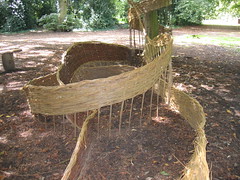
Before long it had a roof supported by a couple of bamboo canes which had finished there summer work in the garden. The door that Daddy had cut into one side had been modified so that it was now in a stable door configuration. A windows and some flowers to decorate were also added.
Then the second phase of play began, the imagining play. Emily had created her own house and she was making the most of this new world.
Hours of fun.
Earlier this week the news was full of reports about a letter written to the Daily Telegraph. The letter was written by academic and professionals involved with children. One of the things this letter was calling for was:
“real play (as opposed to sedentary, screen-based entertainment)”.
Emily certainly had “real play” with her cardboard box.
I know a day is coming when she will probably no longer want to play with cardboard boxes, but I do hope that she will never lose the value of “real play”.
As an adult I sometimes think I need to rediscover the value of “real play”. Anyone else feel like that?
 Yesterday I wrote about the fun of learning the times-tables, and how important I believe fun is.
The sad part of this story is that Emily didn’t do great in her time-tables at school.
She did worse than she was doing at home.
Why?
Because being tested wasn’t fun. Being tested was stressful.
None of us, especially children, perform well when we are stressed.
So why do we test our children so much?
Does someone think it’s good for them?
Why can’t we make the testing part of the fun?
This year is going to be an especially test ridden one because it’s SATS. Having seen one child through it already it would appear, from a parents perspective, that for this whole year education is set aside so that the children can learn how to pass a test. The doubly-sad thing is that this test is all about the school looking good in league tables and has absolutely no value to the child.
The SATS themselves are only supposed to take a few hours, but that doesn’t stop them dominating the whole year.
 My daily schedule means that I am normally sat upstairs in my office before other members of the family (apart from Jonathan) have left. They normally come upstairs to see me before they leave.
Some time later I normally go downstairs to make coffee (decaff at the moment) and do some stretching.
This morning I was greeted by a lounge covered in cards – 72 of them.
I know there was 72 of them because they were 3 lots of times-tables – one for the equation, another for the answer.
Emily is right in the middle of learning her times-tables – and she’s struggling.
We have always tried to make learning fun. I have always believed that we learn more when we are having fun, and others seem to agree.
The Chief Happiness Officer had this to say only last week:
Who says our workplaces have to be so boring, lifeless and meaningless that we can only get people to show up there by paying them to sacrifice their time and energy at jobs that don’t make them happy?
Let’s stop doing that, OK? It’s been proven time and again that both schools and workplaces can be fun, energizing affairs that draw people in voluntarily. It’s also been proven that doing this makes them more effective.
Let’s not settle for any less any more!
I’ve always regarded myself as quite privileged to have a job which for the most part I find fun and energizing. The challenge is that people are constantly trying to burden me with things that aren’t fun or energizing. Sometimes I let me guard down and find myself in a position I don’t enjoy. I’m in a 50/50 situation at the moment which means that a good deal of this week will be spent removing the 50% that is dull and adding to the 50% that is fun and energizing. Removing the 50% of dull is not likely to be a good career move in the short term, but experience has shown me that it pays dividends in the long-run.
Fun and energizing is more important to me than almost any other reward you can give me.
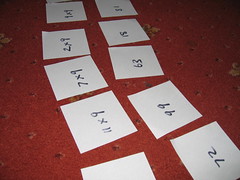 The cards were all part of a matching game. We start with the cards all upside down, and you have to match the equation with the answer. The fun is that you get to play the game with Mum or Dad and beat them. The trick is that you have to say the equations out loud all the time embedding them.
 Having mentioned in one of my previous posts that I started the week with a head-ache a colleague told me that I needed to relax more. I explained that the problem with ‘relaxing’ was that it had no goal associated with it. One of the characteristics of being a male is that I am included to be goal focused, some would say too goal focused. The reverse is also true; no goal- no focus.
Anyhow my colleague decided that she would define the goal of relaxing for me. I copy it here as a form of record, but also so you can marvel, along with me, at the inventiveness of some people:
Goal = Relax, the way to achieve the goal is to sit still for up to 30 minutes per day whilst thinking positive thoughts. You will have achieved this goal if you are successful in sitting still for 30 minutes and not allowing your mind to stray into negative thoughts. You will have surpassed this goal if you find yourself being able to sit still for 30 minutes without having to prevent negative thoughts entering your brain.
No sure, now, whether putting ‘relax’ on my to-do list is a good idea or not. Does reading count, Steve just gave me a copy of Making a Good Brain Best?
 If you read this post regularly you have probably picked up that I get a lot of inspiration from my regular walks before work. Working from home, as I do, I find it’s very important to get my body to wake-up before I get to work. It would be very easy to be really lazy and not move beyond the bounds of the house but that would eventually drive me crazy.
Taking the daily walk wakes my body and my brain.
(This is where I walk most of the time)
Right down the middle of this walk run a couple of brooks, one of them is Savick Brook which travels all the way across Preston and eventually becomes the new Ribble Link Canal.
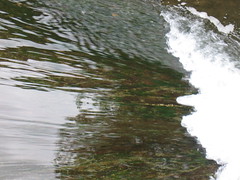
Today these two brooks had been swelled by the last few days (and nights) of rain.
I love to sit and watch rivers like this. I like sleepy river too, but there is something far more interesting about rivers that are gushing. There’s something mysterious about the chocolate brown water rushing by. What is it carrying in the darkness? What will it have washed way when it subsides?
As a child we went on holiday to Scotland – at least I think it was Scotland. I am not renown for my ability to remember childhood events. The cottage we were staying in was right next to a river. There was also a stone bridge carry a track to a farm beyond the river. I have had many wonderful holidays in Scotland where the weather was very kind to us. On this occasion it rained for days, it tipped it down.
At the start of the holiday we could see trout in the river. As the week went on the river at the back of the cottage swelled. The clear water that let us see trout turned into a brown soup carrying sand, silt, branches and all sorts of other debris. We wondered how the trout were surviving in all the turmoil.
The stone bridge that had looked so immovable before started to take the strain of everything being thrown at it. The river became wider than the archway, whirlpools formed at the edges. We watched as branches got sucked into the whirlpools, being spat out further down the river.
 I have glass of water sitting by me as I write. It looks all peaceful and calming. Combine it with profusion of water then tip it down a hillside and the effect is quite different.
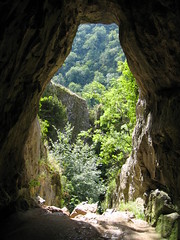
At the weekend we were on holiday in Derbyshire and went to Dovedale. Dovedale is the remnant of a huge cavern which has long since collapsed, but all the signs are still there to be seen. Jonathan and I went up to some of the caves and archways. It was great especially because it was a little precarious at times. Masses of rock, washed away by a river.
The Message uses the picture of a river overflowing its banks to represent some of the words of Jesus:
“When a woman gives birth, she has a hard time, there’s no getting around it. But when the baby is born, there is joy in the birth. This new life in the world wipes out memory of the pain. The sadness you have right now is similar to that pain, but the coming joy is also similar. When I see you again, you’ll be full of joy, and it will be a joy no one can rob from you. You’ll no longer be so full of questions.
“This is what I want you to do: Ask the Father for whatever is in keeping with the things I’ve revealed to you. Ask in my name, according to my will, and he’ll most certainly give it to you. Your joy will be a river overflowing its banks!
“I’ve used figures of speech in telling you these things. Soon I’ll drop the figures and tell you about the Father in plain language. Then you can make your requests directly to him in relation to this life I’ve revealed to you. I won’t continue making requests of the Father on your behalf. I won’t need to. Because you’ve gone out on a limb, committed yourselves to love and trust in me, believing I came directly from the Father, the Father loves you directly. First, I left the Father and arrived in the world; now I leave the world and travel to the Father.”
Our joy at being able to talk directly with God (because that is what he was talking about) will bring joy that will be like a river overflowing its banks! Now that is a powerful joy indeed.
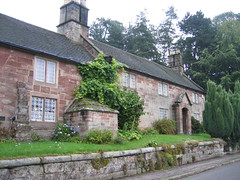 This weekend was a bank holiday in the UK. The Chastney family got together in Derbyshire. We had a good time visiting a few sites.
Driving home through the countryside took ages. The delays were only to be expected as it was a Bank Holiday and were trying to get through Buxton.
I started with a head-ache on the way home, this continued through Monday evening, Tuesday and is now only a dull thud (on Tuesday).
I’m back now though.
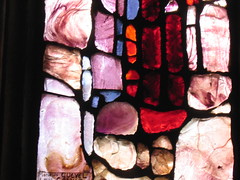 In a post about the use of PowerPoint during the Iraq War, Visual Beings used this term “Visual Illiteracy”.
Some days a phrase gets me thinking – Visual Illiteracy is a new one.
Visual Illiteracy is of course the opposite of Visual Literacy of which there seems to be a lot written.
There’s even an International Visual Literacy Association.
Take your pick of definitions, they all seem to be saying very similar things: the ability to communicate and understand visually rather than in words.
I suppose this fits into my brain series. The right-brained people seem to be the ones who are more likely to be visually literate. Visual literacy is going to be a skill which will be invaluable to people who are needing to be more creative and more conceptual. It seems to be something you can learn.
Having done a small amount of research I am staggered by how many words have been written about a topic that is all about visual. Apparently there is a taxonomy of visual literacy?
tags: visual+literacy, PowerPoint, visual+illiteracy, right-brain
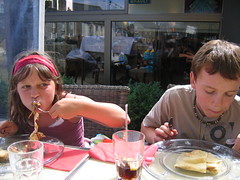 Tonight Sue and I went out to our local book shop and participated in the weekly quiz. Just the two of us.
Until recently this adventure would have required a specially choreographed dance involving a trusted baby-sitters and numerous conversations with Emily to reassure her that everything was going to be OK.
We are now fortunate enough to have a son who is old enough to look after his younger sister. Not only is he old enough, but the two of them get on well enough for us to be confident that there will be no blood on the carpet when we return.
Thanks kids.
 Graham Chastney