Enjoying some birdsong today

I’m working from home today still being the holidays there’s noise around, and I really need to concentrate.

I needed a distraction from the background noise so turned to birdsong.fm for today’s accompaniment.

All I need now is large spare screen to put on one of the walls in this small room so I can glance up at the nice videos to.

There’s also an app if you want to make birdsong a bit more mobile.

A Virtual Desktop Analogy – Rooms and Properties

One of the techniques that I like to use when discussing technology with customers and colleagues is analogy. I find that it helps to break through the barriers of technology terminology and acronyms. It creates a picture in people’s heads that they can relate to.

Granddad wonders what a virtual desktop is?I’ve recently really enjoyed reading the analogy for Virtual Desktops put forward by Andreas Groth on IBM’s Thoughts on the Cloud Blog:

The virtual desktop arena is particularly mired in terminology and acronyms. For starters, what is a desktop anyway? Is it the top of this desk I’m sitting at? Is it the device that’s sitting on top of the desk? Is it the layout of the things on the screens that I am looking at? Well, of course, it’s all three of them depending on the context, even though the device that I’m currently using is a laptop. What does virtual really mean anyway? So when we start talking about shared virtual desktops, persistent virtual desktops, dedicated virtual desktops, local virtual desktops, pooled virtual desktops, etc. it just adds to the confusion. Virtual applications anyone?

Andreas’ analogy uses different residency types (hotels, private residence, etc.) as a parallel for the different virtual desktop types.

  • The hotel is analogous to the basic pooled virtual desktop approach. It has all of the basic capabilities you require. It’s the same every time you go into it because it’s serviced. You’re allowed to take some of your own stuff in, but you have to take it with you when you go.
  • The private residence is analogous to the dedicated virtual desktop approach. It’s yours, you can do what you like inside it. If you break it then you’ll have to fix it yourself, or hire someone in to do a professional repair. You may check into a hotel room while it’s being fixed, but it won’t be home.

He then extends this parallel to look at the different perspectives that people have about the residency – the occupier sees things differently to the property manager.

A really good analogy isn’t there to provide all of the answers, it’s there to help you get a different insight, and this one does.

It provides the insight about why people don’t really like the hotel approach (pooled virtual desktops). They generally have no technical reason, or even a functional reason for disliking it, it’s just that the desktop experience has become personal to them and you can’t really personalise a hotel room. Likewise, some people will, given the choice, always live in a hotel, because they like the way it’s serviced.

Another insight is the difference in costs and charging models. You generally pay for a hotel on a per-night basis, but you take out a longer term relationship for a private residence. Perhaps we are doing ourselves is disservice by viewing them as the same in the virtual desktop world.

I suppose that in this analogy a local virtual desktop on a  laptop is a gypsy caravan. It’s where you live, you can do what you like to it, and you carry it around with you. What do you think?

The 7 Habits of Serious Procrastinators

Anyone like to raise their hand in agreement?

This picture reminded me of this post: I could spend hours doing this…

Domino Delivered by Drone anyone?

Imagine having your pizza delivered by a drone?

Apparently Domino Pizza in the UK are looking into it.

Or perhaps it’s just a publicity stunt?

I’m not sure I’m ready for it just yet, but it does seem almost inevitable, particularly in rural settings where having people drive around the countryside is an expensive thing to do.


Walking and Texting – Modus Erraticus

This video from Improv Everywhere made me smile this morning:

If you’ve walked in any public place recently you’ll relate to the challenge. Once upon a time the people who were a menace on the pavement were people walking a bit slower than everyone else. It was relatively easy to negotiate your way around these people because all you had to do was to execute a simple overtake manoeuvre and you were past them.

Over recent years though a new menace has entered our streets, these are the people who are distracted by the little screen in front of them. The problem with these people is not just that they are generally going slower than everyone else, but that they also behave erratically.

My own particular grievance is with those people who are walking along at a pace keeping everything moving, and then they receive a text. There response to this text is an immediate transition into a new mode which means that they can no longer be relied upon to behave like everyone else, they are now in modus erraticus. This is especially annoying when it’s a member of the group of people that you are walking with.

It’s another example of the massive social change that our response to technology is precipitating. Note here that I’m not blaming technology for the problem, but our response to it, although, I do think that there is a balance to make. The design of technology isn’t completely agnostic in these situations, much of our response to technology is automatic and would require a significant amount of retraining to change.

New modes of being plugged-in are on their way that may less social impact, but I suspect that they will still result in attention problems, just different ones.

The power of sharing

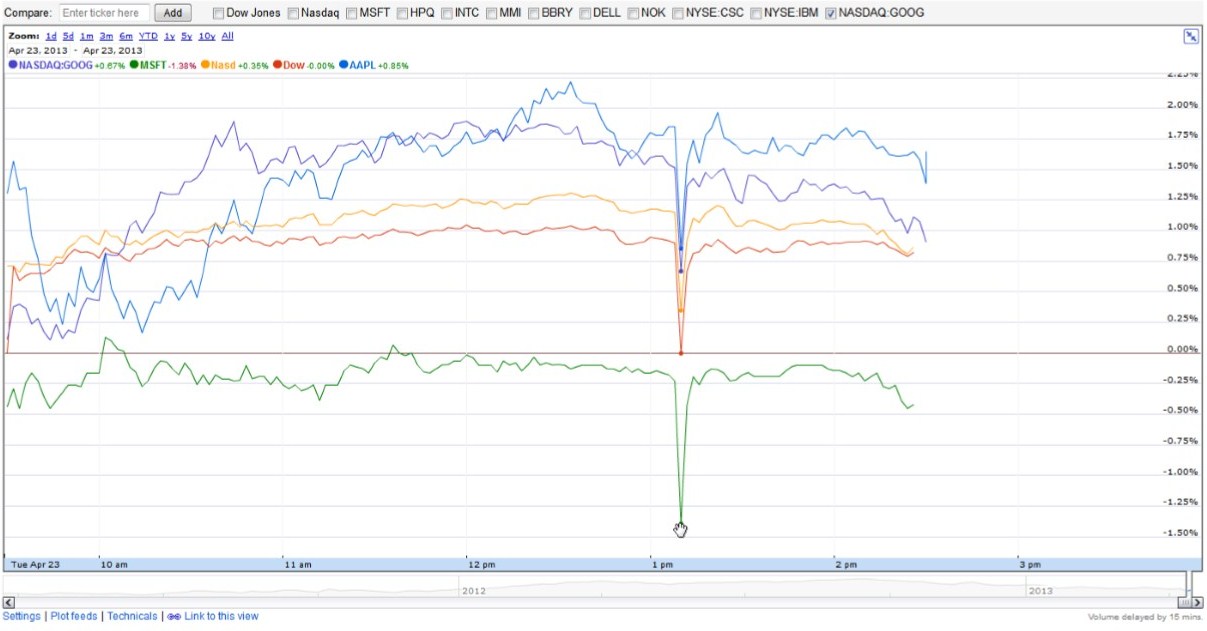
Just as I was writing my post yesterday – Did you really share that online? – another incident was playing out on the US stock market:

Associated Press Tweet

The chart above shows the impact of a single tweet from the Associated Press twitter account on the stock of Apple, Google and Microsoft as well as the NASDAQ and Dow Jones indexes. That dip right in the middle was all caused by a single tweet.

The tweet reported, falsely as it turns out:”Breaking: Two Explosions in the White House and Barack Obama is injured.”

This wasn’t news at all, it was a hack, and Associated Press had to move quickly to quash the false information.

What this demonstrates, again, is the power of the tools that we have available to us to communicate information rapidly. The real power that caused the impact wasn’t, however, with Twitter, it’s with Associated Press as a trusted source of news. The tweet only had an impact because of where it appeared to come from, but it only had an immediate impact because of Twitter’s ability to communicate broadly and quickly.

The problem for Associated Press now is that the level of trust in its Twitter feed has been diminished and the current embarrassment is in danger of having a last impact. It’s the same for us as individuals. If our Twitter (or Facebook, or any other site you’d like to choose) gets hacked the level of trust from others goes down. Associated Press responded decisively and with clarity, it’s a good strategy. We will have to do the same if we are ever in that situation our reputation may depend upon it.

It takes 20 years to build a reputation and five minutes to ruin it. If you think about that, you’ll do things differently.

Warren Buffett

Did you really share that online?

Like people exploring a dark cave system we stumble through the social change that is being facilitated by our ability to share everything and anything with the world.

We are exploring a new world and don’t really understand the consequences of our actions, both personally and socially.

Cromarty to Nigg FerryHere in the UK a teenager is removed (resigns?) from her post as Youth Police Commissioner because of views expressed on Twitter:

Paris Brown, 17, from Sheerness in Kent, said bravado had led to her statements on Twitter, which had offended many people. She said she was resigning from her post as the youth police and crime commissioner for Kent after police announced they were investigating whether her comments amounted to a criminal offence.

Critics claimed the comments were racist, homophobic and condoned violence and drug-taking. Brown pleaded to be left alone now that she was standing down.

Once upon a time the tools at our disposal were quite rudimentary and had limited impact. I wrote a while back about an incident that had led to my own embarrassment. In this I committed the classic reply-to-all mistake and managed to send lots of people an email with the wonderful words – “have you got any slots left for back, neck and shoulder massage?”

In the events that followed the bombings at the Boston Marathon people on twitter and reddit latched on to a rumour about who had carried out the atrocities, only for them to be proved completely erroneous.

Recently David Zax wrote about some of his personal experience:

Email is only one way we communicate today, though, and only one among many web services that include some sort of social, shared, or collaborative component (cf. this “cloud” you may have heard of). And in the past several months, I and people in my social circles have accidentally shared private information we only intended to share with one person, a select few people, or no people at all. There was the week during which I scheduled the likes of personal doctor’s appointments in a communal calendar (partly a symptom of my having bought a new computer, and some hiccups in getting my old device-synching techniques to work under my new setup). There was the moment an old professor accidentally posted sensitive banking information to a shared Dropbox folder. He was lucky that I immediately clicked on an alert pushed to my desktop, saw what he had done, and emailed him about the breach. “This is the way things become a disaster,” he wrote me.

We now have massively powerful tools at our disposal, but we don’t yet have the protocols or the safeguards available to stop us causing ourselves all sorts of damage.

In vehicles we recognise the power that we have available to us, power for good, but also dangerous power. As such we have training and driving protocols. Here in the UK it’s known as the highway code, a failure to use it could lead to embarrassment, but also to legal action. As well as a set of protocols though, we also have a set of safety features built into our vehicles for those times when things go wrong, we also have systems to warn us about things that are about to go wrong unless we do something.

We continue our journey through the dark cave of discovery and the casualties mount up.

Waking up with you Facebook

One of the regular themes on this blog is Information Addiction and our ever present need to be connected.
Loch Creran
There’s more evidence this week about just how connected we are, this time focussed on Facebook mobile usage and a report from IDC:

Depending on your perspective, many of the results are either depressing or confirm what you knew all along. For example, it seems that 79% of smartphone users reach for their devices within 15 minutes of waking up. A clear majority — 62% — don’t even wait 15 minutes, and grab their phones immediately. (Among 18-24 year olds, the numbers rise to 89% and 74%.)

via Mashable.

That’s right, people can’t even wait to go through their morning routine before diving in – wake-up and connect. But it’s not just about the speed of connection, it’s also about the frequency of connection, the average is 14 times a day rising to nearly 18 times a day at the weekend just for Facebook.

According to the report, the average daily time on Facebook on a smartphone is 32 min 51 sec, the total daily time communicating on a smartphone is 131 min 43 sec. That’s right, over 2 hours every day on a smartphone.

Smartphones are powerful tools that are changing the way that we interact. What concerns me is that I don’t think most people recognise it. The smartphone is only just the start of it, watch the Google Glass backlash build even before the product has been released.

ISO Global Standard Numeric Date Format

Every day I find myself reading dates multiple times to be sure that I’m getting the correct understanding, so this made me smile:

How to Measure Knowledge Worker Output? Metrics?

What is productivity?

I quite like this definition:

The quality, state, or fact of being able to generate, create, enhance, or bring forth goods and services

Productivity is also a measure in economics; being a ratio of production output to what is required to produce it.

In purely economic terms that’s an easy measure to make – an organisation spends x to produce good that it sells for y meaning that it’s productivity is simply y/x. But that’s really poor measure to use within an organisation or between individuals or teams, especially when the goods and services aren’t monetary in value.

For a long time now the productivity of knowledge workers has been measured by other outputs, the primary one being the document. The measure of cost being the number of hours required to produce it. I’ve worked on numerous projects where the planning process has primarily consisted of repeatedly asking the question “how long will it take to write this xyz report?” The cost of the project being the sum total of the time required to write the documents. The measured output being a set of documents.

But it’s not the document that people want!

A document is simply a way of recording and transferring information. What’s really wanted are the insights, the information, the knowledge.

Using the measure of the document creates all sorts of distortions. The distortion that I regularly come across can be characterised by the phrase “never mind the quality feel the width”. Because it’s the document itself that is being measured then a document it is that will be produced. There is a hidden viewpoint that reasons the size of the document should be proportional to the amount of time spent on it.

Einstein (possibly) once said:

Everything should be made as simple as possible, but no simpler.

This gets forgotten when time is allocated to a document. I’ve never seen a published hours to pages ratio, but there is a hidden pressure on the author to make the work look credible by providing an appropriate volume of words to support the amount of time spent.

It’s not the number of pages that makes a document more valuable than another, it’s the insight that it contains.

I’m not sure I have too many answers here, but I have been intrigued by people looking to metrics to try and find an answer. The latest has been Chris Dancy now at BMC who has made it his mission to measure all sorts of elements of his life:

Dancy is connected to at least three sensors all day, every day. Sometimes, it’s as much as five. They measure his pulse, his REM sleep, his skin temperature, and more. He also has sensors all over his house. There’s even one on his toilet so he can look for correlations between his bathroom habits and his sleep patterns.

From Wired.

Dancy’s view is interesting:

Soon, Dancy says, companies will start tracking their employees in much the same way he tracks himself. They have no choice. “Enterprise needs new measurements of success for knowledge workers. Today’s knowledge work is measured in really inappropriate ways,” he says.

From Wired.

Dancy doesn’t think that all tracking is necessarily positive, but he’s fatalistic about the future. Even if workers reject more Orwellian surveillance from employers — or companies determine these measures to be counter productive — individual workers will likely use self-tracking to gain a competitive edge.

Perhaps new metrics and “quantified self” are the way forward, but personally that makes me shiver. Most people struggle to adequately compensate for the impact of technology in their life today.

I’m not sure whether I’m ready for this level of immersion but change is on the way, that’s for sure.

Cisco Connected World Techology Report

Over the last few years Cisco have produced a report on the changing attitude of people to being permanently connected.

This years report – 2012 Cisco Connected World Technology Report – has just been released. The report is based on two surveys, one looking into the attitudes of Gen Y, and the other looking at the attitude of IT Professionals.

At the heart of this year’s study is the smartphone and the constant connectivity it provides to work, entertainment, shopping, and friends. There are 206 bones in the human body, and the smartphone should be considered the 207th bone for Generation Y. They view smartphones as an appendage to their beings — an indispensable part of their lives, and yet they are concerned about data management and Internet security.

Who knew that 43% of British Gen Y always check there smart-phone as part of their morning ritual alongside brushing there teeth? It wasn’t much of a surprise to me having seen how many of them check their smart phone while stood at the latrine at work! The French are far less bothered about such things with only 29% always checking. It’s interesting that women are significantly more driven to be connected with 85% of them being compulsive checkers; it’s only 63% of men.

There’s a fun visualisation that enables you to calculate your data footprint, I apparently have a highly connected lifestyle. As you might expect there’s also a report highlighting some of the statistics and drawing some conclusions along with the seemingly mandatory set of Infographics including an interactive one showing the results for the different countries that took part.

The world is changing fast, there are a lot of people who don’t realise how fast.

A bit too social?

A wonderful cartoon from the New Yorker today. I know some people who would think that this cartoon was a good idea:

Speaking personally, there are some things that should remain private.