Force Cafe and Terrace, Ambleside | Graham’s Guides

Food with a fabulous view across the Lake District.

Graham’s Guidelines* Rating (1 to 5)
CoffeeN/A
Food5*
Conversation5*
People Watching4*

On a recent bank holiday Sue and I decided to revisit one of our favourite walks, incorporate a swim and do it all before lunch. Sue even managed a trip to the gym before we set off.

One of the advantages of being close to the Lake District is that you can get into some of the more popular spots before everyone arrives and out again before they decide to leave. Despite our early start we only just managed to stick to our plans, squeezing into the last parking space in Pelter Bridge Car Park at the southern end of Rydal.

There was an interesting encounter in the car park, but I’ll write about that in a different post.

Having completed our 4.3 mile moderate walk and swum between the islands we were ready for food.

There are several good cafe options in this area but on a bank holiday you want somewhere a little away from the tourist honeypots. It was with this in mind that we chose to make a return visit to Force Cafe and Terrace.

We’d been before, only for coffee and cake, it was alright, but not great. That was not long after the launch and sometimes it takes a place time to find the right staff and bed in.

Last time we visited was on our way down from Wansfell Pike having parked in Ambleside. This time, having already done our exercise, we drove up. The road is quite steep running alongside Stock Ghyll which contains a set of waterfalls, worth a visit most of the time, especially when it’s been raining, which it hasn’t done for weeks.

There is plenty of parking at Force, but it’s time limited, don’t expect to leave your vehicle there all day.

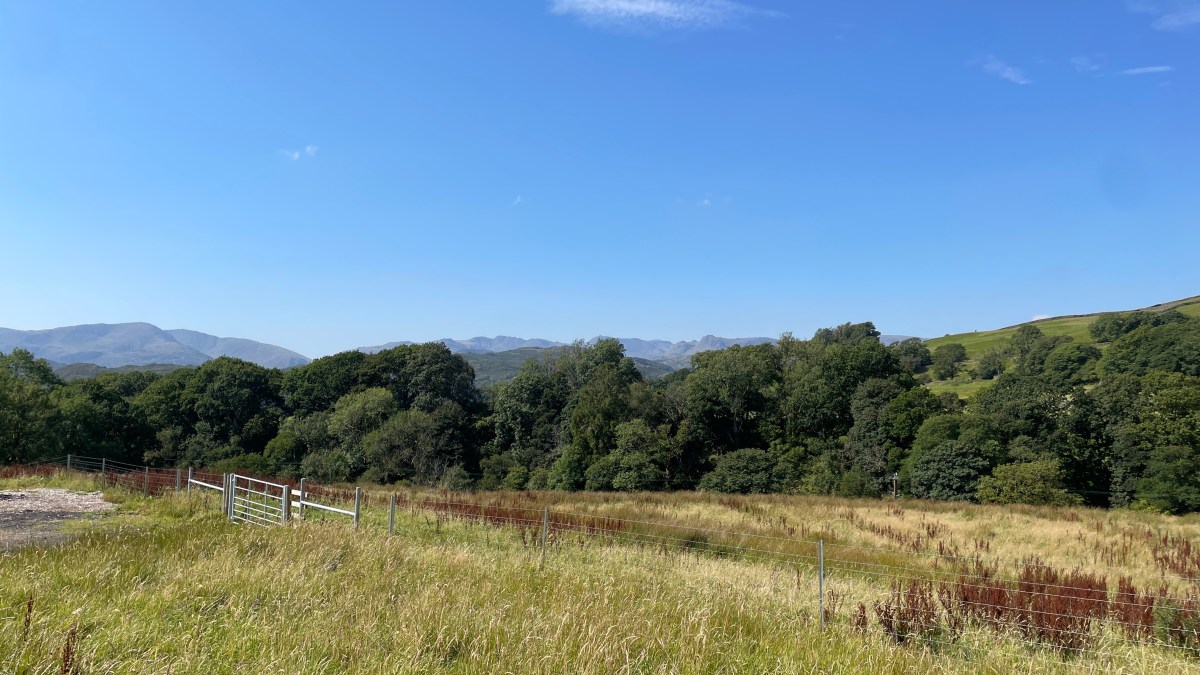
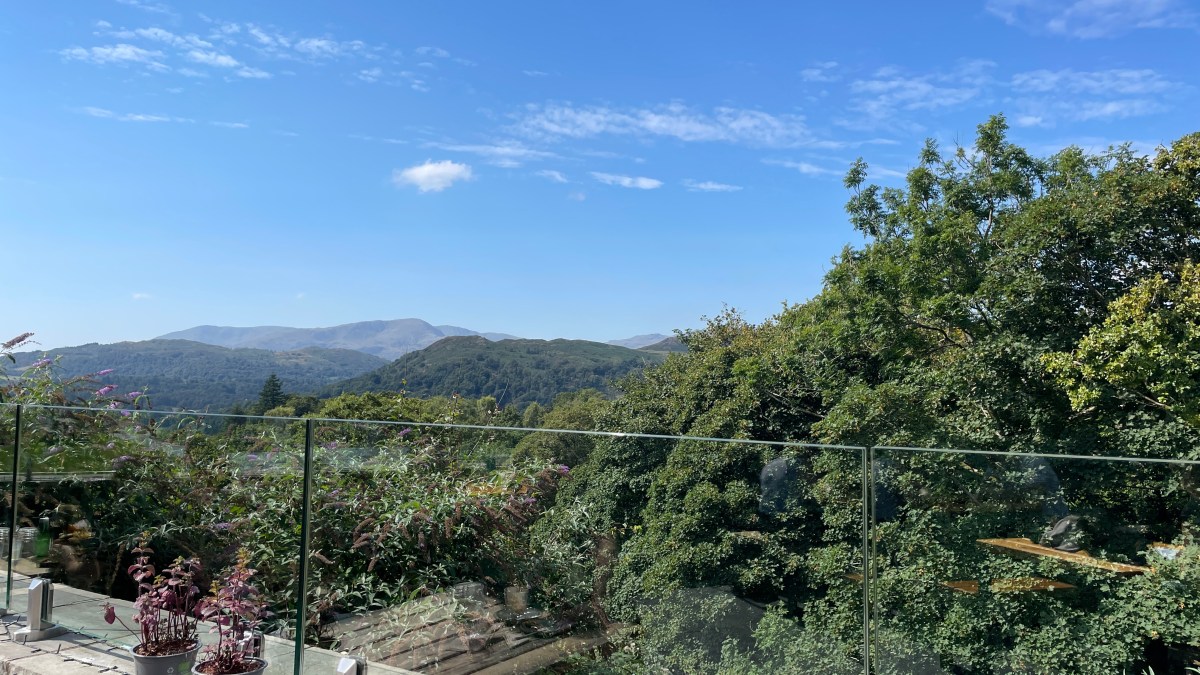
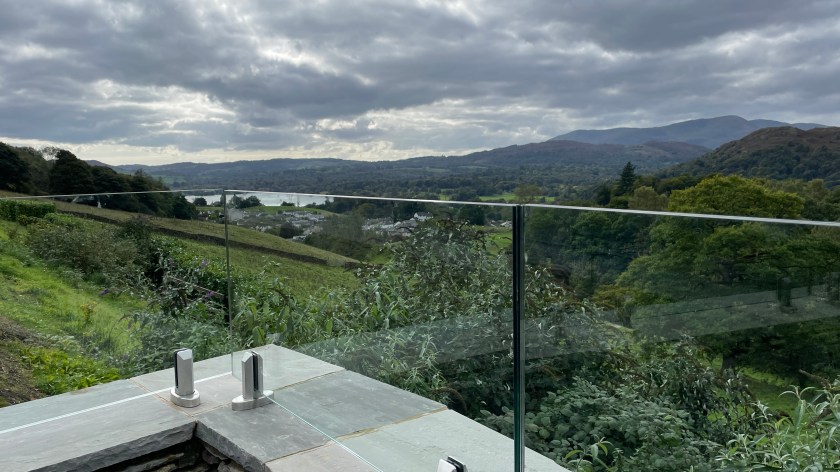
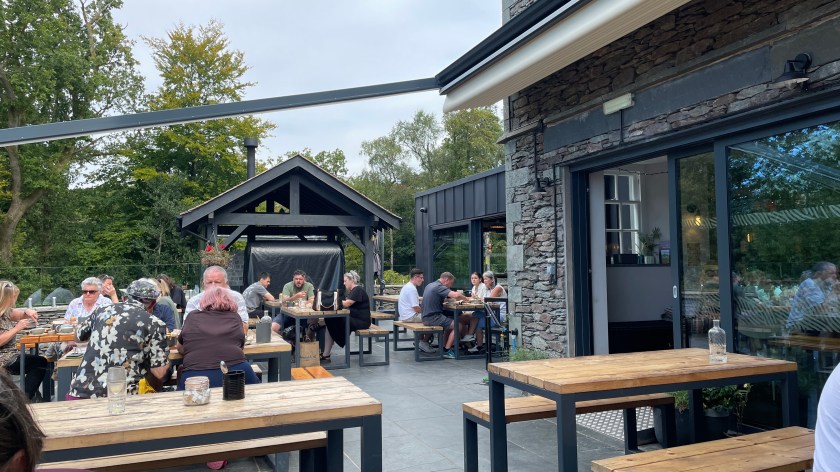
While the inside of the cafe at Force is lovely, the real showstopper is the terrace. I’m not saying that visiting on a good-weather day is mandatory, but if you do, you are in for a treat. On this occasion we struck the jackpot, clear skies with glorious views across the Lake District fells to the west with Coniston Old Man standing majestically in the distance.

There was plenty of people watching to do on the terrace. Several foreign languages and accents, definitely French, others Eastern European and some Asian. There were young people who were barely starting their day, others like us, a little older who had been awake a while. Many dressed for the hills, a few who were more country casual. From the body language everyone commenting on the scenery.

Lunch comprised Apple and Celeriac Soup and Eggs Benedict Rosti with extra bacon. Both were excellent, and so were the soft drinks that we chose for accompaniment. Lots of people were tricking into the breakfast, brunch, options.

The menu at Force is quite limited which you might regard as a challenge; for me a limited menu tends to indicate somewhere that cares about its food.

The service was good, despite the business of the day. We even got into a conversation with one of the ladies serving regarding the various places available for a swim. Neither of us had anywhere new to share in the Lake District, but it was good to find a kindred spirit.

We will be back.

Force Cafe and Terrace
Kelsick Grammar,
Stockghyll Ln,
Ambleside
LA22 0QY

From the terrace on a previous visit
Force Terrace

Silverdale Circular via Scout Wood and The Cove | Graham’s Guides

A favourite revisited, with an added glorious surprise.

Graham’s Walks📌
Distance2.6 miles
DifficultyModerate
Map🗺
GPX📁
Graham’s CafeThe Wolf Cafe

The Area

While we love the Lake District, we are privileged to be surrounded by many beautiful places a bit closer to home. Silverdale is somewhere we have visited regularly even spending holiday weeks. A frequent route for us is a circular walk from Wolfhouse through Scout Wood, across the village to The Cove and back to the car and a cafe stop.

On a recent visit our walk was tinged with sadness; one of our favourite cafes, the one at Wolfhouse itself, had closed a few months before. We have many fond memories of sitting in the tiny cafe, or the outside courtyard having rented the house next to the gallery a coupe of times..

Silverdale sits on limestone which makes this countryside what it is, showing up in outcrops, forming the cliffs and in the miles of drystone walls. While we are reflecting on Silverdale, it’s worth noting that it’s probably not called Silverdale because of the colour or even the metal, it’s far more likely to be a morphing of a Norse word. There are quite a lot of things around the Irish Sea that were named by the Vikings.

The Walk

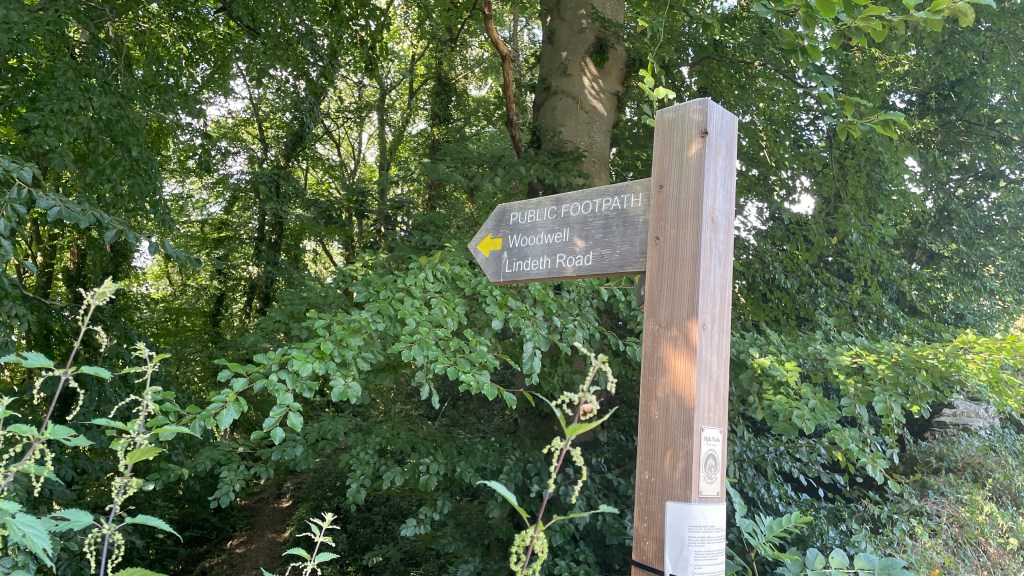
On the map this walk starts from Wolfhouse itself, but on our latest visit we set off from the entrance to Scout Wood which is a little way up the hill from Wolfhouse. There’s room for a few cars there; it’s also a great place to start one of the alternatives to this walk which adds in Jenny Brown’s Point. The entrance to Scout Wood is through a gap in the limestone wall immediately followed by a fork of the path, we take the one to the right, the higher road.

This portion of the walk takes us along the top of a limestone cliff covered in ancient woodland on one side, with pastureland, over the drystone wall, on the other. The cliff is known as Woodwell Cliff reflecting the presence of the Woodwell at the bottom. There is another route around Silverdale that takes in the various ancient wells in the area but that’s not what we have planned for today.

This is sheep country, they are likely to be in the fields on at least part of this walk; this also means that it’s a great walk in the spring when the lambs have been born.

We follow the path along the top of the cliff and through the woods. At the end of the woods is a kissing-gate where the woods opens out. The path takes a bit of a wiggle here to the right and then to the left where there’s another gate following which the route is again defined by the cliff, a wall and some more pastureland.

At the end of the wall there’s a gap to the right onto a path alongside a field and onto a lane known as The Chase.

We are at the outskirts of the village here and about to meet Stankelt Road. At the end of The Chase turn right and then the next left down a lane. At the end of the is a farmhouse and to the left of it is a gate into a field. The path here runs along the back of some houses to the left and opens out to a wonderful view across the open countryside to the right. If you know what you are looking for you can see the outline of the huge Middlebarrow Quarry now disused but providing another variation to this walk.

At the end of the field there’s a small gate onto a lane that takes you down the back of St John’s Church and onto Emersgate Lane. Turn right onto Emersgate Lane and a short way along you will see a narrow lane on the left between two houses. Some would call it a ginnel or even a snicket; the name you use for a narrow lane can define you in the eyes of certain people.

At the end of the footpath you will come out onto Cove Road near to the children’s playground, plenty of fun here for the younger ones, the zip-wire is particularly good.

As its name would suggest Cove Road is what will take us to The Cove. Unfortunately, there isn’t a defined path along the full length of Cove Road so you do have to be watchful for vehicles. It’s generally not too busy and the tightness of the space means that, hopefully, none of the vehicles are travelling too quickly.
Having travelled along Cove Road for a little way the road will take a sharp righthand turn towards Arnside at Cove Orchard and Cove House. We, however, are taking the road off to the left called Cove Lane. Anyone like to guess what the defining feature of the landscape is in this area?

Cove Lane takes you down to the long-anticipated cove. We are quite relaxed about how we name things in the UK despite our love of definitions. A lane and a road have distinct meanings but are used interchangeably in many situations. This is one of those situations; a cove would normally define an inlet of water and here that’s not really the case. It’s a very lovely cutting in the limestone down to the shore, but I’m not sure it’s really a cove. Also, I’m not sure whether to call it a beach.

As you enter The Cove note that there’s a path off to the left, that’s where we are going after we’ve done a bit of exploring.

To the right is a cliff that curves around and in which there is a cave. The cave doesn’t go very deep, but it’s big enough to get into. The clamber up has become smoothed by the many feet that have made their way up and care is required. The house on the land above the cave has a tenuous connection with the Bronte sisters via its original owner Rev Carus Wilson.

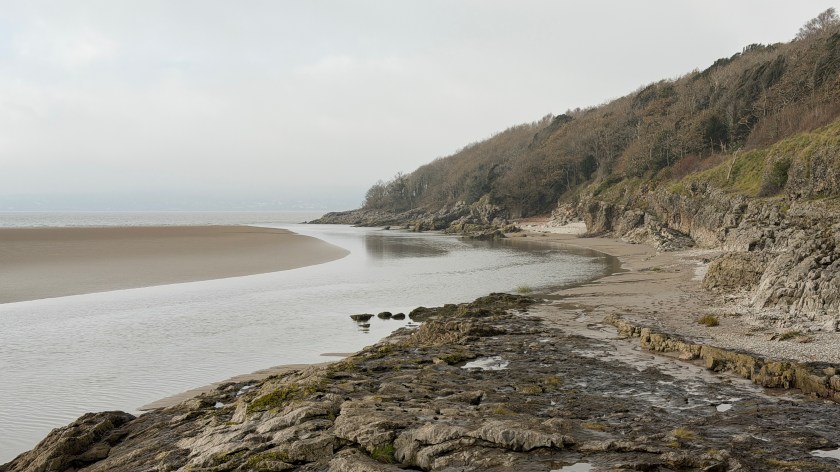
What lies beyond the cove is the flatland of Morecambe Bay which often has an other-worldly look about it. If you are there in the afternoon or evening the bay looks particularly spectacular with the sun on it; the sunsets can be amazing. This isn’t, however, a place you go to for the traditional seaside experiences. You’re unlikely to see any sea, or waves, and I wouldn’t recommend going in if you did; the combination of tidal forces, mud, quicksand and swirling winds can be deadly. If an exploration out into the bay sounds like an appealing idea, the best way of doing it is to join the Kings Guide to the Sands on one of their walks.

From the cove we wander up the path along the top of the cliffs, through a kissing gate and across a couple of fields with further views across the bay. In the far corner of the second field there’s a gate out onto Stankelt Road. Stankelt Road becomes Shore Road as it heads down to Silverdale Beach past the Silverdale Hotel. We are heading along Lindeth Road which is the other option you should see in front of you at this point.

Lindeth Road leads all the way back to Wolfhouse. There isn’t a path all of the way and there are portions of this section where you have to walk on the road. It’s a steady uphill climb back to the car.

As we rounded the corner we were delighted to notice that the cafe at Wolfhouse appeared to be occupied, a board outside confirmed that to be the case, and boasting a new name The Wolf Cafe. We’ve known a few iterations of the cafe at Wolfhouse, and it’s always been an excellent place for a refreshment stop. As we weren’t planning on visiting the cafe our sojourn only involved a drink and a cake so I’m not in a position to comment on the broader menu. The coffee was glorious, the cake was excellent and we’ll certainly be back, perhaps next time we’ll do food. Interestingly the new owners operate the Lone Wolf Bakery in Lancaster.

Alternative and variations

Silverdale has a huge variety of options for a morning, or afternoon, tramp; so many that I’m not sure I know where to start.

Perhaps the best place to start is at the beginning?

As you walk up the hill from Wolfhouse rather than turning left into Scout Wood you can turn right and take the path to Jenny Brown’s Point via Heald Brow and the Copper Smelt Kiln Tower. This will turn the walk into a figure of eight walk bringing you back up to Wolfhouse. You could do the walk the other way around and head down to Jenny Brown’s Point via Gibraltar Farm and the Lindeth Tower coming back over Heald Brow to join the path into Scout Wood. Whichever way you go it’s worth noting that the path near to the Kiln Tower is on the shoreline and changes regularly as erosion and accretion play their part. There’s also the option to explore Jack Scout and the Giant Seat on this route. At the right time of the year Jack Scout has excellent brambling.

Another adaptation would be to take a detour across to Middlebarrow Quarry by taking the path to the right just before you arrive at St John’s Church. This will bring you out onto Bottom Lane. At the end of Bottom Lane, you can head up into Eaves Wood heading right around to the Quarry entrance. You can’t currently get into the quarry, but there are several places where you can get a good view inside. If you head anticlockwise around the back of the quarry you will eventually come out at Arnside Tower via Middlebarrow Wood. From here you could head up Arnside Knott, but that would be another walk altogether. From Arnside Tower you can take the path into the back of Holgates Holiday Park and down the road to The Cove.

If you are feeling like you want to gain a bit of height to get a better view, a short extension to the walk is to head up to The Pepperpot in Eaves Wood on your route to The Cove. The monument marks the Golden Jubilee of Queen Victoria in 1887, but the real star is the view from this elevated position.

From The Cove, given the right tidal conditions, you can follow the shoreline to Silverdale Beach from which you can rejoin the route. If, however, you are enjoying the shoreline walking you can carry on all the way to Jenny Brown’s Point with a couple of options to head back inland along the way, including the option to head into Jack Scout. I can’t guarantee that any of this is going to be possible on any given day such is the fluidity of the coastline around Morecambe Bay.

There are other options for a cafe in Silverdale Village itself where there are also public toilets and a convenience store not far off the route as shown.

Heading into Scout Wood
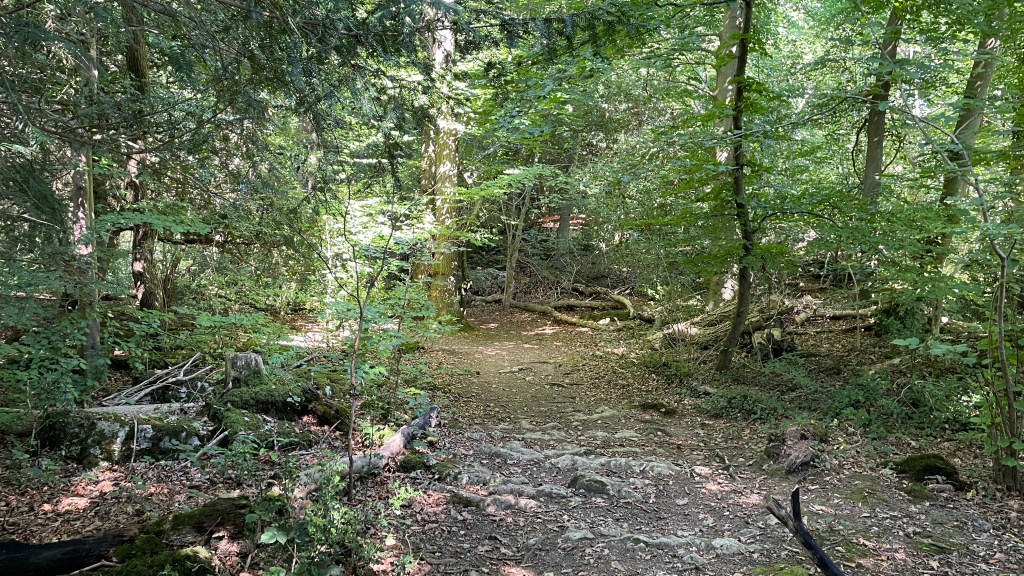
Through the woods
Time to be nosey – peaking into back gardens
In the cove
Across the fields
Gibraltar Farm
The glorious surprise

Office Speak: Word Salad

Is it a mess, a confusion, or is it a salad?

You have walked into a restaurant and order a superfood salad; whatever that really means. I few minutes later the waiter arrives with a plate containing a wonderful selection of grains and fruit, leaves and tomato, nuts and goats cheese. All of the ingredients are placed randomly on the plate yet somehow it doesn’t look like a mess, it looks tasty and delicious.

This is a salad.

You are listening to a corporate communication which is filled with a wonderful array of business speak – synergies, win-win, low-hanging fruit, culture, silos, competencies, wheelhouse, strategic, transformational, world-beating, and actions.

You know what each of these terms means. You think you know the context in which the words are being used and yet, you think to yourself “I have no idea what this person is saying, these words don’t make any sense.” It doesn’t taste delicious, it tastes unpalatable.

This is word salad.

Or perhaps you are in a question and answer session and a tricky question comes up. The person providing the answers starts talking, and talking, and even talking a bit more. They use lots of words, impressive sounding words, technical sounding terms, and yet they don’t make any sense.

This is word salad.

A current colleague has used the term for a long time, but I’ve heard it more broadly in recent weeks and months so decided it was time to promote it to Office Speak.

According to Google Trends there has, since the spring of 2024, been a significant increase in people searching for it.

Some of the increase is related to the release of a word game with the same name that the Sunday Times, no less, described as “the game of the moment.” I’ve never played it so I’m in no position to comment on how good it is, but I do find it fascinating that this semi-obscure term has, in quite a short time, become mainstream.

The increase is likely, also, attributable to the growing group of politicians trying to avoid giving an unpalatable answer. In recent months I’ve noticed the same tactic being deployed by business people to similar ends.

There’s plenty of Office Speak that could be termed word salad.

While salad is, dependent upon your preferences, tasty and healthy, word salad is unpalatable and decidedly unhealthy.

While I am pointing fingers at several groups, the real challenge is that there are still several fingers pointing back at the author. Keeping things simple and understandable is something to which I, for one, need to be vigilant. On a recent project I worked with a person who would edit what I’d written for certain communications. They were brilliant at asking a simple question “Graham, what does that mean?” What I thought obvious was frequently incomprehensible for them, and their English was far better than mine.

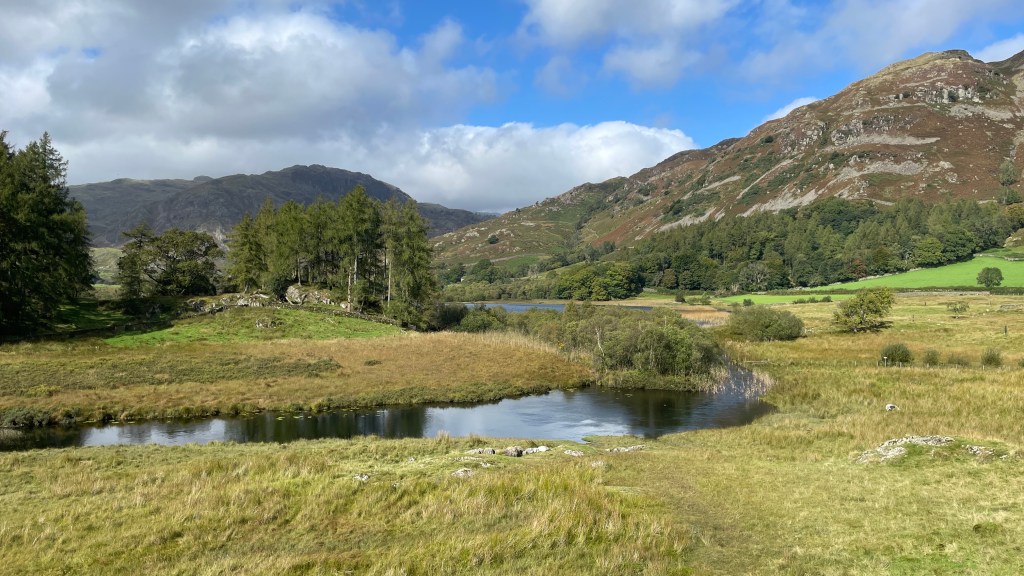
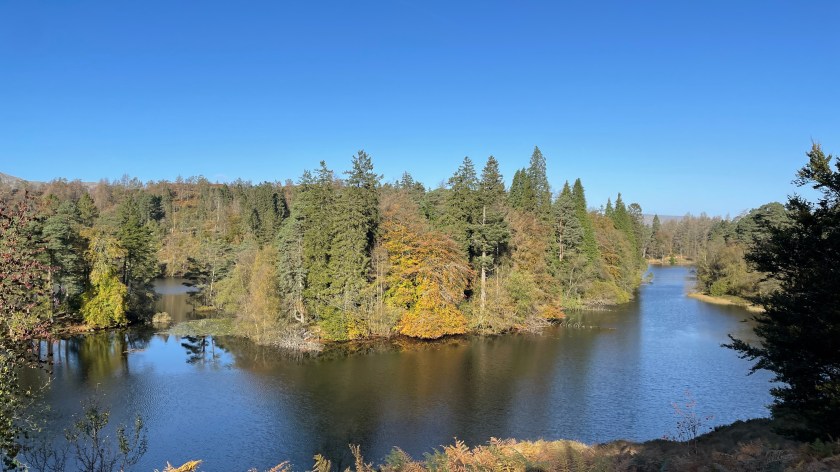
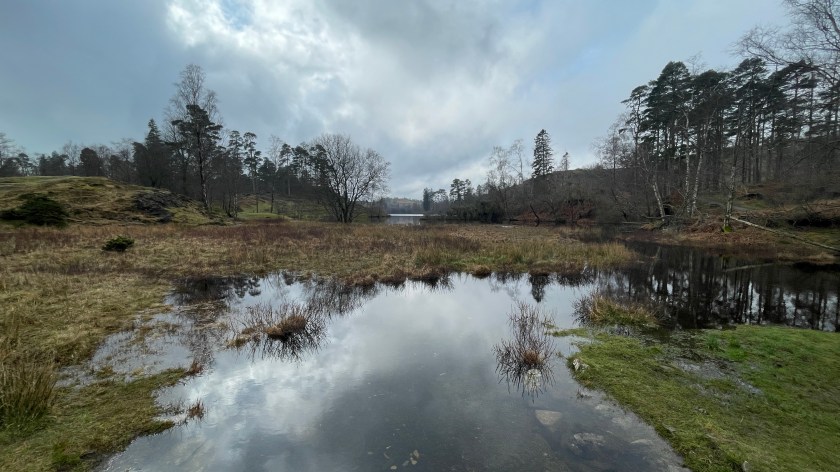
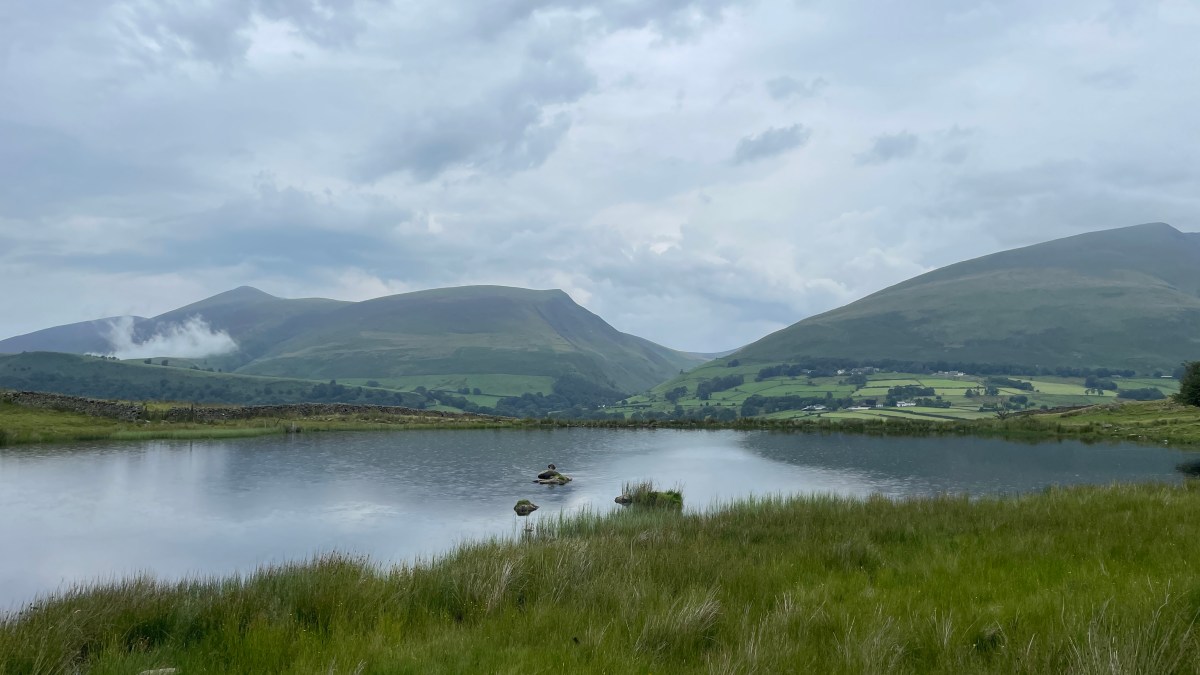
Header Image: This is Tewet tarn which sits in the hills near to Threlkeld and not too far from the Castlerigg Stone Circle.

Beacon Fell Circular – Up Hill and Down Dale | Graham’s Guides

A lovely little walk that takes you up a small hill with a fabulous view, then down dale for even more views. Made for the summer, boggy the rest of the year.

Graham’s Walks📌
Distance3.2 miles
DifficultyModerate
Map🗺
GPX📁
Graham’s CafeNot on this one, but there is a cafe. If you are travelling from Preston The Lookout is on the route through Longridge.

The Area

A conversation from my Polytechnic days has stuck in my mind for over 30 years now. One of the other students who was from somewhere in the south said “We went out to the Forest of Bowland over the weekend, but there aren’t any trees there.”

The area of hillside to the north west of Preston from roughly Whitechapel in the south-west up to Hornby in the north-west, across to Clapham in the north-east and Bolton-by-Bowland in the south-east is known as The Forest of Bowland and designated an Area of Outstanding Natural Beauty.

As my student friend suggests, if you associate forests with trees you’ll be disappointed, there haven’t been that many trees since the 17th century when the land was increasingly used for livestock. We don’t like changing the name of things in the UK.

Just beyond Inglewhite and Whitechapel, and just within the Forest of Bowland, lies a small hill know as Beacon Fell.

It’s currently owned by the local council and operated as country park. As the name suggests Beacon Fell was once a vital part of the national chain of beacons communicating major events a role it’s had for over 1,000 years.

The fell is not very big, but it does sit on the edge of the west Lancashire lowlands giving it spectacular views across to the mountains of both Wales and the Lake District. On a day with good visibility you can see the Isle of Man, most days you can see the Manx ferry making its way in-to, or out-of Heysham. In the opposite direction you get great views of the more substantial Forest of Bowland fells including Parlick and Fair Snape.

As a country park Beacon Fell has good facilities with several car parks, lots of good paths and even a visitors centre with a cafe and toilets.

The Walk

This walk starts from the Sheepfold Car Park. There are a couple of reasons for this, the first is that this car park is free, unlike the one at the visitors centre although the one at the visitor centre only charges £1 for the day. The second reason is that there’s a back route to get here without travelling half of the circular one-way road around the fell.

I’ve called it ‘up hill and down dale’ because that’s the order I did the walk. I tend to prefer walks that go up and then come down, even if that means going down first to go up. This walk goes the other way around, you finish by going up, there’s really no way of avoiding that as the car park really isn’t very far from the top. You could minimise the amount of up at the end by doing the walk the other way around, that way around the walk back up to the car park wouldn’t be as steep.

This walk starts on the wide, well marked, paths of the Beacon Fell Country Park travelling around the park first before veering off into the surrounding farmland.

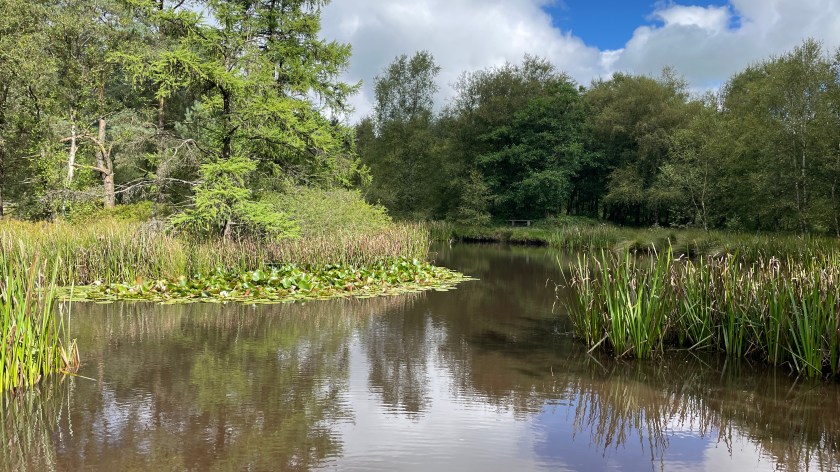
From the car park we are heading towards The Tarn along Larch Avenue which was previously the road up to a farm which stood where the visitors centre is now. It’s worth spending a little bit of time at The Tarn where the Dragonflies and Damselflies can be glorious.

There a little bit of tricky navigating here if you want to follow the same route as me, there are several paths that all converge here. You are aiming for the circular route that takes you between Quarry Wood and Quarry Car Parks. Don’t worry if you miss this and find yourself on a different route to the summit, that’s where you are heading eventually.

Part way along the circular route there’s a short cut-back connecting path that puts you on a path to the top. It’s worth taking what feels like a detour to experience the views on any day, but especially when the visibility is good.

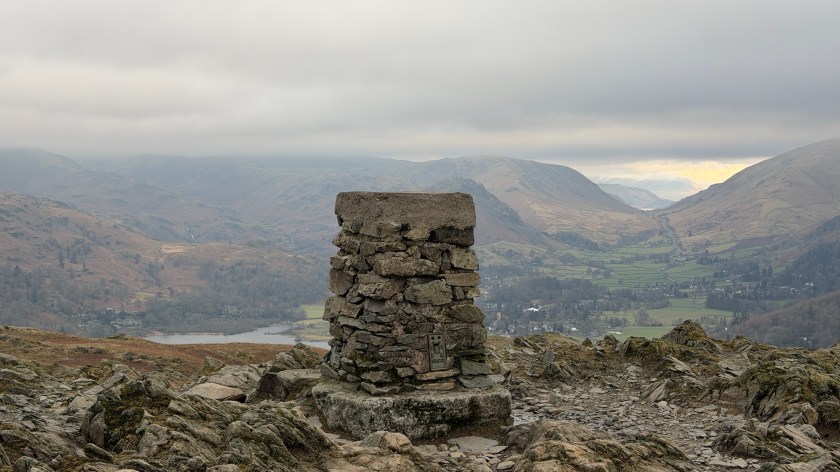
Having reached the trig-point at the top it’s time to head back down to the circular path, but only for a short while. You are aiming for a point on this path where there is a sculpture known as The Lizard Love Seat on your left and a gate with a path heading down hill on your right which will take us down-dale.

Up to this point you could travel this walk almost any day of the year, beyond here we start to move into farmland and some of it is particularly boggy, so I don’t recommend it as a winter walk. This year has been dry for weeks and it was still wet in places. There’s no need to do this piece of the walk, if you want to get back to you car you can simply stay on he circular route. This part of the route is there to add interest and some different views.

At this point you should be heading down to the circular road then across the road down toward Sagar’s Farm (no idea who Sagar was), the path is marked by some nicely placed yellow topped posts. Before you get to Sagar’s farm, though, you’ll reach a not very well defined hedgerow cutting across your path, at this point you want to turn left along the line of the hedgerow.

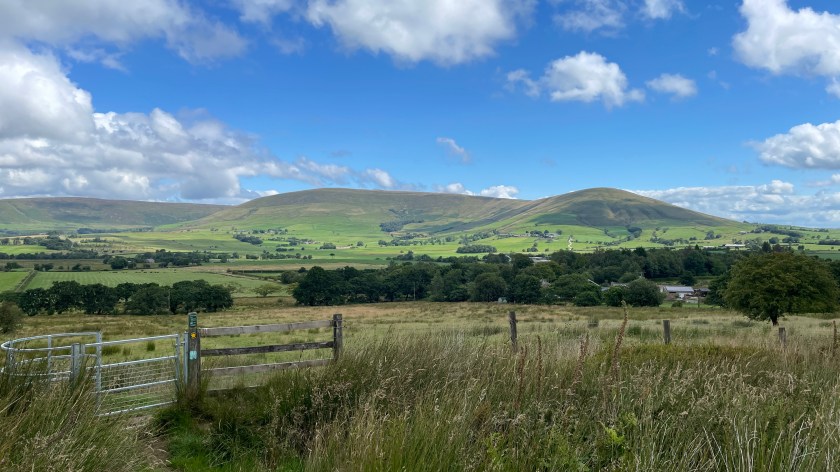
The views of the Forest of Bowland Fells from here are spectacular. If you are fortunate you may even see a glider heading off from the nearby club, paraglider are also quite common floating off the top of the larger fells.

You are heading toward North Nook across a series of boggy fields via a set of stiles, each one marked by a yellow pole. All you have to do is find the stiles which isn’t always easy.

Just before North Nook you cross a road and along a path that feels a bit like you are walking through someone’s garden. Across the garden are two stiles close together. Once you come out the other side you are looking for a tall stile which isn’t quite where it’s marked on the OS map.

You’ll now make your way through some young woodland and then out into some more open scrub. You are looking for a path heading left on a steep incline. You are heading up into an area known as the Rosemary Bullivant Memorial Forest where each of the trees is dedicated to someone.

From the Memorial Forest you work your way to the right either via the visitors centre and toilets, or a less travelled route via the Jubilee Memorial.

There’s a path from the end of the visitor centre car park, across from the Orme sculpture, that takes you back up onto Larch Avenue and back to the Sheepfold car park.

Alternatives and Variations

There are so many variations to this walk I nearly didn’t write any. The country park is criss-crossed with paths that you can use to shorten or elongate this walk. I’ve already mentioned the option of missing out the down-dale part but then it would only be half the walk.

You can start the walk in one of the other car parks the walk passes nearby to most of them.

There are several sculptures around the park; this route only passes a couple of them, you can add in more of them if you head straight to the top from Sheepfold, passing the Heron, the Walking Snake and the Bat as you go. From there you can partially double back down to the tarn, or head down to the circular route and the Lizard Kissing Chair.

On the map there are various options from extending the down-dale part of the walk also, but I’ve not walked any of them so can’t comment on their suitability.

Larch Avenue
The Tarn
From the top
Some more of the view from the top
Across the boggy bit – look out for the yellow topped posts
The view across to Parlick and Fair Snape from the down-dale bit
Back to the top

No.15 Cafe House, Macmillans, Penwortham | Graham’s Guides

It’s time for brunch, and a glorious brunch it was too.

Graham’s Guidelines* Rating (1 to 5)
Coffee4*
Food5*
Conversation5*
People Watching3*

It’s Saturday morning and we are looking forward to spending most of our day as guests at a wedding. The timing of weddings makes for interesting eating. It’s called a wedding breakfast but that’s happening later in the day and it’s traditional that the wedding itself happens at about the time you would normally be eating your lunch. Experience has taught us that the best way to prepare for a wedding is to have a good breakfast, or brunch, which will see you through to the wedding reception.

Our chosen location is not new to us, we’ve been on many occasions. I suspect that Sue and I have had a similar brunch on a similar occasion, Sue might even remember the exact day and occasion but my memory doesn’t work that way.

If the truth be told, we’ve visited often enough that we know the menu and our order is set before we’ve walked in the door. That doesn’t stop us both reading the menu thinking that we might do something different. We don’t, we know what we like. It’s poached eggs on granary toast with bacon or sausage and topped off with mushrooms. To drink we will both have some orange juice and a black americano. The coffee is Carvetii which is roasted in Threlkeld, not too far from where Sue spent her early years. It’s a full body roast which is well prepared in the No. 15 espresso machine.

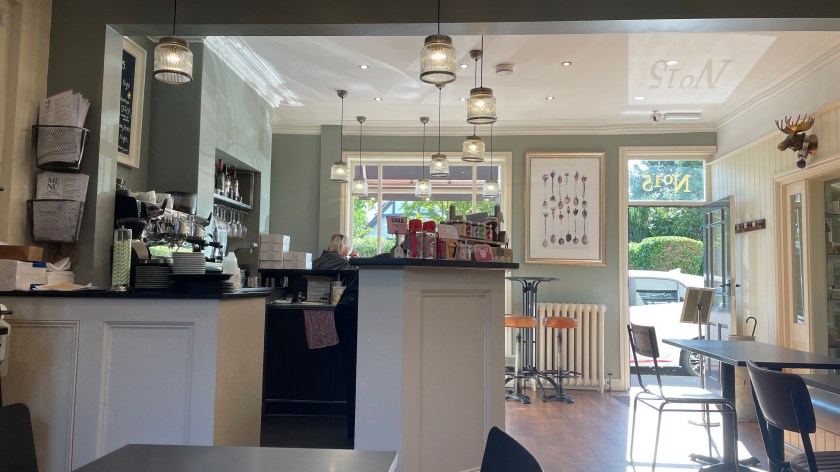
No. 15 Cafe House is a cosy place hidden away from Penwortham high street on the quieter side of Priory Lane adjacent to, and connected with, Macmillans gift shop.

The display of cakes is always a delight, but they aren’t on the order for today.

There’s normally parking available on the street outside, but even if there isn’t there’s plenty of on-street parking around.

It’s advisable to book, we didn’t, but there were only the two of us.

We settle down and talk through the people we think are going to be at the wedding. Weddings are great occasions for reconnecting. We’ve known many of the people who will be there a very long time.

It was quiet on this particular visit which meant that the people watching was somewhat restricted. Everyone quietly getting on with their Saturday morning. The most notable thing was a man who had the full breakfast, which is substantial, buying some of the rather large scones, on his way out, stating that he would be eating them for his mid-morning snack. I was impressed by his ability to eat anything mid-morning after such a feast.

The food is, as ever, excellent, the staff are warm and friends, and the coffee is good.

Food eaten, I decide to indulge in a second cup of the Corvetii while Sue does a tour of the gifts having previously reminded herself of the upcoming events requiring a card, gift, etc.. If it was left to me we wouldn’t send anything like as many cards even though I know how much people value the connection that they bring.

Coffee drunk it’s time for the rest of a very special day knowing that we’ve taken on the calories we need to see us through to breakfast.

No. 15 Cafe House,
Macmillans of Penwortham
15 Priory Lane,
Penwortham,
Preston
PR1 0AR

No. 15 Cafe
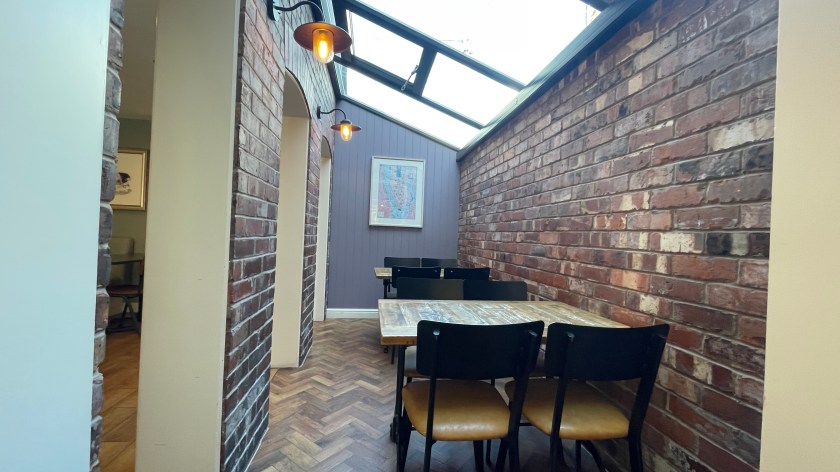
In the conservatory

“You did what?” I switching to a MacBook as my ‘home’ laptop

The joys and frustrations of retraining myself to use a MacBook after decades as a Windows person.

For personal reasons it became an opportune time to refresh the device that I use for ‘home’ and for the first time I chose an Apple MacBook.

You did what?

There are people for whom the choice between Windows and Mac is almost a religious one, I’m a bit more pragmatic than that, I want what makes me productive.

A long time ago there were the famous and celebrated Get a Mac adverts which pitched PC v Mac, these adverts had the opposite effect on me and pushed me away from the Mac.

For most of my working career I have been a Microsoft Windows user, before that I was a DOS, VMS, UNIX and MVS user. If you don’t know what most of those acronyms mean, then don’t worry about it all they indicate is that I have been using Windows for about as long as it has existed.

In many ways, Windows is how I think when I look at a screen.

My ‘smart’ mobile life, however, has been almost exclusively Apple iPhone and iPad. Again, there was a time before the iPhone when I spent a lot of my life bashing away on a Blackberry Keyboard, but that’s a different history.

For the last couple of years, I’ve also been an Apple Watch wearer. So even further into the Apple ecosystem.

My employer is heavily Microsoft Windows, and I don’t see that changing anytime soon, so Windows isn’t going anywhere for much of my life.

I considered not having a “home” laptop at all, after all surely I can do everything I need to do on an iPad? Why do I even need a full-fat operating system?

Decisions are always a mixture of logic and feelings; in this case it was the feelings that won. There really wasn’t a deal breaker with any of the options I was considering, there were some things I really liked about the MacBook, so I purchased a MacBook.

Impressions so far

My first concern was how long it would take me to become productive.

So much of what we do on our devices has become instinctive, we don’t really think our way through the menu options or the keyboard shortcuts, we just use them when we need them. I have developed a way of working in Windows that I think is efficient, would the MacOS get in the way of that?

There has been some frustration along the way, but for the most part things are working quite well.

Thankfully I’ve not had to replace any apps, what I use is either available on both Windows and Mac, or I already prefer the Apple version from my iPhone.

Some time ago I switched to a desk setup that made use of a USB-C switch the connected to a suitable power supply for my work Windows Laptop, peripherals, monitor, etc. I was delighted when I first plugged my MacBook into this set-up and everything just worked.

It took me less than a half a day to get to a working setup that gave me 80% to 90% of what I needed to be productive.

I’ve found most of the interface changes easy to get used to, even the closing of a window which is in the opposite corner for a Windows person.

Further Joys

I might be giving up on Windows for personal use, but I’m not giving up on Office just yet. I use OneDrive for storage, my email is in Outlook, I’m used to using Excel, Word and PowerPoint. In the past Office on Mac was clunky and didn’t really feel like it was either Office or a truly Mac. From my experience so far those days are thankfully behind us.

I’m a big keyboard-shortcut user and for the most part these are the same between Mac and Windows, although some of the keys are in different places. The basic set using the same letters – cut (command+x), copy (command+c), paste (command+v), undo (command+z), select all (command+a).

Before I purchased the MacBook several people raved about the Apple processors and the amazing battery life that this enabled. So far, I agree with them wholeheartedly. I’ve been working away from home for a few days this week and several times a day I’m having to find power for my work HP Z-Book, but the MacBook that I’ve used almost as much is still sitting at 70% battery. I didn’t think that the battery issue was one that would really impact me, but I’ve been surprised by how much I’ve noticed it, or rather, not noticed it, I just assume that the MacBook has power.

I am loving the ecosystem integrations. Having photos on my MacBook is brilliant, when I write the Graham’s Guides having the photos there, on a map, is excellent. Not having to switch to my iPhone to send a message is another one.

I am privileged to have a Windows laptop with a camera that supports Windows Hello for authentication, something that just works. I wasn’t looking forward to using the fingerprint reader on the MacBook, but little did I know that Apple had built in Apple Watch proximity recognition so for most of the time I don’t need to.

The physical build quality of the MacBook is so good.

Some Frustrations

My primary annoyance is that some keys are in different places, the main one being the swap of the @ and the .

The other strange one that keeps interrupting my flow is the position of the command key in comparison to the ctrl key on Windows keyboards. I’m still having to look down to find the command key, finding the ctrl key on Windows is still second-nature.

I do miss the home key and the end key; it’s taking me a long time to make the mental shift to command+right-arrow and command+left-arrow. This is particularly irksome when I use an external keyboard that also has a home and end key that both do something very different to their function on Windows.

Another key I miss is the Windows key as a rapid way to access the Windows Start screen. I quite regularly start applications by pressing the Windows key and typing the name of the app. Spotlight via Command-Space is another mental shift I haven’t yet got used to.

Mouse scroll direction is another interesting one. When I sit at a desk, I like to use an external keyboard and an ergonomic mouse. The mouse has a scroll wheel – the default scroll on the MacBook is in the opposite direction to Windows. I can change this, but I haven’t yet decided whether I want to, I don’t want to be one of those people who buy a Mac and set it up to work like Windows. I’ve also toyed with the idea of changing the direction on my Windows setup.

When I am working on multiple screens, I would love the Mac Dock to be visible on all of them, that’s a personal preference I know, but seems like such an obvious thing to do. The option to automatically hide and show the Dock goes part way there and may become my option of choice.

Yet to be Fully Explored

I can’t honestly say that I’ve properly explored the capabilities of the MacBook trackpad. I’ve never been a huge fan of any of the trackpad technologies, even on Windows, so I’ve got some way to go before I can honestly say I’m proficient.

I like the way on Windows that you can navigate to the window that you want from the taskbar, control+click on the app icon in the Dock doesn’t yet feel as intuitive.

The Apple Watch recognition works most of the time, but sometimes it doesn’t and then I need to enter my password. I’m not sure why this is; the cause doesn’t seem clear.

Finder and the way it’s structured still feels a bit strange, I’m not even sure I know what it is, but something makes me wary of it. One little example is the file save dialogue in applications, on Windows it seems obvious how to create a new folder, this isn’t obvious to me on the MacBook.

Other Oddities

I have a Bluetooth keyboard and ergonomic mouse that support multiple connections. I’ve used this combination to support both my work and home laptops at the same time on my desk. This makes for relatively easy switching from device-to-device, I say “relatively” because the keyboard switch is very easy having physical keys dedicated to the different input, the mouse also has a button to switch, but it’s tiny and it’s on the base of the device. Having to pick up the mouse and press a tiny button only takes a few seconds, but the fact that it’s a two-handed operation makes it feel like an utter faff. I suspect that there is a combination of keys on the mouse that will do the switch, but the manual for this model doesn’t mention one. I may have to investigate an alternative; I’ve had this mouse a long while.

This blog, and others, was first written in Typora, a markdown editor, the license nicely includes the ability to run more than one device. I was really pleased to experience that the Typora app on the MacBook is just as good as the Windows version and I can run both at the same time.

Concluding

I’m very happy with my purchase; the joys are outshining the frustrations. There is certainly some confirmation bias in this statement, but it would be a strange situation if there wasn’t. There isn’t any buyers remorse.

Header Image: This is Crummock Water on a glorious day just before we went for a swim. Crummock can get quite busy in places, but it can also be gloriously tranquil if you know where to look.

Atkinsons The Castle, Lancaster | Graham’s Guides

One of Lancaster’s emporiums for the coffee lover

Graham’s Guidelines* Rating (1 to 5)
Coffee5*
Food4*
Conversation5*
People Watching4*

Atkinsons is a highly regarded, award winning, coffee roaster in Lancaster, also known as coffeehopper on social media due to their logo. They operate three cafes within quite a small area of the city. On this occasion we are visiting Atkinsons at Lancaster Castle, we’ll cover The Hall and The Music Room another time. There shop, near to The Hall, is itself a wonder to behold.

Each of the Atkinsons cafes in Lancaster serves the same great coffee, but has a different feel. Atkinsons The Castle is, as the name suggests, within the grounds of Lancaster Castle which has stood on these ground for nearly 1,000 years dating back to the Normans and probably before. Prior to its most recent refurbishment the castle was, until 2011, a prison. One quirk of this history is that Lancaster Castle is still owned by the Duchy of Lancaster and hence by the Sovereign (the King).

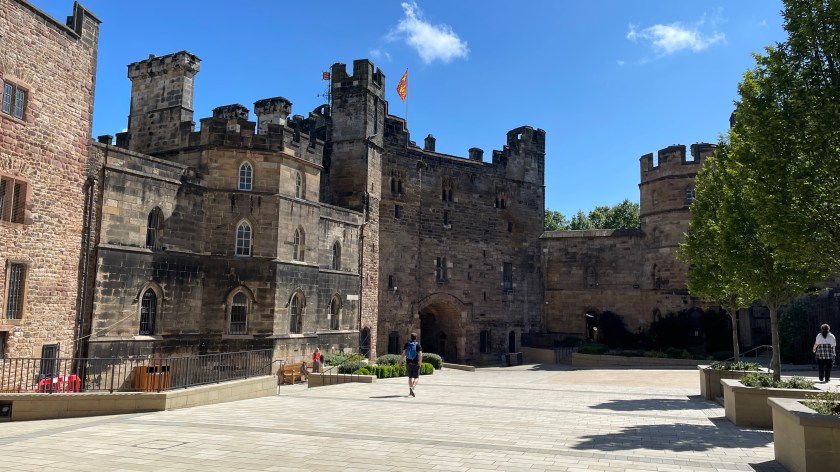
As you enter the castle square through the imposing keep you can feel the history everywhere. The Castle Cafe is in an opposing corner to the castle keep to the right. The cafe sits in what was a portion of the castle kitchen and a newly covered area with glass doors opening out into the square. The seating is within the new area with additional seating outside in the square. If the weather is good you should expect to loiter for a while to get an outside seat. The whole place looks particularly atmospheric on a dark winter’s day.

On this occasion we are making a quick visit for coffee and cake. We are rewarding ourselves having just been to give blood at the local hospital.

This isn’t a place to visit for a huge lunch, or even brunch, the food menu is limited to cakes, pastries and sandwiches, which are always excellent.

Today we are sticking to the house Americano based on their Archetype blend, but this wouldn’t be Atkinsons if there weren’t choices for the coffee connoisseur and here at the castle they are offered as speciality pour-over brews. The menu of pour-over changing on regular basis depending on what is in season.

They also do speciality teas at the castle, but I’ve never tried one so couldn’t comment. If I’m coming to the castle I’m here for the coffee.

Each of the Atkinsons cafes attracts an eclectic mix of people making for excellent people watching – the flirty couple on the high table, the family outside over-reacting to a solitary wasp, the two ladies in dry-robes on a glorious warm and dry day in the middle of a city, the arty student in the corner typing away on his MacBook wearing expensive beige coloured over-the-ear headphones, the older gentleman sat outside in his summer hat.

You do have to be able to walk up a short steep hill on cables to get to the castle whichever way you come.

We normally park just down the hill from the entrance on Castle Hill, accessed via Market Street, where there are a few roadside pay-and-display/RingGo spaces.

Atkinsons The Castle
Castle Hill,
Lancaster
LA1 1YN

https://www.thecoffeehopper.com/locations/lancaster-castle/
https://maps.app.goo.gl/soF71NU7pD6Vfc7T9

The Castle Square
Atkinsons The Castle on a Wet Lancashire Day
A day for sitting out
Looking up at the keep on the way in

The Lingholm Kitchen and Walled Garden, Portinscale, Keswick | Graham’s Guides

A great place to start a walk, a good stop part-way through a circular ramble and an equally great place for sustenance after a bimble.

Graham’s Guidelines* Rating (1 to 5)
Coffee4*
Food4*
Conversation5*
People Watching4*

The Lingholm Kitchen and Walled Garden sits near to the shore of Derwentwater just outside Portinscale which itself is just outside Keswick. It’s location sites it just off the circular walking route of the lake and not far below Cat Bells making it an ideal start, finish and stop-off point on several walks.

On this occasion we were meeting some good friends who were just finishing off a week’s holiday in Keswick. After warm hugs I was greeted by the words “‘You’ll struggle to get lost’ you said” as one of our friends lifted up her arm showing a graze on her elbow. It felt strange having my words repeated back to me. While in the area our friends had decided to follow my Tarn Hows Circular via Tom Gill guide, a confusion at the beginning had led them along a completely different path to the one I’d intended them to follow. It turns out that their route was a lot steeper than the one I’d guided and some water on a rock had resulted in a fall and the displayed wound. I’ve always regarded the beginning of any walk as the most dangerous part for navigation, get it wrong then and you are always going to be wrong.

We laughed a lot during our time together and it was wonderful to catch up.

There’s a good car park at Lingholm which you do pay for. The parking fee is currently £5 for 3 hours and has been for a long while, but you will get £4 of this back when you pay in the cafe. The car park is a short walk from the cafe itself, but there is also accessible parking which is accessed via some electric gates for which you need a code. The code is obtained by calling the cafe.

You access the car park from a driveway that is well signposted from the Portinscale to Grange road which winds around the ‘back of the lake.’ I’ve always known it as that as that’s what the Keswick locals call the area on the other side of Derwentwater. The car park is near to the end of the driveway with additional room running alongside the driveway itself.

Further along from the car park is an entrance through an archway which takes you into the grounds of the Lingholm Estate. Follow the path along the stream, around the field where there are often Alpaca, past the entrance to the walled garden and up onto the veranda entrance to the cafe.

Take time to look around as you walk though, this place has an interesting history. The large house behind the cafe was a regular holiday rental for the Potter family. From the age of 19, Beatrix Potter spent 10 summers here, over a 20 year period. These are the days when a summer holiday lasted a couple of months and the house had to be big enough for servants. Some of Beatrix’s most popular stories were inspired by these grounds. The drawings of Owl Islands in The Tale of Squirrel Nutkin were based on St Herbert’s Islands on Derwentwater which is just across from the shoreline. The cottage gardens at Lingholm was one of the inspirations behind Mr McGregor’s garden in Peter Rabbit.

It’s worth wandering around the walled garden and imagining being here at the end of the nineteenth, start of the twentieth century, before either world war.

The cafe itself is constructed with a glass wall down one side giving views of the Skiddaw range of hills and making them some of the best cafe views in the Lake District.

Lingholm Kitchen is another cafe that serves Carvetii, which is roasted just the other side of Keswick in Threlkeld, they know how to make a good coffee. The cakes are always good with the scones being a particular favourite. Sue and I have been known to order a cheese scone and a fruit scone then split them half-and-half. We’ve regularly used Lingholm as a lunch stop, there’s always something interesting on the specials board with the soup being a regular choice there’s also much that we like on the regular menu.

I’m a few cafe guides in now and I’ve realised that I need to do a better job of taking pictures that show the places themselves. Apologies if the few in this one don’t really give you a good view of what type of place it is. I do have lots of pictures of shelves of cakes, but that’s not very helpful if they have different cakes on when you go. Why do I have lots of pictures of cakes? It’s the easiest way of explaining to people what the options are without each one of us going to the counter to see. Did I mention that the scones are always a good choice?

The Lingholm Kitchen and Walled Garden
The Lingholm Estate,
Portinscale,
Keswick,
Cumbria,
CA12 5TZ

https://thelingholmkitchen.co.uk
https://maps.app.goo.gl/GKvMm1VV595duogP9

Scones are always a good choice

Roberts & Co Coffee Roastery & Espresso Bar, Cedar Farm | Graham’s Guides

For us, these seats carry a lot of nostalgia.

Graham’s Guidelines* Rating (1 to 5)
Coffee5*
Food4*
Conversation5*
People Watching4*

There are some cafes that are just right for a summers day with great outdoor seating and fabulous views, there are other cafes that are a cozy place to hide on a duller day. The Roberts and Co Roastery and Espresso Bar at the back of the Studios at Cedar Farm is lovely at any time but comes into its own when the weather is more inclement.

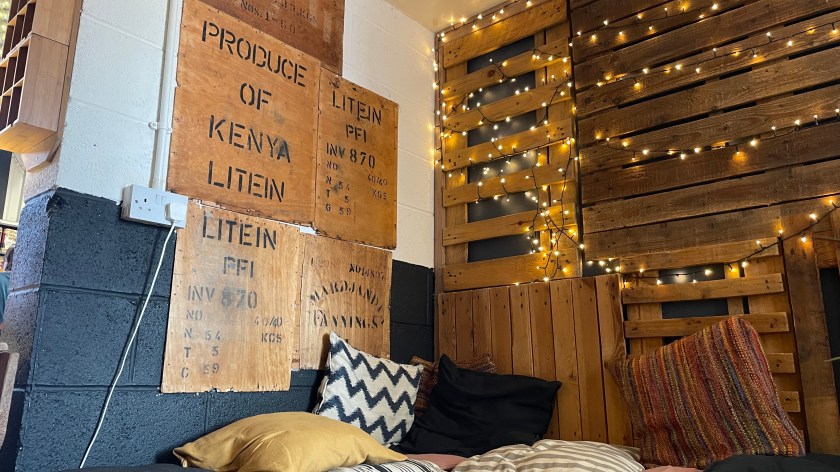
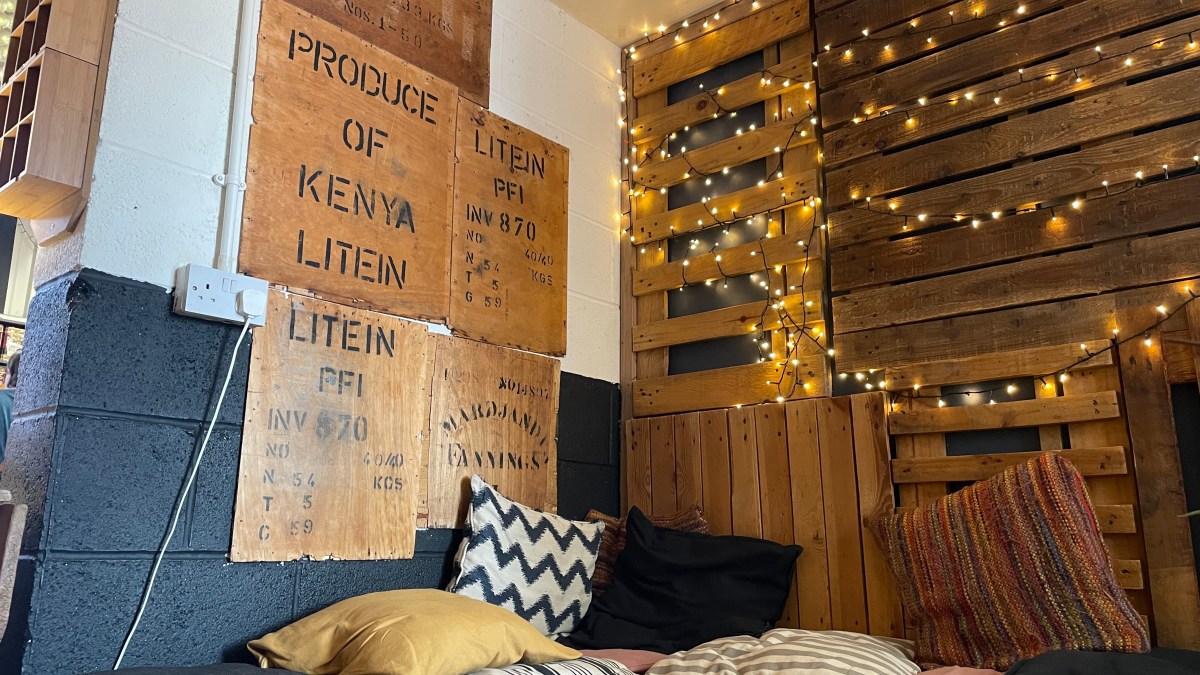
You may already know that I like places where they roast their own coffee, and as the name suggests the Espresso Bar is inside the Roastery. There’s an antique industrial feel as you sit amongst the roasting equipment. Behind the bar are old style coffee storage canisters that remind me of a shop I used to go into as a child. The chalk board above outlines the array of single-origin and blends that are available. The walls are decorated with old coffee bags from around the globe.

If you are looking for sleek modern straight lines and matching furniture this isn’t the place for you. The Espresso Bar is a quirky selection of sofas and chairs, some made out of shipping pallets, interspersed with similarly eclectic tables. There are shelves loaded with items that I’m quite confident were there when we first started coming which must be more than 20 years ago.

We are fortunate today, one of the voluminous sofas are free. We ask the people sat on the facing sofa whether they mind us joining them – they aren’t going to say “no”, and we know they aren’t going to say “no”, but it’s the British thing to ask.

We choose a muffin each and one of the South American single origin coffees, it’s normally Columbian. It comes in a cafeteria with enough for at least four people, we sometimes feel a bit guilty at the amount we leave.

If you want something more substantial than a cake or some crisps then I recommend that you head out of the Roastery, down the corridor and into The Barn which is the adjoining building. Here you will find a wide selection of food options including another outlet for Roberts.

When the children were younger Cedar Farm was a place we would come on a wet Sunday afternoon to catch up with each other’s lives. These days it’s more often a trip with just the two of us, but the purpose is the same – we regularly have the diaries out or sit and complete a crossword together. There’s often a recent newspaper left by someone who no longer has a use for it.

There’s always an interesting group of people in the Roastery, on this occasion it was a mum, dad and two daughters discussing the challenges of student accommodation.

Having relished our coffee and savoured our muffin we head over to the counter to order some beans to take home with us, it’s normally the Napoli Blend and some Dark Decaf.

Coffee Bags

Tarn Hows Circular via Tom Gill from Glen Mary Bridge | Graham’s Guides

A beautiful walk when you don’t want to be out too long.

Graham’s Walks📌
Distance2.6 miles
DifficultyModerate
Map🗺
GPX📁
Graham’s CafeNot on this one.

Tarn Hows is a popular destination. If you want a walk where you don’t see anyone, this is not the place. This popularity isn’t anything new, Charabanc would travel up from Ambleside and Windermere in the 1890s. That said, I’ve never known the tarn to be over-run with people; there’s plenty of space to spread out and there’s probably less public transport now than there was in the days of the charabanc.

The walk starts from the Glen Mary Bridge car park, a name that was given to the local area by John Ruskin who thought that the name Tom Gill wasn’t picturesque enough. It is a picturesque. It’s a National Trust car park making it free for members. Much of the land around here is owned and operated by the National Trust including the tarn itself, I’ll talk a bit more about that later.

(It’s worth noting here that a “gill” is a local Cumbrian name for a valley with a stream in it, with Scandinavian roots. A “glen” is a Scottish name for the same thing.)

If Glen Mary car park is full, which it can do, there are a few other parking spaces just off the main road alongside Yew Tree Tarn from where you can also begin this dainty walk.

This is a walk of two halves. The first part takes you rambling up through an ancient wood alongside a cascading stream, it’s not hard but it is uneven in places. The second part is around the tarn which is more like a promenade than a ramble. The main path around the tarn is flat, wide and well paved.

From the car park there’s a footbridge across the stream which is your guide to the tarn. There aren’t any decisions to make on this route, you follow the well worn path on the ground which follows the general route of the stream. There are several delightful waterfalls on your way up the hill, some you explore via short detours.

Part way up the hill, through a small gate, the cutting narrows significantly, the walking gets a bit more tricky, you’ll struggle to get lost though.

The stream takes you to the tarn where it flows out via a small dam. There used to be three small tarns in this area, the dam raised the water level to join them together into the larger expanse of water we see today. Much of what people assume is natural in the Lake District has been tinkered with by humans.

The tarn is banded by a circular route which brings you back to the dam. On your way around there are several places to drift off the main path to see something of interest, or get a better view. This is a great place to let children explore, there are still plenty of trees to climb even though the area has been heavily impacted by storms over recent years.

The promenade is very picturesque with photo opportunities around many of the corners.

It’s traditional for us to go clockwise around the tarn, so we head left, but could just as easily head right. The end of the tarn is marked by a bridge which is accompanied by a seat with glorious views along the full length of the tarn.

Having promenaded down one side it’s time to do the same along the other.

At the other end of the tarn there’s another car park operated by the National Trust, you could use this as a start to the walk, but where’s the fun in that. There are some toilets at the car park, if you are fortunate there will also be an ice-cream van.

From the ice-cream van head back down to the dam and onto the path back to Glen Mary Bridge.

On the other side of the road from Glen Mary Bridge is Yew Tree Farm which is notable for several reasons. The farm is part of an estate of land known as Monk Coniston which stretches all the way down to the shores of Coniston, and included Tarn Hows. When this land was put up for sale in 1930 a local couple Mr and Mrs Heelis, him a solicitor, her an author and illustrator who is better known as Beatrix Potter, purchased it. They were determined that the estate shouldn’t be broken up or developed. The National Trust wasn’t the large organisation it is today and weren’t in a position to buy the land. Beatrix later donated the land to the National Trust, but with a stipulation, the local Herdwick sheep were to continue on the land, each farm being allocated a minimum headcount.

The Herdwick allocation probably saved the breed from extinction in this area of the Lake District, but it hasn’t always been easy, the wool is course and they develop slowly so you can’t use the lamb meat. In recent years, however, the farmers at Yew Tree farm have found a way of making the Herdwick profitable and now have over 1,000. Sue and I recently spent a wonderful day at the farm on a Herdwick Experience where they tell you about the history of the sheep, about the resulting hogget which is used in several Michelin Starred restaurants in the area and can be purchased from the farm. They also, as part of the experience, take you to meet a group of the sheep who like to be petted. You sit in a field and they join you, sitting alongside you as you scratch their backs.

(A lamb is a sheep that is less than a year old, a hogget is a step between one and two years.)

Oh, yes, also, Yew Tree Farm is one of the main locations for the ‘Miss Potter’ film with Rene Zellwigger and Ewan McGregor.

What about variations?

There aren’t many options for variant walks through the woods along the stream, you can sometimes venture closer to the stream, but that’s about it.

Once you get to Tarn Hows there are a few more options to add in extra distance and difficulty. Near the beginning you can head off to Tom Heights from which there are good views of the surrounding hills (it’s been a few years since I’ve been up there so I’m hoping the views are still there). You can join the Tom Heights path on to the walk up to Black Fell. Black Fell is one of the smaller, and easier, Wainwrights, so you can get an easy tick.

Another route up to Black Fell is from a stile at the end of the Tarn via the Iron Keld Plantation. The path to Iron Keld Plantation can also be used to access a route that circles the tarn from higher up. The higher route gives better views of the surrounding hills and is less well travelled.

From the car park at Tarn Hows there’s a different route back to Glen Mary Bridge, I’ve never walked it so can’t comment.

Glen Mary
Tom Gill Waterfall
Tarn Hows
Tarn Hows near to the car park
Yew Tree Farm
One of the friendly Herdwicks

Clock House Farm, Cow Hill, Fulwood Park Wood and Ladywell Circular | Graham’s Guides

A local walk providing endless variations if you know where to look with plenty of history thrown in for good measure.

Graham’s Walks📌
Distance3.6 miles
DifficultyModerate
Map🗺
GPX📁
Graham’s CafeNot on this one.

A short walk from my front door is a portion of the Guild Wheel. From where I join I can walk east and soon get to Fulwood Row, if I walk west I reach Fernyhalgh Lane. Both of these roads allow me to traverse the M6 motorway and then onward into the mixed countryside beyond.

I’ve pondered a few different ways of depicting the matrix of walks that are available from this local area and decided on a few of guides with lots of descriptions of the available variations. Think of the variations as a menu of options that can be added on, or taken away, depending on your day. If you do venture into this area my advice to you is to follow the lines on the map and follow the lines on the ground. There are lines on the ground that are delightful but aren’t on the map, there are lines on the map that aren’t that well defined on the ground.

This walk is shown as starting on Fulwood Row at about the point where it goes under the motorway. There are normally plenty of places to leave a car here if that’s your method of transport.

While the adjacent houses are relatively modern, ours was built right at the end of the last century, the routes are mostly ancient. Fulwood Row and the initial footpath is clearly visible on the archive maps from the 1840s as are the other major landmarks of this walk. The most significant landmark that isn’t on the maps from the 1840s is the M6 motorway, that wouldn’t arrive until the 1950s.

This is a long post, there’s a lot more to describe in the this environment, particularly one where the old is intersected by the new.

Our walk begins on Fulwood Row which we follow under neither the M6, up the hill on the other side, past the Guild Wheel exit on the right continuing on to Clock House Farm. Continue across the front of the farm buildings, none of which appear to be used for farming anymore. Beyond the farm buildings you’ll come to gate with a stile a little further along. Hop over the stile and onto a bridleway running alongside several fields. These fields are regularly visited by Roe Deer and Hare, there’s also a good selection of birds including a local Tawny Owl. Buzzards nest in the trees on the other side of the field.

At the end of the fields you’ll come out onto Cow Hill, carry on straight, along the road a while further until you see a stile on the left. Walk across the field along the hedgerow to another stile. Once over the stile turn left on the road where the lane to Clarkson’s Fold is visible. You’ll also notice the local, normally patriotic, flagpole. Travel along the lane, through the farm, out the other side, across a field, over a small footbridge, across another field, over a stile and onto a narrow tree lined lane. You can’t see any of this from the farm gate because the footbridge is down a slope and hidden behind some trees, also, the paths across these fields aren’t really visible on the ground. When I last went over the stile, just this morning, it was broken which made for an interesting scramble. Turn left one over the stile.

This lane is another one of those ancient routes that used to be vital links between small communities in a time before cars. From Cow Hill this lane goes out to Haighton and the farms beyond, we’ll leave the many routes beyond here for another guide. Head down the hill around the back of a house on the left and onto a road. Walk past some fancy gates and across a bridge where you’ll see a path on the right alongside Savick Brook. The brook flows through Preston, out the other side and into the Ribble, for the latter part of its journey it becomes the Ribble Link Canal. There are several places where you can walk alongside the brook, I have a plan to string a route together at some point.

After the bridge the path travels alongside the grounds of Haighton House. In the spring and early summer the stream is banked with successive wild flower; Snowdrops to Bluebells, Wild Garlic to Campions and Cow Parsley. Sadly, in recent years, this area has become completely engulfed by Himalayan Balsam by the mid summer. While we are talking about alien species it’s worth noting that this is also the stomping ground of a local flock of Ring-necked Parakeet with their distinctive call.

The path takes a few twists and turns here, but if you follow the path on the ground you won’t go wrong, and will arrive at a footbridge over which you will join the white-fence lined driveway of the House. The wood here is known locally as Bluebell Wood, on the map is titles Fulwood Park Wood, some people also call it Squire Anderton’s Wood, but that’s somewhere else. I have a morning ritual in these wood, this is a headphone free zone, the birdsong is so varied that it would be a shame not to listen in, besides there’s good evidence that birdsong is good for our mental health. Is there anything like the chorus of Blackbird, Wren, Song Thrush and Robin accompanied by Nuthatch, Treecreeper, Gold Crest and many more.

At the end of the driveway you’ll exit through some gates onto the road. A little further along there’s a path off to the right just before the road crosses back over the brook to the left. The house on the hill is called The Mount which is apt. Here we are on Fernyhalgh Lane which takes us to Ladywell, a place of pilgrimage since at least the 11th century. There’s an interesting legend about a sailor who, in danger of shipwrecked, prayed to the Virgin Mary and received instructions to create a shrine at a place with a spring called Fernyhalgh, hence the name Ladye Well. It’s also worth noting that the name Fernyhalgh is a combination of two Anglo-Saxon words – “ferny” meaning old and “halgh” meaning shrine. This place may have been a place of pilgrimage even before Christianity came to England. Ladywell and Ladyewell, with and without an “e”, are both used on signs in the local area. There’s still a chapel, retreat and shrine on the site which you will see on the right as you walk up the cutting past the outflow from the spring.

Just beyond the entrance to the shrine grounds there is a small gate on the left with a path across a field. At the far end of the field there’s a stile. To the left you’ll see a path across another field and a footbridge over the motorway. On the other side is a path that runs alongside the motorway back towards Fernyhalgh Lane. The houses here sit on the site of some of the skirmishes prior to the Battle of Preston during the Second English Civil War. There’s a sculpture that commemorates this not far from the end of the footbridge, we aren’t going that way today.

As the path nears the bottom of the bank there’s a t-junction, to the left will take you across a footbridge and up on to Fernyhalgh Lane, we’ll go right and rejoin the flow of Savick Brook. Further along cross the footbridge over the brook to the left and up onto the Guild Wheel again notable by a return to tarmac. The Guild Wheel will take you back to your transport if you head left (you will get to your transport if you head right but not for many miles). Having crossed Fernyhalgh Lane for the last time you’ll pass a local landmark known as Peter’s Garden which commemorates Peter Ward who was one of the driving forces behind the Guild Wheel, following a lifetime of cycling.

Now, the variations, where to begin?

At the start of the walk, rather than following the route onward to Clock House Farm you could take a right turn on the Guild Wheel. This is a good walking alternative, but opens up another set of walks which I’ll cover in another guide. There’s also a couple of options on the left of Fulwood Row, one is almost opposite the Guild Wheel junction, this will take you across some fields and drop you onto Fernyhalgh Lane near to the motorway and cut out most of the walk. The other option on the left is just before Clock House Farm, this takes you down another ancient pathway to the footbridge over Savick Brook near to Haighton House, this route can be very muddy, but is a good option for a shorter walk.

Once you’ve travelled across the fields beyond Clock House Farm and you drop onto the road at Cow Hill rather than continuing straight on, you can turn left. The road will bring you to a right-hand turn and another lane on the left. If you follow the lane down the hill it will bring you to bridge over Savick Brook with the path off to the right immediately before it. In the same way, you can skip the lane down to Clarkson’s Fold and continue on the road to the same lane from the other direction.

As you come through the fancy gates at the end of the Haighton House driveway you can extend the walk a bit by heading up the hill to Shepherd’s Hill Farm, walk through the farm and out the other side from where you’ll see a path off to the left. This path will bring you around the back of Ladywell Shrine. You can also continue a bit further before heading back to the footbridge over the motorway.

At the end of the driveway for Haighton House you can shorten the walk a bit by turning left across the bridge over Savick Brook. This is Fernyhalgh Lane, continue along until you get to where the Guild Wheel crosses.

Another variant of this walk comes as you head up the hill past the Ladywell Shrine, rather than heading left across the field you can carry on a bit further where there’s another footbridge across the motorway. The map shows a path running from the end of the bridge alongside the motorway, that is one of those paths that’s not very well marked on the ground and you’ll find yourself tramping through waist high vegetation. To avoid the tramping you can carry on straight beyond the end of the bridge and will come out onto Pittman Way, from here you have a multiple choices to get back onto route.

From the end of the footbridge over the M6 on the original route, there are several paths through the houses that bring you out onto Midgery Lane which connects up with the Guild Wheel just beyond the bridge over the brook. This path will take you up through Hindley Hill Woods – I have no idea why it’s called Hindley Hill Woods.

Beyond Clarkson’s Fold
The entrance to the path alongside Savick Brook (on the right)
Follow the path on the ground…
Savick Brook in the early spring
Winter trees
The footbridge into the woods
Joining Haighton House driveway

Rydal and Loughrigg Terrace Circular | Graham’s Guides

An all-year-round favourite with glorious views and plenty of other interest.

Graham’s Walks📌
Distance4.3 miles
DifficultyModerate
Map🗺
GPX📁
Graham’s Cafe?No
Swim?Yes

We start this walk from the Pelter Bridge Car Park at the southern/easterly end of Rydal Water near to the village. Pelter Bridge is one of the Lake Districts smaller places to leave your vehicle and can often be full. As an alternative I’ve included instructions when starting from either White Moss Carp Park or Rydal Water Car Park. These car parks are bigger but can also get full.

My walking guides tend not to take you step-by-step through your journey, I prefer to give you an outline of where to go, then make the mapping information available. If you just have the words below I can’t guarantee that I haven’t missed something important.

The first part of this walk takes us along the former quarry tracks up to Rydal Cave. Simply head up the road that you’ve just driven on to get to the car park and carry on once you get to the gate at the end. Just after the gate you’ll get your first view across Rydal Water (the header image). You may, at this point, start to feel something poetic building inside you, if you do you wouldn’t be the first. The village of Rydal was the favourite home of the acclaimed poet William Wordsworth, his family, and his sister Dorothy, who deserves far more acclaim than she receives.

Dorothy Wordsworth’s Journals, many written in Rydal and Grasmere, are wonderfully poetic:

After tea we rowed down to Loughrigg Fell, visited the white foxglove, gathered wild strawberries, and walked up to view Rydale. We lay a long time looking at the lake; the shores all dim with the scorching sun. The ferns were turning yellow, that is, here and there one was quite turned. We walked round by Benson’s wood home. The lake was now most still, and reflected the beautiful yellow and blue and purple and grey colours of the sky.

Dorothy Wordsworth

(I don’t know when Rydale became Rydal, other than to note it was at some point after the early 1800s which is when Dorothy was writing.)

You’ll see from this vantage point that there is a path running alongside the lake, we are coming back that way, for now we are going to head up to Rydal Caves keeping left on the higher path.

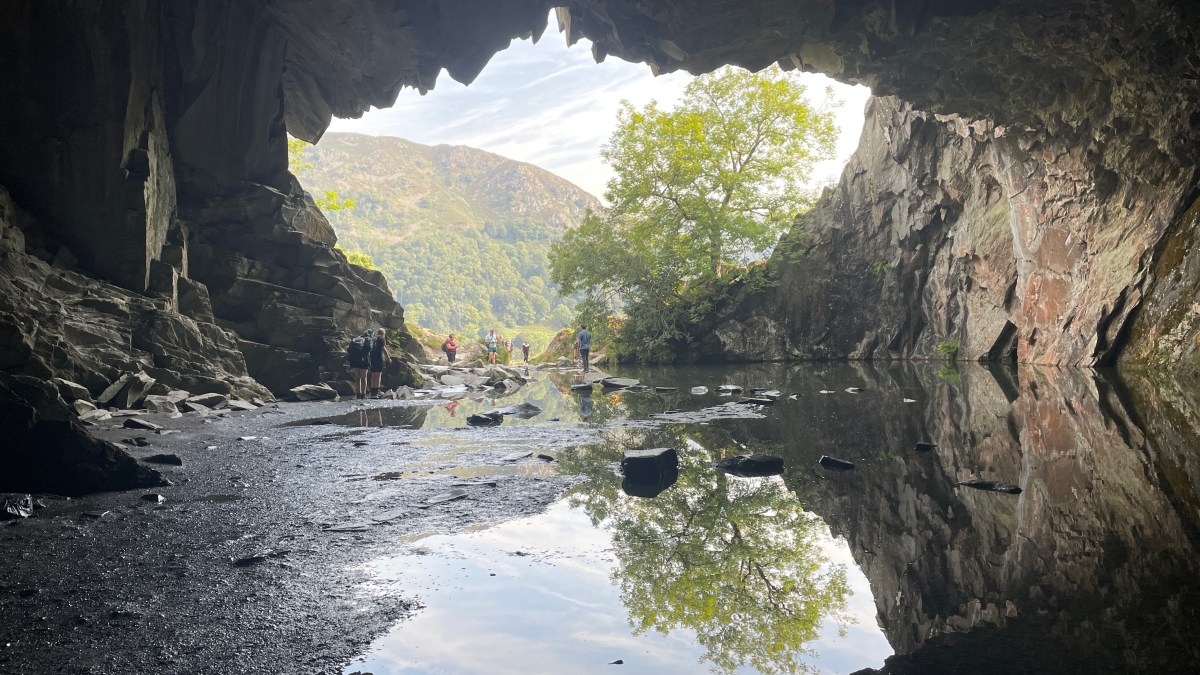
There is one very famous cave directly on this route which you can go into with ease, but before that there are a few smaller caves which are more challenging to get into. One of the smaller caves used to have a drum kit inside it which sounded amazing. It’s been a while since I’ve been in that cave, as it now requires a rope to get in, so can’t confirm whether the drum kit is still there.

These caves are the result of slate mining and as you work your way along this lane and into the vast cathedral space it is worth remembering that this was a place of noisy, dusty, dangerous toil.

The Lake District is littered with various mines and quarries, the area wouldn’t be the same without them. This is a land shaped by people.

Having stepped inside the large cave and taken in the view and the acoustics, it’s time to carry on along the side of Rydal Water towards Grasmere. I love the views of Nab Scar towering over the diminutive Rydal Water from this elevated position.

As you near the end of Rydal Water there is a fork in the path where you should continue to take the higher option. This path will take you around the corner onto Loughrigg Terrace with elevated views across Grasmere including Helm Crag (also known as the Lion and the Lamb) and Dunmail Riase (remembering the last king of Cumbria who is reportedly buried below the cairn near to the top).

Carry on along Loughrigg Terrace to the end and into the woods. You need to go through one gate at the end of the path and then a slight right through another gate into Red Bank Wood. This is a gentle walk through established trees marking the seasons by their attire.

Eventually you’ll reach a cottage next to the road between Grasmere and Loughrigg Tarn. At the entrance to the driveway for the cottage there is a path to the right which cuts back through the woods heading downhill and on to the lakeside path below Loughrigg Terrace. The beach here is a great place for a swim but can get a bit crowded.

On leaving the beach you’ll come to a wooden footbridge across the stream. You have a choice here, the route I’ve provided takes you along the southern edge of the stream this path can be flooded when the river is high, but rarely. It can also be a bit uneven. If you prefer something a bit more even, you can cross the bridge take a right hand turn on the other side and follow the path along the other side of the river. Both paths meet at a metal bridge.

The metal bridge is where you’d join the route if you’ve parked at either White Moss or Rydal Water car parks.

From the metal bridge head through the woods up the hill until you reach a gate. Through the gate turn left and along the path by the wall. You should be able to see Rydal Water ahead of you. Walk along this path all the way to the other end of the lake. There are several places to swim along this part of the route, it’s also a great place to practice your skimming, there are plenty of flat stones available.

As you near the end of the lake you’ll notice the gate that you came through on your way to the cave higher up on your right. We are going to go through the lower gate. This route takes you through some more woods and along the river where you’ll get views of the boathouse which is a classic Lake District photo opportunity. Soon you’ll come to a footbridge, don’t go over the bridge but head right and up the hill through some woods and onto the car park road. You’ll reach the car park road via a small gate; the car park is down the hill to your left.

There are several variations to this walk:

As hinted a couple of times you can start this route from White Moss Carp Park or Rydal Water Car Park. There are a few reasons why you may choose to do this, the first being parking. The second is access to a toilet which can be found in the woods between White Moss and Rydal Water car parks. The third reason being access to refreshments; there is normally a pop-up coffee van by the side of the stream near to the toilets.

You can extend the walk a bit near the end. Instead of turning right up onto the car park road you can turn left across the footbridge, from there you can cross the road into the village. In the village there are several places of interest.

Almost directly opposite the exit from the footbridge is Dora’s Field which is full of daffodils in the spring. The daffodils were planted as a memorial to one of the Wordsworth’s daughters who died aged 43 of tuberculosis. Dora’s Field has a gate into the church grounds, both the grounds and the church are lovely with even more Wordsworth associations. Up the hill from the church is Rydal Mount where the Wordsworth family lived for a while.

As you go up the hill, before Rydal Mount there is an entrance to the ground of Rydal Hall. The hall is a Christian retreat, but the grounds are open to the public where there are several walks and gardens to explore. Within the ground is one of the Lake District’s most photographed waterfalls with The Grot alongside it. The Grot is a great place to spend some time in quiet. Swimming is not permitted in the waterfall.

Within the grounds of Rydal Hall is the Old School Room Tea Shop which we’ve visited several times and always had great food, but haven’t visited for a while and hence it’s not currently included in Graham’s Cafes.

There are a couple of Graham’s Cafe’s nearby, last time we did this walk we ventured to Lucia’s Coffee + Bakehouse in Grasmere.

Another option on this walk is to follow the Coffin Trail along the other shore back to your car, I’m going to cover that route as a whole new guide.

The view across Rydal Water towards Grasmere
Inside the cave
Inside the cave
The view from the start of Loughrigg Terrace towards Grasmere Village
The view across Grasmere towards Dunmail Raise
A frozen Rydal Water towards Nab Scar
The Daffodils of Dora’s Field