Blessings #202 – Home

There’s a well known song that has these words in the chorus:

Wherever I lay my hat, that’s my home

I don’t believe them!

Home is the place where you fit in, and it fits around you.

Whenever I am away from home I spend much of my time trying to find things and checking where things are. At home I don’t have to think about where I’ve put my keys down; even if I can’t remember where I put them I know the places where to look. When I’m away from home they could be anywhere.

I’ve spent enough nights in hotel rooms to develop a twitch every time I leave a room – “Where’s the room key card? Where’s my wallet? Have I got everything?

At home there is an unspoken routine. We don’t have to be constantly talking through what we are going to do next, for most of the time we instinctively know.

We know the signs of who’s in and who’s out when we are home. We have three cars in our house, these days, but the drive is only two cars wide. If everyone is in there is always one car blocked in, but that’s not a problem because at home we know who is going to be needing there car next so we know where to park.

Home is the place where you know which draw to look in for which clothes. You don’t have to go through all of the drawers trying to find your socks.

At home you don’t have to think too hard about what clothes you are going to wear.

Home is a place of memories. Memories of evenings with friends around the table. Memories of chocolate chilli roulette. Memories of huddles of young people around a fire pit. Memories of Christmas mornings and birthday teas. Memories of newborn babies entering the place where they will build their own library of memories. Memories of saying goodbye as those babies, now grown, set out on new adventures of their own. Memories of tears and disappointments too.

Home is a privilege and a joy. It saddens we to know that in this world of conflict and refugees so many don’t live in a place that they can call home. But I also have a hope that one day this world will be swept aside and we will move from this home to another home where there is no more conflict and strife, a place where everyone is at home.

My Stories: £9 or £10

Stereotypical men are supposed to love a fancy car, preferably a sports car with a loud engine. In this regard my dad is certainly not stereotypical.

Car’s have never been high on my dad’s priority list, they tended to be bought already aged and run from purchase to grave. A vehicle is purely a utility for carrying people and things. Even during the weekly commute the car’s boot would be adorned with a standard set of allotment gardening equipment including a spade, a fork, a watering can and a selection of dirty carrier bags ready for retrieved produce.

One car was an aged Ford Anglia Estate. I can’t remember how old it was, but they ceased production before I was born. I can’t even remember how old I would be when we had it, but suspect that I was somewhere between 8 and 12. I do remember that it was a deep red, burgundy even. At it’s youngest it would have been 10 years old.

Modern vehicles have all sorts of safety features the Ford Anglia didn’t even have seat-belts in the back. The wearing of seat-belts in the front of vehicles only became a legal requirement in the UK in 1983; it wasn’t until 1989 that it was a mandatory requirement for children in the rear of vehicles, the Ford Anglia went to it’s grave long before that. The three of us would sit in the back, we’d even add in a few friends if the need arose. There wasn’t the same sensitivity about the potential danger of accidents.

One day the time came for the Ford Anglia to go to its grave. I’m not sure what the terminal calamity that precipitated its demise was but I suspect that it was related to the expense of getting it through an annual MOT.

The chosen graveyard for our burgundy family bus was a breakers yard which, I think, was in a small village outside Beverley called Weel which also happened to be the location of the local tip.  My memory is of being sat in the car as my dad conducted the business with the breaker. Another memory is that the car was sat on a newly tarmacked road, it’s interesting what your brain stores away even if it’s not accurate. The windows must have been wound down because we could hear the negotiations as they unfolded.

The breakers initial offer was “£9”, for some reason my dad had a glint in his eye and wasn’t going to settle for that, he countered with “£10”. In modern money terms this is roughly the difference between £45 and £50. Backwards and forwards went the offer and counter offer but neither of them were shifting there was still £1 between them. Eventually my dad suggested that they toss a coin for it a truly British way of resolving a conflict.

The look of delight on my dad’s face when he won was priceless – £10 it was.

I don’t remember how we got home, but suspect that a neighbour picked us up because it’s a 3 mile walk from our house, but it wasn’t unheard of us to walk that kind of distance either. It couldn’t have been my mum who picked us up because she didn’t drive until we were older and they weren’t a two car family until after I left home.

I can’t be absolutely sure of all of the pieces of this story, the only bit that I’m reasonably confident about is that the bartering was between £9 and £10.

My Stories: Hornsea Waves

One of the things we would regularly do on a weekend as children was to travel to the seaside.

There are many beautiful seaside location within easy reach of Beverley. Beaches, cliffs and caves. Harbours, promenades and caravan parks. Lighthouses, lifeboats and fishing boats. Rocky beaches, sandy beaches and even a naturist beach.

The nearest place is the small seaside resort of Hornsea.

We would walk on the beach at Hornsea for hours. It wasn’t a place we  would go to for sunbathing, the breeze coming in from the North Sea is more normally biting. The cliffs are made of ancient boulder clay which are being steadily eroded. This erosion means that the beach is a pattern of sand with islands of pebbles extracted from the boulder clay and polished by the waves. Many of the pebbles include fossils so we would spend much of our time walking along looking at the ground, picking up stones and closely examining each one. More often than not we would throw the stones away but sometimes the tell-tale signs of Ammonites would have us bashing stones together in the hope of a ridged swirl revelation. We’d regularly pick up fossilised Gryphaea, not that we would call them that, to us they were Devil’s Toenails. For a period we would walk the beach in search of driftwood, but that’s part of another story.

The coastal erosion means that Hornsea has extensive sea defences providing a split level promenade and an extensive system of groins. Climbing over the groins was part of the adventure. Sometimes we would deliberately go to the seaside when the tides were high and the wind was blustering. On the best days the waves would slam into the sea wall and break over the upper promenade.

We were walking along the upper promenade one day when, from what I remember, the wind and the waves were moderately high. Not high enough to break over the very top of the promenade but still giving a moody seascape. I don’t think it can have been too violent, because if it was really wild my actions were downright stupid, but I think I was just being absent minded. Anyway, I was walking along, a little way behind the rest of the family, when I decided that a visit to the lower promenade was in order.

I don’t remember whether I was on my way down, or my way back up. What I do remember is hearing my Mum shout “Graham!” as I was on a walkway connecting the lower and upper promenade. Before I’d even had chance to look up a wave engulfed me.

It was fortunate that I was on the walkway because there was a handrail on the outside which the wave pulled me into and stopped me from being dragged out to sea by the wave.

Somehow, I don’t remember how, I got to the upper promenade and was reunited with the rest of the family. My clothes were absolutely soaked through. Other people walking the promenade had clearly seen the incident too with many of them making comments as we walked back to the car.

It wasn’t until years later that I realised how close I came to being a search incident for the local lifeboat at best, at worst I wouldn’t be here today.

Back at the car I stripped off and sat in the car in someone else’s coat and jumper. I don’t know how old I was, but I was small enough to be encased by an adult jumper.

I still love watching violent waves breaking over cliffs and sea walls, but I’ve not got as close as I did that day.

Blessings #201 – Seen, Heard and Known

Some of the deepest desires of people are to be seen, to be heard and to be known.

I can remember many times when I have been none of these things, often in the busiest of places. Think about the busy train station with thousands of people passing through now imagine the effort that you would have to go through to get the attention of all of those people.

Sometimes we see people, but we don’t want to hear them. The other day I was walking through the centre of Preston and was really conscious of the number of homeless people sat by the side of the pavement. It’s almost impossible not to see them, but few of us will take the time to sit and listen to them. In Chester the other day everyone was keeping wide of a man stood by a poster board and handing out religious leaflets.

A few weeks ago I was sat on a plane next to an older lady who was returning from a trip to America where she attended a sister’s funeral. While there she had decided that she needed a full cowboy outfit as memory of the adventure; this included cowboy boots, fancy jeans, denim jacket and hat. It must have been an interesting experience because she can’t have been more than 4′ tall and was a very slender lady. I imagine that she was fitted out in children’s clothes. She wanted to talk about her experience and I was happy to listen.

We’ve recently celebrated our Silver Wedding Anniversary and marked it with a gathering of friends. We received many cards and handed around a book for people to write their thoughts in. Reading the two sets of messages together it was striking how we were known by so many people in so many different ways.

Most Wednesday morning’s I meet with a couple of close friends for breakfast. As a group we have been through many highs and many lows together. This week I needed these friends to know about the highs of holidays and also some significant challenges in my life. This time and place is one where I can know that whatever else has happened I will be seen, I will be heard and I will be known. Thanks Dave. Thanks Bob.

The Genesis story describes the separation between people and God. The first sign of this is that Adam and Eve go to hide because they don’t want to be seen or heard by God. Many of Jesus parables tell us of God’s perspective; though we may try to hide God searches for us because He want’s to know us:

The Story of the Lost Sheep

By this time a lot of men and women of doubtful reputation were hanging around Jesus, listening intently. The Pharisees and religion scholars were not pleased, not at all pleased. They growled, “He takes in sinners and eats meals with them, treating them like old friends.” Their grumbling triggered this story.

4-7 “Suppose one of you had a hundred sheep and lost one. Wouldn’t you leave the ninety-nine in the wilderness and go after the lost one until you found it? When found, you can be sure you would put it across your shoulders, rejoicing, and when you got home call in your friends and neighbours, saying, ‘Celebrate with me! I’ve found my lost sheep!’ Count on it—there’s more joy in heaven over one sinner’s rescued life than over ninety-nine good people in no need of rescue.

The Story of the Lost Coin

“Or imagine a woman who has ten coins and loses one. Won’t she light a lamp and scour the house, looking in every nook and cranny until she finds it? And when she finds it you can be sure she’ll call her friends and neighbours: ‘Celebrate with me! I found my lost coin!’ Count on it—that’s the kind of party God’s angels throw every time one lost soul turns to God.”

Luke 15

I am so, so grateful to be seen, heard and known. The challenge to us, especially to those of us who call ourselves followers of Jesus, is to create the places where other’s can also be seen, heard and known. Someone who writes about this is Shauna Niequist. In her book called Bread & Wine she says this:

“The heart of hospitality is about creating space for someone to feel seen and heard and loved. It’s about declaring your table a safe zone, a place of warmth and nourishment.”

Hospitality around a table might not be your thing, but we can all create somewhere where others feel significant.

Blessings #200 – The Buzzard Feather

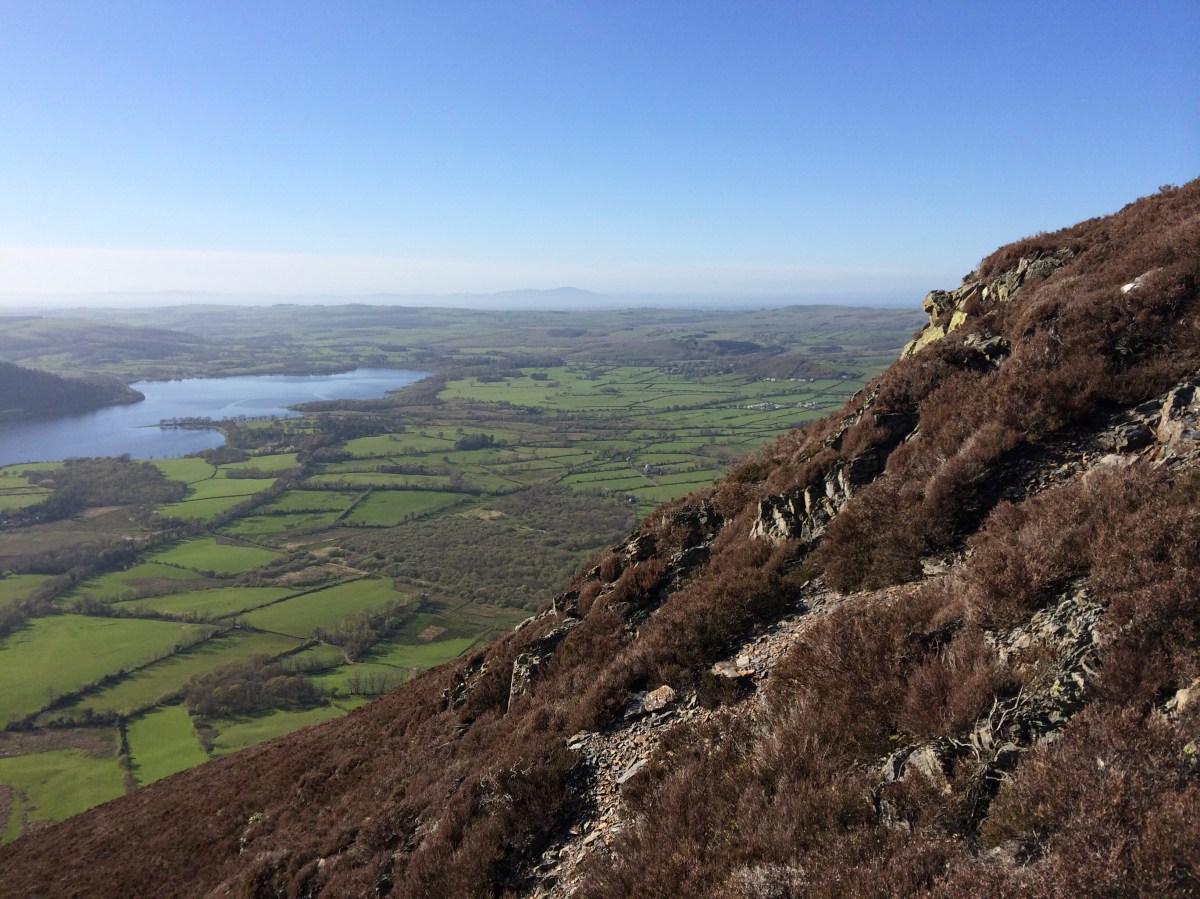
We’ve just returned for a week’s holiday near Lorton in the English Lake District

One of the things I’m currently trying to do is to climb all of the Wainwright peaks so on Tuesday I set off to tick-off a set of peaks stretching from Crummock Water to Derwentwater.

Nearing the end of this walk I was meandering through a field when a Buzzard squawked and launched into the air. It made me jump.

This spectacular bird of prey left behind one of it’s magnificent feathers, a wing feather I think.

Feathers are amazing feats of engineering. They are strong and yet very light, supporting a bird to amazing heights and magnificent speeds. They are only connected to the body of the bird with a narrow quill. The barbs and barbules that make up the vanes are intricately detailed tiny pieces of keratin woven together to be highly resistant to the air.

As the feathers layer together with the other feathers on the wing they form the perfect shape for flying.

The structure of a feather is a marvel, but feathers aren’t just functional, they are decorative too. The feather that I picked up was a piece of art in its own right with patterns of rich browns.

Alongside the other feathers on the bird each one forms part of a pattern that marks out each bird as a member of its species.

God is a God of detail too:

“What’s the price of two or three pet canaries? Some loose change, right? But God never overlooks a single one. And he pays even greater attention to you, down to the last detail—even numbering the hairs on your head! So don’t be intimidated by all this bully talk. You’re worth more than a million canaries. (?Luke? ?12?:?6-7? MSG)

My Stories: Two Allotments

The allotment is a standard feature of British cities, towns and villages. They can be single small plots of land but more usually are portions of land divided into individual plots. Each plot is big enough to be worked by one person and support a family.

The history of allotments goes back hundreds of years. In more recent history, during the industrial revolution, land would be given over to the labouring poor to enable them to grow food. In 1908 the Small Holdings and Allotment act was written and local authorities were given a duty to provide allotment space. At the end of the First World War further land was provided to returning service men. Numerous statutes in the intervening time has preserved the allotment across the British urban landscape.

Allotments are massively popular and most councils have a waiting list of people wanting one; many of them for years. In 2009 there were reports of waiting lists reaching 40 years.

It’s hard to give a definition of an allotment beyond it being a piece of land. They are wonderfully varied places where the whole spectrum of society come together. They reflect the British temperament for eccentricity and the human desire for space, for creativity and at some level for meaning. The variety of sheds and their contents would be enough to provide study material for a psychologist for many lifetimes. Some of the sheds are little more than tool storage areas but some are veritable home-from-homes.

Once a place for people to supplement their family income with food many allotments are now primarily places of hobby, but a hobby that produces very valuable outcomes.  The fruit, vegetables and flowers that they produce are treasured by those who graft to enable their fruition.

For most of my childhood we had two allotments which we imaginatively named as the top allotment and the bottom allotment.

The top allotment was where Mr Smith would come. That allotment was one of a single row of plots.

The bottom allotment was set in the middle of a far more comprehensive system off Kitchen Lane in Beverley. There are now 130 allotments in that area which seems about right from what I remember. Though it’s one large area there are really two allotment areas, the Kitchen Lane grouping and the Queensgate grouping.

Both allotments used to be on the edge of town, the top allotment still is, but there’s been quite a lot of development around the bottom allotment. I’ve no idea why one was chosen to be top and one bottom other then that seems sensible; the top allotment was roughly north of our house and up a hill; the bottom allotment was roughly south of our house and not up a hill. I don’t think it was anything more scientific than that.

There’s a saying in gardening circles:

One year’s seeding – seven years’ weeding.

When we took possession of the bottom allotment it had experienced at least one year’s seeding and plenty of marestail growing. Marestail is a terrible weed that creates networks of roots shooting all over the place below the depth of a spade.

That first year my Dad set about double-digging the whole plot as a good foundation for future years. Digging over a plot by hand is hard enough, spade-by-spade, row-by-row; double-digging is more than twice the effort. What you do in double-digging is that you dig a row to a spades depth, lifting the soil to a spare patch of soil. You then dig another spade’s depth in the bottom of that row, loosening the soil and adding in manure. You then dig another row moving the soil over the top of the first row, again digging in manure. You then dig over the bottom of the second row adding in more manure. You do this whilst also removing handfuls of weeds and miles of marestail roots. You then repeat until you have finished. I don’t know how long this took, but in my head it took FOREVER!

The essence of an allotment is it’s soil, without good soil all of your other efforts are worthless. Each year the soil would need to be prepared for the next year’s crops. This meant digging in the Autumn because you didn’t want to dig in the winter. Digging frozen soil is impossible, but it’s also detrimental to the health of the soil.

Autumn soil preparation also meant smoky fires and black potatoes. All of the remains of produce and weeds that managed to survive into the Autumn was piled into one corner of the plot where it was set alight using newspaper that we had brought with us. These fires weren’t roaring, flaming, affairs their purpose was to burn slowly and methodologically through all of the waste material which needed drying our before it would burn. As we dug we would regularly find potatoes that we had missed in the harvesting (I sometimes wondered whether Dad left them deliberately). These would be added to the base of the fire where it was nice and hot, but not flaming. There the potatoes would be left to cook until later in the day when we would pull them out and sit with muddy frozen fingers picking through the scolding potato flesh. We place each piece of potato into our mouths and pant heavily in a vain attempt to cool it down enough to be swallowed.

Spring days were taken up with seeding which would be done from packets that had arrived in the post in a small cardboard box marked with the name of Dobie’s. I can still picture the cardboard box and the green-turquoise packets that it contained. There are many seeds still today that I can name just from their size, shape and colour. Seeds are fascinatingly varied things.

Summer days were taken up with weeding, watering and cropping.

Weeds, what can I say about weeds, if you garden then you know about weeds, if you don’t then you are best left in blissful ignorance.

Watering was all done by watering-can.  Each set of allotments had a free-standing tap. In our case it was a couple of plots over. The tap itself was a push-button contraption connected requiring you to keep the heavy button depressed to keep the water flowing. As a young boy I barely had enough strength to push the tap down let alone keeping it depressed for a whole can full. Thankfully some helpful sole had created a piece of wood with a slot cut out of it, this would be fixed across the tap to keep the button depressed as long as you positioned it correctly. At the bottom of the tap was a large bucket into which a watering-can would fit. You would leave the tap running to fill the bucket, you’d then fill your watering-can from the bucket. The trick was to water fast enough that the bucket never overran. Quite often in the summer the opposite problem occurred as all of the allotment characters queued up to get their fair share of water.

Cropping is an art-form, you have to know what you are looking for and how to treat each plant. Allotments are normally used for a whole variety of produce, we were no exception: strawberries, raspberries, gooseberries, black-currants, white-currants, red-currant (immensely sharp), runner-beans, french-beans, broad-beans (that made your teeth squeak), peas, carrots, parsnips, swede, turnips, beetroot, potatoes, savoy-cabbages, red-cabbages, brussels-sprouts (left until after the first frost), onions, shallots, leaks, garlic, courgettes, marrows, squashes, sweetcorn (also cooked in the fire sometimes), cauliflower, broccoli, radish and lettuce. Different crops were grown in the different allotments because the soil was different and so was the sun and shelter, a small plot at home was also used to grow asparagus.

After a fulfilling day in the sun with a car boot full of fruit and vegetables you would get home and it was then that the preparation would start. We were expecting to do our part in getting everything ready to be frozen, dried, stored, jammed, turned into chutney and other preserves. I suspect that I cold still top-and-tail gooseberries while watching the television.

In those days the allotments were a place for the men, if women were there they were helping their husbands. I’m sure that many of them went the allotment to escape to some solitude. I can’t say that I remember many of the characters other than knowing that they were generally a friendly bunch always ready to give some helpful advice. Dad knew many of them by name. I don’t remember there ever being many children though, perhaps that’s because many of the other gardeners were older and their children had long since grown up also. Sometimes we would get bored and go off down the country lanes, but not very often, from what I remember.

Our cars always had some tools in the back ready for a trip to the allotment. My Dad has never been particularly car proud and has run some proper old bangers over the years, but that’s another story for another day.
My Stories: Jet Planes, Helicopters and Army Vehicles

The house where I grew up wasn’t far from the edge of the market town of Beverley. We lived at what was known as the push end called  Molescroft. I’m not sure about it being posh, it was certainly the newer end of that ancient place. There’s been lots of development since those times and the house is no longer as close to the edge of town.

Beverley is surrounded by many villages mostly picturesque and distinctly rural. These are the type of villages that feature on British drama programmes that they hope to sell to an American audience. They have a wonderful set of names too Bishop Burton, Cherry Burton, North Cave, South Cake, Walkington, Tickton as well as the gloriously named Wetwang.

The nearest village to where we lived was probably a quaint rural village at one time but it had mostly been subsumed by a large RAF base built not long before the Second World War.

During the Second World War it had been part of Fighter Command and hosted Spitfires during the Battle of Britain. While we were kids, though, there wasn’t that much flying going on. My understanding, after doing a little research, is that by then it was a maintenance unit with planes flown in for work and flown out when completed. If you stood at the end of our road, which  finished near the top of a small hill, not far from the top allotment, you got a good view of the runway and an even better view of the hangers.

The planes I remember the most were the English Electric Lightening and the Avro Vulcan.

From our view of the runway it was fascinating to watch the Lightening screaming down the runway until a parachute was fired out of the back slowing it down significantly. I often wondered what would happen of the parachute was to break.

I’m not sure how often the Vulcan visited; the one a remember was showing its prowess at a splendid local Air Show and Open Day. I’ve found some pictures from 1974 which are just how I remember it, I’m not sure whether this is the same day as the one a remember, but it’s about the right time. At six, if that’s when it was, this arrow shaped giant was fascinating as it flew over our house and rattled the single paned windows, amazingly agile for such a large aircraft.

I had no idea of the purpose of these aircraft during those days of the Cold War, for me they were entrancing roaring giant birds. I’d never known real war, I’m not even sure that I even knew about the cold war at that age.

Being close to the North Sea the airfield at Leconfield was also home to RAF Rescue Helicopters; first it was the Westland Wessex followed later by the Westland Sea King Westland Sea Kingwhich looked so much more prepared for the job it was being called to do. They would fly in and out low over our house sometimes hovering in their splendid high-visibility yellow paintwork. We would regularly stand in the back garden and wave to them, sometimes we could see them waving back as they leaned out of the open side.  I would imagine what it would be like if they lowered the rope down and took us for a ride, sadly, they never did.

A few years after the glorious Vulcan acrobatics the airfield changed its use and became the home to the Army School of Mechanical Transport. The Lightening and Vulcan were replaced by Trucks, Tanks and Land Rovers. The flat land around the runway was turned into hills and gullies providing off-road experiences. The roaring noise in the skies became extra vehicles on the local roads. In the army you could learn to drive at 16; seeing these boys who didn’t look much older than myself drive such large vehicles was amazing. The locals soon became adept at knowing how to avoid the delays caused.

On one particular day in 1982 the vehicles streamed out of the base on their way to a ship, the Southern Ocean and war. It was the talk of the school the next day, I missed it completely, in the coming weeks I would learn what war was as the images were shown on our televisions.

My Stories: Mr Smith

Mr Smith was a short wiry man.

He had jet black wire-wool hair and dark olive skin.

I have in my mind that he mostly wore a flat cap, but that bit of my memory is a little fuzzy. He regularly had a cigarette in his hand, not a smart long white cigarette, but a short crumpled roll-up.

The jacket that he wore looked like it was once part of a suit but the trousers never matched. The shirt was always accompanied by a tie but more from tradition than a need for formality. He often wore a jumper under his jacket. The boots were black, but not polished, functional rather than cosmetic.

I knew Mrs Smith and the children by sight, but I don’t remember ever talking to them.

They were occasional visitors to the wide grass verge just along from the top allotment where they dwelt in a bow topped caravan that was painted in faded traditional patterns. The pony that pulled the caravan from location to location was attached to a large weight and a long string. Long enough for it to roam for grass but short enough to keep it from straying onto the road. There were chickens too but only a couple.

The allotment was on top of a small hill at the edge of the Yorkshire Wolds with views over the flat plains towards the coast and the North Sea. On clear evenings you could see the lighthouse at Flamborough Head spinning and flashing it’s unique signal.

While Mr Smith and his family were around treasured produce would very occasionally go missing from the short single row of allotments. I wasn’t aware of anyone complaining though; while the Smiths were around there weren’t any rabbits. The rabbits did far more damage and I assume people saw it as a bit of bartering.

I assume that Mr Smith had a trade but I couldn’t tell you what it was, it would have been something agricultural, but probably not skilled. Mr Smith was a simple man with simple traditional ways.

While we were working on the allotment Mr Smith would sometimes come for a chat and a smoke, our allotment was near to the end were the caravan was stationed. My Dad would chat, I wouldn’t, I was a child and thought Mr Smith was odd with a strange smell and a peculiar accent. I would busy myself putting some more weeds on the fire, or cut another spade full.

One day my Dad was stood talking over the fence to Mr Smith when he looked down at the plants growing their and said:

“Your bananas are growing well”

My Dad turned to look in the direction Mr Smith was facing, somewhat puzzled. We might have lived on the drier side of England, but it certainly wasn’t warm enough to grow bananas.

Having looked my Dad knew what Mr Smith meant, this year he had decided to grow something a bit new, yellow courgettes. They were, at least, the right size and the right colour for bananas, but they tasted very differently.

My Dad chuckled about the bananas for days afterwards.

No, I don’t know whether is name was really Mr Smith, I suspect not, but it’s the name we knew him by.

Blessings #199 – My Stories, Our Stories

We’ve been out for the day today with friends. On the way home we started talking about our pasts, primarily about the food that we used to eat.

I’m not sure why it was food that got us talking about bygone days but it was the trigger to all sorts of reminiscing.

Sue’s dad has been talking for a while about recording some of his stories. We’ve heard many of them before, but there is no permanent record of them. He wants to record them as a kind of history of a life that no longer exists.

We each have a history that is punctuated by stories that contribute to our personality and character.

They aren’t just my stories though, I share them with the other people involved in the events. On our day we were looking at the story of Elkanah, Ramah and Hannah (1 Samuel 1). The star of this story is Hannah, but that doesn’t make Elkanah and Ramah redundant.

This story has twists and turns, results in the birth of Samuel one of the greatest of Israel’s prophets. I don’t think that any of the stories that I am living are quite that significant, but they may be, who am I to know?

Hannah’s story has survived thousands of years; I don’t expect mine to have such a long life. Again, I don’t know that they won’t, I just don’t think that they will.

Whether my stories are nationally significant or have millennial longevity doesn’t really matter.  These are my stories and that’s enough, they are part of who I am and for the most part I regard them as a blessing.

I’ve been thinking about how to live a good story. For a long while I thought that a good story came as the result of success. I wouldn’t have said that success was my motivator if you’d asked me, but my actions said something different. The better story that I am now trying to live is one of a follower because a good story comes from faithfulness.

“We live in a world where bad stories are told, stories that teach us life doesn’t mean anything and that humanity has no great purpose. It’s a good calling, then, to speak a better story. How brightly a better story shines. How easily the world looks to it in wonder. How grateful we are to hear these stories, and how happy it makes us to repeat them.” 

Donald Miller

(I’ve been thinking about writing some of my stories on this blog as a bit of an occasional series)

Blessings #198 – Personal Proverbs

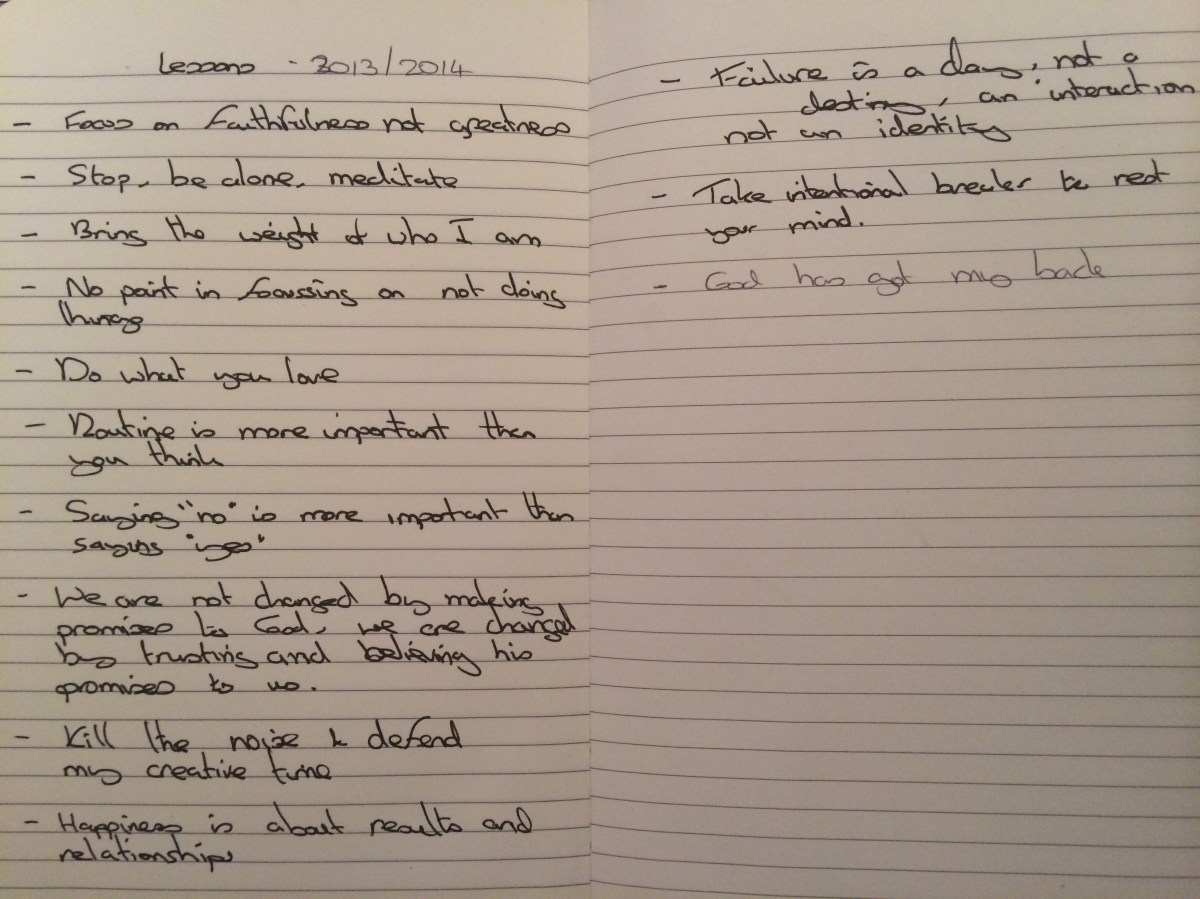
I am one of those people who carries around a moleskine notebook, those black ones with a piece of elastic around them to hold them together. Even though I spend all of my working life with technology, my preferred method of taking notes is still with a pencil and paper.

In the back of my current moleskine there are a couple of pages that are titled “Lessons – 2013/2014”. As I learn things throughout the lifetime of a notebook I add them to these pages to the rear.

A proverb is a short, well-known pithy saying, stating a general truth or piece of advice; these lessons are my personal proverbs. These words contain sayings that I’ve heard, or read, that have stuck with me and some that I have been inspired enough to create, but rarely. A saying has to really stick to become a personal proverb, it’s not good enough for it to sound like a wise saying, it has to teach me something significant and be worthy of revisiting.

The current notebook includes a period of time when I was off work with stress related issues, so many of the current proverbs reflect the lessons that I’m still trying to learn from that time.

The best proverbs reside in a time and a place, I can tell you where I heard or read many of the current sayings.

I regularly turn to this set of proverbs to remind myself of the wisdom that they contain. This is particularly true on frustrating or stressful days.

You’ll see a picture of my current notebook at the top of this post, but I’ll replay some of the personal proverbs here for those of you who struggle with my left-handed scrawl:

Focus on faithfulness not greatness.

Stop, be alone, meditate.

Bring the weight of who you are.

No point in focussing on not doing things.

Do what you love.

Routine is more important than you think.

Failure is a day, not a destiny; an iteration not an identity.

Happiness is found in results and relationships.

The book of proverbs in the Bible begins like this:

These are the wise sayings of Solomon,
David’s son, Israel’s king –
Written down so we’ll know how to live well and right,
to understand what life means and where it’s going;
A manual for living,
for learning what’s right and just and fair;
To teach the inexperienced the ropes
and give our young people a grasp on reality.
There’s something here also for seasoned men and women,
still a thing or two for the experienced to learn –
Fresh wisdom to probe and penetrate,
the rhymes and reasons of wise men and women.

Proverbs 1

I’m not seeking to write a manual for living but I am recognising that there is still a thing or two for the experienced to learn because I want to live well and right. The book of Proverbs contains some wonderful wisdom and deserves repeated visits.

Starting Today

On this Easter Day
I am reminded that
because of this day
this resurrection day
I can leave my past behind
and be reshaped
rebuilt
and restart
again
and again
and again

https://www.youtube.com/watch?v=Rcm5vdiHCHE

“Remember me when you come into your Kingdom”

Some reflections on this Good Friday about the events on this day: