A Virtual Desktop Analogy – Rooms and Properties

One of the techniques that I like to use when discussing technology with customers and colleagues is analogy. I find that it helps to break through the barriers of technology terminology and acronyms. It creates a picture in people’s heads that they can relate to.

Granddad wonders what a virtual desktop is?I’ve recently really enjoyed reading the analogy for Virtual Desktops put forward by Andreas Groth on IBM’s Thoughts on the Cloud Blog:

The virtual desktop arena is particularly mired in terminology and acronyms. For starters, what is a desktop anyway? Is it the top of this desk I’m sitting at? Is it the device that’s sitting on top of the desk? Is it the layout of the things on the screens that I am looking at? Well, of course, it’s all three of them depending on the context, even though the device that I’m currently using is a laptop. What does virtual really mean anyway? So when we start talking about shared virtual desktops, persistent virtual desktops, dedicated virtual desktops, local virtual desktops, pooled virtual desktops, etc. it just adds to the confusion. Virtual applications anyone?

Andreas’ analogy uses different residency types (hotels, private residence, etc.) as a parallel for the different virtual desktop types.

  • The hotel is analogous to the basic pooled virtual desktop approach. It has all of the basic capabilities you require. It’s the same every time you go into it because it’s serviced. You’re allowed to take some of your own stuff in, but you have to take it with you when you go.
  • The private residence is analogous to the dedicated virtual desktop approach. It’s yours, you can do what you like inside it. If you break it then you’ll have to fix it yourself, or hire someone in to do a professional repair. You may check into a hotel room while it’s being fixed, but it won’t be home.

He then extends this parallel to look at the different perspectives that people have about the residency – the occupier sees things differently to the property manager.

A really good analogy isn’t there to provide all of the answers, it’s there to help you get a different insight, and this one does.

It provides the insight about why people don’t really like the hotel approach (pooled virtual desktops). They generally have no technical reason, or even a functional reason for disliking it, it’s just that the desktop experience has become personal to them and you can’t really personalise a hotel room. Likewise, some people will, given the choice, always live in a hotel, because they like the way it’s serviced.

Another insight is the difference in costs and charging models. You generally pay for a hotel on a per-night basis, but you take out a longer term relationship for a private residence. Perhaps we are doing ourselves is disservice by viewing them as the same in the virtual desktop world.

I suppose that in this analogy a local virtual desktop on a  laptop is a gypsy caravan. It’s where you live, you can do what you like to it, and you carry it around with you. What do you think?

Domino Delivered by Drone anyone?

Imagine having your pizza delivered by a drone?

Apparently Domino Pizza in the UK are looking into it.

Or perhaps it’s just a publicity stunt?

I’m not sure I’m ready for it just yet, but it does seem almost inevitable, particularly in rural settings where having people drive around the countryside is an expensive thing to do.


Walking and Texting – Modus Erraticus

This video from Improv Everywhere made me smile this morning:

If you’ve walked in any public place recently you’ll relate to the challenge. Once upon a time the people who were a menace on the pavement were people walking a bit slower than everyone else. It was relatively easy to negotiate your way around these people because all you had to do was to execute a simple overtake manoeuvre and you were past them.

Over recent years though a new menace has entered our streets, these are the people who are distracted by the little screen in front of them. The problem with these people is not just that they are generally going slower than everyone else, but that they also behave erratically.

My own particular grievance is with those people who are walking along at a pace keeping everything moving, and then they receive a text. There response to this text is an immediate transition into a new mode which means that they can no longer be relied upon to behave like everyone else, they are now in modus erraticus. This is especially annoying when it’s a member of the group of people that you are walking with.

It’s another example of the massive social change that our response to technology is precipitating. Note here that I’m not blaming technology for the problem, but our response to it, although, I do think that there is a balance to make. The design of technology isn’t completely agnostic in these situations, much of our response to technology is automatic and would require a significant amount of retraining to change.

New modes of being plugged-in are on their way that may less social impact, but I suspect that they will still result in attention problems, just different ones.

The power of sharing

Just as I was writing my post yesterday – Did you really share that online? – another incident was playing out on the US stock market:

Associated Press Tweet

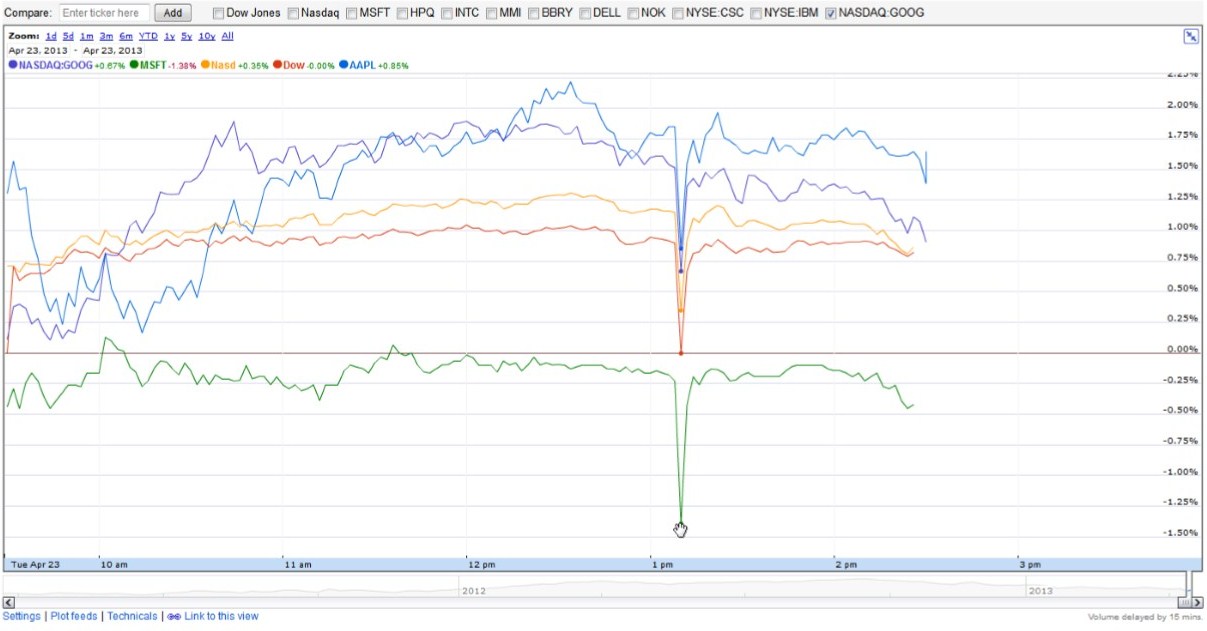
The chart above shows the impact of a single tweet from the Associated Press twitter account on the stock of Apple, Google and Microsoft as well as the NASDAQ and Dow Jones indexes. That dip right in the middle was all caused by a single tweet.

The tweet reported, falsely as it turns out:”Breaking: Two Explosions in the White House and Barack Obama is injured.”

This wasn’t news at all, it was a hack, and Associated Press had to move quickly to quash the false information.

What this demonstrates, again, is the power of the tools that we have available to us to communicate information rapidly. The real power that caused the impact wasn’t, however, with Twitter, it’s with Associated Press as a trusted source of news. The tweet only had an impact because of where it appeared to come from, but it only had an immediate impact because of Twitter’s ability to communicate broadly and quickly.

The problem for Associated Press now is that the level of trust in its Twitter feed has been diminished and the current embarrassment is in danger of having a last impact. It’s the same for us as individuals. If our Twitter (or Facebook, or any other site you’d like to choose) gets hacked the level of trust from others goes down. Associated Press responded decisively and with clarity, it’s a good strategy. We will have to do the same if we are ever in that situation our reputation may depend upon it.

It takes 20 years to build a reputation and five minutes to ruin it. If you think about that, you’ll do things differently.

Warren Buffett

Did you really share that online?

Like people exploring a dark cave system we stumble through the social change that is being facilitated by our ability to share everything and anything with the world.

We are exploring a new world and don’t really understand the consequences of our actions, both personally and socially.

Cromarty to Nigg FerryHere in the UK a teenager is removed (resigns?) from her post as Youth Police Commissioner because of views expressed on Twitter:

Paris Brown, 17, from Sheerness in Kent, said bravado had led to her statements on Twitter, which had offended many people. She said she was resigning from her post as the youth police and crime commissioner for Kent after police announced they were investigating whether her comments amounted to a criminal offence.

Critics claimed the comments were racist, homophobic and condoned violence and drug-taking. Brown pleaded to be left alone now that she was standing down.

Once upon a time the tools at our disposal were quite rudimentary and had limited impact. I wrote a while back about an incident that had led to my own embarrassment. In this I committed the classic reply-to-all mistake and managed to send lots of people an email with the wonderful words – “have you got any slots left for back, neck and shoulder massage?”

In the events that followed the bombings at the Boston Marathon people on twitter and reddit latched on to a rumour about who had carried out the atrocities, only for them to be proved completely erroneous.

Recently David Zax wrote about some of his personal experience:

Email is only one way we communicate today, though, and only one among many web services that include some sort of social, shared, or collaborative component (cf. this “cloud” you may have heard of). And in the past several months, I and people in my social circles have accidentally shared private information we only intended to share with one person, a select few people, or no people at all. There was the week during which I scheduled the likes of personal doctor’s appointments in a communal calendar (partly a symptom of my having bought a new computer, and some hiccups in getting my old device-synching techniques to work under my new setup). There was the moment an old professor accidentally posted sensitive banking information to a shared Dropbox folder. He was lucky that I immediately clicked on an alert pushed to my desktop, saw what he had done, and emailed him about the breach. “This is the way things become a disaster,” he wrote me.

We now have massively powerful tools at our disposal, but we don’t yet have the protocols or the safeguards available to stop us causing ourselves all sorts of damage.

In vehicles we recognise the power that we have available to us, power for good, but also dangerous power. As such we have training and driving protocols. Here in the UK it’s known as the highway code, a failure to use it could lead to embarrassment, but also to legal action. As well as a set of protocols though, we also have a set of safety features built into our vehicles for those times when things go wrong, we also have systems to warn us about things that are about to go wrong unless we do something.

We continue our journey through the dark cave of discovery and the casualties mount up.

We never look up

Following on from my earlier post, We sit on the train and look at our telephones whilst life goes by, someone has put together a beautiful, if somewhat depressing, photoblog of black-and-white snaps.

Check out We never look up it might make you think:

Via Mashable

We sit on the train and look at our telephones whilst life goes by

Last year we averaged 4 hours a day on the Internet, in 2002 it was only 46 minutes.

I, for one, don’t necessarily think that a statistic like that is all good:

We sit on the train and look at our telephones whilst life goes by

Cisco Connected World Techology Report

Over the last few years Cisco have produced a report on the changing attitude of people to being permanently connected.

This years report – 2012 Cisco Connected World Technology Report – has just been released. The report is based on two surveys, one looking into the attitudes of Gen Y, and the other looking at the attitude of IT Professionals.

At the heart of this year’s study is the smartphone and the constant connectivity it provides to work, entertainment, shopping, and friends. There are 206 bones in the human body, and the smartphone should be considered the 207th bone for Generation Y. They view smartphones as an appendage to their beings — an indispensable part of their lives, and yet they are concerned about data management and Internet security.

Who knew that 43% of British Gen Y always check there smart-phone as part of their morning ritual alongside brushing there teeth? It wasn’t much of a surprise to me having seen how many of them check their smart phone while stood at the latrine at work! The French are far less bothered about such things with only 29% always checking. It’s interesting that women are significantly more driven to be connected with 85% of them being compulsive checkers; it’s only 63% of men.

There’s a fun visualisation that enables you to calculate your data footprint, I apparently have a highly connected lifestyle. As you might expect there’s also a report highlighting some of the statistics and drawing some conclusions along with the seemingly mandatory set of Infographics including an interactive one showing the results for the different countries that took part.

The world is changing fast, there are a lot of people who don’t realise how fast.

The Freelancers are Already Marching

Following on from my piece The March of the Freelancers – the New York times has an article on the extent of freelancing focussing on the people who work online through online staffing agencies:

Recently two of the biggest online staffing companies, oDesk and Elance, have released surveys concerning the companies that hire workers over the Internet to do things like write software, and the mindset of online workers themselves.

Between them, oDesk and Elance claim to have more than four million coders, Web designers, marketing professionals and other workers. Some even spot porn on Facebook at a rate of four for a penny. In the second quarter of 2012, oDesk says, its contractors worked over 8.5 million hours, a 70 percent increase over a year earlier. The average freelancer at Elance, meantime, expects to make 43 percent more money in 2013, as more employers come online.

That’s lot of people working a lot of hours. Freelancing is already big business and getting bigger.

Relating to the machines

Like many of my blogs this one is a coming together of a number of thoughts and events.

It starts with reading the Gollum Effect by Venkatesh Rao which links to a video of a hand model. The video is the creepiest thing I’ve seen in a long time:

The Hand Model

As Venkat puts it:

The concrete idea is something I call the Gollum effect.  It is a process by which regular humans are Gollumized: transformed into hollow shells of their former selves, defined almost entirely by their patterns of consumption.

Imagine that the woman in the video is holding an iPhone and tell me that you don’t know someone who treats it in a similar way? Now ask yourself who’s in charge, the iPhone or the person?

The other day I watched Andrew McAfee’s presentation at TED – Are droids taking our jobs? (covering some of the content from his book: Race Against the Machines):

Within [our lifetimes], we’re going to transition into an economy that … doesn’t need a lot of human workers. Managing that transition is going to be the greatest challenge that our society faces.

But McAfee is an optimist:

So, yeah, the droids are taking our jobs, but focusing on that fact misses the point entirely. The point is that then we are freed up to do other things, and what we are going to do, I am very confident, what we’re going to do is reduce poverty and drudgery and misery around the world. I’m very confident we’re going to learn to live more lightly on the planet, and I am extremely confident that what we’re going to do with our new digital tools is going to be so profound and so beneficial that it’s going to make a mockery out of everything that came before.

Andrew McAfee: Are droids taking our jobs?

About the same time I came across this quote from Marshall McLuhan:

“We become what we behold. We shape our tools and then our tools shape us."

Marshall is also the person who penned oft used phrase – "the medium is the message". It’s interesting to note that Marshall died in 1980 before much of the current change was envisaged.

And then another quote, this time, from Danny Hillis:

“In some sense you can argue that the science fiction scenario is already starting to happen. The computers are in control. We just live in their world.”

The final circumstance was reading about a jacket that gives you a hug when someone likes you on Facebook.

The Facebook Jacket that gives you a hug

What each of these observations and events have in common is that they are all highlighting the changing relationship between ourselves and the machines around us. The pace of change has been building for some time. There was a time when information technology was limited to the work place, but that day has long gone. We are now in a world where information technology is connecting us into the machines wherever we are and whatever we are doing.

What impact is that change having?

We are relationship beings and we build relationships with people, animals, objects and substances. Technology is no exception but the relationship is changing as the machines change. It seems to me that we have a choice in how we approach this changing relationship. We can either become subservient (and become Gollumised) or we can become liberated (as Andrew McAfee hopes). We can choose a relationship where we hand over all of the responsibility to the machine and let them make us sub-human, or we can use the power of the machines to enable us to do new things. Either way there’s a huge change already in progress.

Some of these changes are seemingly innocuous, how
many people have you bumped into in the street because they were too busy interacting with their smart-phone? But even these changes have consequences. Commenting on a new safety campaign, here in the UK, Martin Gallagher, head of level crossings for Network Rail, said:

"Although we have thousands, if not millions of people who use level crossings every day, we’ve seen a trend in incidents and accidents where distraction, because people are wearing headphones, or walking dogs, or sending text messages, has become a causal factor."

That’s right, people are being killed because they are too encapsulated in their technology to notice a train speeding towards them.

Other changes are going to be more fundamental. I quite like the idea of self driving cars, but that’s going to radically change the roads and our day-to-day travel. What happens when the automated cars are so sophisticated and accurate that it’s too dangerous for us to drive alongside them? What happens when we have to hand control of the roads over to the machines?

We are in pioneering days and we still don’t really understand what it is that we are dealing with. We are giving people increasingly powerful tools but I’m not sure that we are yet giving them the necessary training on how to handle those tools. I’m not sure we even know what the required training is or what the necessary safeguards are. Every time I see another person prosecuted for writing something malevolent on Twitter or Facebook I wonder whether it was really malice or stupidity that was the primary factor.

On the whole I’m an optimist, but I think that we’ll make some pretty big mistakes along the way. Our relationship with technology is shifting and I’d prefer it became one that was similar to the relationship we have with the car rather than the one we have with heroine.

Choose freedom!

The March of the Freelancers

As I look around the changing workplace the more I see evidence that we are moving away from the large monolithic organisation of the industrial age to one which is dominated by freelancers – people who work for themselves.

A couple of things have caught my attention recently:

Is this change a good thing or a bad thing? Like all change, it depends a lot on your perspective. For many people I think that the large organisation is a constraint that they would do better without. I wonder, though, about people with disabilities or other constraints on their work, how are they going to compete? What about people who have just left education and still have a lot to learn?

As I consider these questions I see a future that’s not dissimilar to the one that craftsmen of old used to operate with the guilds. My reasoning on this isn’t that well formed yet other than to say that we can learn a lot from history.

My changing workplace – part 8: 00's on the road

Early into the 21st century it was time to leave the working location that I’d spent nearly all of working life in.

Although I’d moved from one company to another and worked in many different offices (5 at this point I think) I’d still been based on the same site. I’d worked with people from different sites for the same customer, but most of my focus had been on this one location. It was a large site and there was plenty of work to do but it was time to move on.

I’d been asked to lead a team of engineers working with the Microsoft technologies that were growing in popularity with our customers and the ones that we had successfully deployed already. This was a new team that didn’t yet exist and needed to be built.

There was a location where some engineers already existed, they were near to another customer who wanted to deploy the latest Windows 2000 technologies both client and server.

It was time for me to get on the road, partly to build the team, but also to help out with the Windows 2000 project. It was time to move from a desktop working life to a laptop working life. It was time to move from a desk-phone to a mobile-phone. My workplace was starting the steps away from being a location towards being an activity that took place wherever I was.

There was still a strong mind-set that was convinced that someone was only working on a project when they were there in person. This meant that I was on the road a lot travelling from project to project, customer to customer. Most of the time was spent on the A14 towards Cambridge because that was where the major project was and the only way to work on the project was to be there.

Windows 2000 included a number of new technologies but the one that would dominate most of our discussions was Active Directory. It’s hard to imagine now the extent of the change that the move from Windows NT 4.0 domains to Active Directory was. There were new skills to learn and new organisational interfaces to work through. Take DNS as an example; most organisations already had some form of DNS but it was run by the networks organisation to support a relatively small number of devices. Windows 2000 would increase the reliance upon DNS, the requirements for DNS and also, potentially the technology on which DNS was hosted. Like most Microsoft technologies the abilities of Windows 2000 as a DNS was viewed by the networks organisation with suspicion. They had existing, mission critical, requirements that they didn’t want to compromise with some ‘immature’ PC technology.

There was still a divide between so called enterprise-class technologies and the perception of the PC technologies as less mature and less stable. A maturity split also existed between the groups of people who looked after the technologies. A good example of this was the different approaches to change control. No mainframe systems programmer (where I started my technology journey) would dream of making a change without going through a management process which required them to think through the impact of the change and how to back-out of the change. PC people were used to working on individual machines without having to think too much about the impact of the change because there was only one person impacted. As the PC server technologies moved into the server room and eventually into the data centre we went through a period of time where there was to much of the PC approach and not enough of the mainframe approach. My background was on the sys-prog side of things and it fell to me to try and instil the correct disciplines. Not only did the technology have to mature our approach to that technology had to mature too.

This split made my job of recruiting interesting too. We saw many people who could build and rebuild a PC with there eyes closed but had no experience working in a managed environment like the ones we were wanting to build. We saw another set of people who’d worked in a smaller organisation and supported a small number of servers but still had a mind-set that if something needed changing they could change it there and then, and would.

The technology was maturing, the processes were maturing and perhaps I was maturing too.

As time progressed I spent more and more of my time travelling around building teams and managing people. This meant that I spent less of my time doing technical things. For some people this is a natural progression but it wasn’t the path for me. I came to the point where I realised that every time someone needed a technical authority I would launch in and get the problem resolved, I’d do this to the detriment of my management duties. Given the choice I would pick the technical challenge every time. While I was providing technical leadership I was happy and motivated, when it came time to do some administration for the team I would make it wait. In time a new role was being discussed, I’d always thought of myself as an engineer, but this new role had a different tile – architect.

There were other shifts that were reaching maturity too. UTP was the only way to wire a building. Ethernet was now the only transport. TCP/IP the only protocol. The Internet was becoming the way to connect things. AltaVista, MSN Search and Google were the options for search.

My changing workplace: