Back today after 2 weeks holiday.
Some of the pictures are over on Flickr.
I tend not to announce that I am not going to be present because I’m suspicious that it leaves my house a little vulnerable.
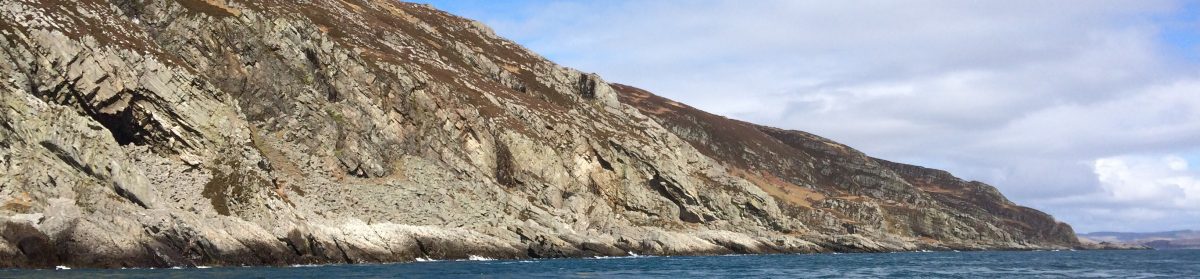
Back today after 2 weeks holiday.
Some of the pictures are over on Flickr.
I tend not to announce that I am not going to be present because I’m suspicious that it leaves my house a little vulnerable.

My parents are really into gardening. When I was a child we had a large garden and two allotments.
For those of you who aren’t from the UK, an allotment is a piece of land that you hire (normally) from the local council in order to have more land to grow things on.
The three children were expected to help out, my brother, my sister and I.
One of the jobs that I had mixed feelings about was the watering. Some days the watering was fun, some days it was pure drudgery.
At the allotments that taps was not directly next to our plots. At one of them it was what seemed like a mile away, but I think it was only a few plots away. This one, I remember, was a screw tap which was really, really difficult to open and close.
At the other allotment the tap was only one plot away. This tap was different. In order to stop water wastage the council had fitted a plunger tap, the type that you press down when you want water and soon after you lift your hand off the water stops. You sometimes see this type in public toilets which is always a challenge because the thing you are trying to wash is the thing that is making the water run. The theory on water wastage hadn’t allowed for human ingenuity though. Hidden behind the tap was a piece of wood which had a slot in it; this slot was just the right size to fit over the top and bottom of the tap once the plunger had been depressed. You could fill a watering can without having to spend the whole time pressing the plunger, you could even wander off and forget about the watering can altogether.
My remembrance of watering at the allotments was that it took hours and hours, but I was a young boy who was easily bored. It probably didn’t take long at all.
Now I’m an adult and have my own watering to do I feel radically different about it. Watering the plants is quite therapeutic. I know that these plants rely on me to bring them life giving water. They need me. They aren’t massively demanding, but they still have a need. A need which I can fulfill.
Although I have fulfilled their need for today I will still need to water tomorrow though.
A woman, a Samaritan, came to draw water. Jesus said, “Would you give me a drink of water?” (His disciples had gone to the village to buy food for lunch.)
The Samaritan woman, taken aback, asked, “How come you, a Jew, are asking me, a Samaritan woman, for a drink?” (Jews in those days wouldn’t be caught dead talking to Samaritans.)
Jesus answered, “If you knew the generosity of God and who I am, you would be asking me for a drink, and I would give you fresh, living water.”
The woman said, “Sir, you don’t even have a bucket to draw with, and this well is deep. So how are you going to get this ‘living water’? Are you a better man than our ancestor Jacob, who dug this well and drank from it, he and his sons and livestock, and passed it down to us?”
Jesus said, “Everyone who drinks this water will get thirsty again and again. Anyone who drinks the water I give will never thirst—not ever. The water I give will be an artesian spring within, gushing fountains of endless life.”
This morning I got out of bed and went downstairs. At the bottom of the stairs I turned right, went down a little corridor and into the kitchen. In the kitchen I opened a cupboard and took out a bowl. I placed the bowl on the work-surface next to another cupboard. I open the other cupboard and took out some cereal. I then reached into the fridge below the work-surface and took out some milk. I poured the milk onto the cereal. I then opened a draw and took out a spoon. Remembering first to shut all of the various cupboards I picked up my bowl of cereal and milk and proceeded into the lounge. In the lounge I ate my cereal.
This routine is similar to the one I follow almost every morning. I follow it so regularly that it has become familiar and almost automatic; so automatic that most of the time I forget what a luxury it is.
I don’t have to worry about whether there will be any cereal in the cupboard – there is always some sort of cereal in the cupboard.
I don’t have to worry whether there will be any milk. If there isn’t any in the fridge there is normally some on the doorstep. If things are really bad and there isn’t any on the doorstep I can get in my car and get some within 10 minutes.
It’s important that we remember that these are luxuries, for most people in the world food is a day-to-day hand-to-mouth struggle.
Sometimes I catch myself getting annoyed that the cereal available in the cupboard isn’t the cereal that I wanted that day when I realise what I am doing I feel ashamed.
Count the day-to-day blessings as well.
I was in the USA last week with a group of colleagues. One of the issue we were talking about was service levels of collaborative and communication solutions. We had quite a good discussion on the difference on reliability and availability requirements. The interesting part of the discussions being on the difference between the actual availability requirements and the perceived availability requirements.
One of my arguments was that we all have so many different communication mechanisms available to us, does it matter if one of them is unavailable for a period of time. We perceive that we need all of them all of the time, but is that really true.
Unfortunately my sub-conscience decided that it would undertake an experiment on this thesis and caused me leave my mobile phone in the taxi that took us to the airport .
I am now one of those “mobile phone left in taxi” statistics .
Thankfully the taxi driver was an honest sole and phone my home to tell my wife of this fact. Unfortunately, know that I had no mobile phone, she was unable to contact me. As it was the early hours of the morning I didn’t contact her until I was back in the UK the next day. Hopefully one of my colleagues who is based in the USA will be able to collect it this week, and he is over in the UK next week.
I wonder how crucial to my work having a mobile phone is? I have four days to find out before the joys of holiday.

Things might be a bit quiet on this sight this week – I’m off to the delights of the USA for a few days, and with travelling I might not get to post anything.
Alternatively, I will be cooped up on a plane for hours on end, so you never know what might come flooding out.
Please, don’t any of you describe this as a ‘jolly’ it is definitely not that.
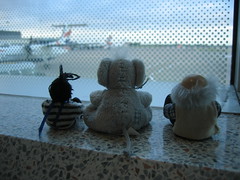
Jimmy and Grandad are coming (on Stu’s suggestion) so there might be some interesting pictures.

That Coyote bloke got me thinking again this morning:
“you need time to see the links between items or areas of knowledge. The brain finds it hard to hang on to disconnected pieces of information. Unlike a computer disc, it doesn’t cope well with large amounts of more or less random data. What it does best is to see connections, linking information together and remembering the patterns, not single pieces of data. Remembering a principle and applying it is far easier to do that recalling some individual “rule” or procedure for handling a situation. Do we see those links instantly? Usually not. It takes time to register them fully and understand them well enough to recall them whenever we want.”
So why do so many of our enterprise information systems do such a poor job of reflecting the links that we have built in our minds between things, and do an even worse job of allowing us to see the links that other individuals have created.
Let’s look at a few example. In the file system I can group a load of files into a folder so that they are all together, but this doesn’t reflect the links that exist between the document. I regularly open a number of files to find the information that I am looking for. I know it’s in one of them because that’s why they are there but there really isn’t any visible linkage. Someone else looking at the set of documents would need to read them all to get a handle on the information contained within.
Document management systems are rarely any better they allow the person who has posted the document to give it a set of key words and to build the taxonomy. Anything information that follows on from this document isn’t reflected and the likely value of each document that has been tagged with a certain keyword isn’t shown either.
Take documents as an entity, particularly technical documents. They are usually a huge blob of data with thousands of internal logical links. The data in this section relates to the data in that section, but we rarely do anything to flag those links. As the links aren’t explicitly shown we need to take in a huge amount of data before we can understand where the links are. It’s rarely possible to structure a technical document in a way that actually makes these links obvious. Lots of people have started making documents out of PowerPoint presentations, it’s something I encouraged initially but now I’m not so sure. The problem with a document is the huge blob problem, the nice thing about a PowerPoint structure is that each page makes a point or a small number of points in this way the huge blob is broken down into a set of smaller blobs. These ‘presentations’ are never going to be presented, they are meant to be read as a set of small chunks which allow people to form their own links.
Blogs are slightly better, assuming people follow the etiquette. Part of the etiquette of blogs is that you do someone the courtesy of referencing their ideas, and rightly so. Because blogs are normally a smaller chunk of data and the links are built in it’s possible to work backward down a subject. Services like track-back and technorati also allow you to follow the links forward.
Tagging services like del.icio.us provide a new way of reflecting the links. They allow items to be tagged by the person consuming the document. Rather than the person who created the item defining the value, the person consuming it does. This capability has taken on the rather ungainly term of folksonomy.
The ability to move beyond taxonomy into folksonomy is rarely available inside an organisation though. Some organisations are getting there – IBM, HP (PDF) (Thanks for the info Stu).
What makes someone tag inside an organisation and how many people does it take. I’m not yet clear about all of the factors that make someone tag, but I can speak from my del.icio.us experience. There are a few reasons why I tag. The main one is a really simple one, I want my voice to be heard. I have valid opinions (or so I think) and I want them to be heard. I’m sure that if I was able to tag within my organisation I would feel exactly the same. Another really important reason is that I tag for my own benefit. As the Coyote says, it take time to register the links in our brains, being able to register the links somewhere helps me to find them in the future. Registering a link also helps me to remember them, I regularly write things down so I don’t forget them, I rarely use the written record because the act of writing it down has implanted the information in my brain, tagging has a similar effect.
We have a long way to go with exposing links, and the value to us humans is in the links rather than in the actual data. The current technologies will take a while to become mainstream in most enterprises, and even longer for the process and social changes to become common practice. There is, however, a new generation who will expect these services to be available and business constrain them at their peril.
Tags: del.icio.us, taxonomy, folksonomy, learning
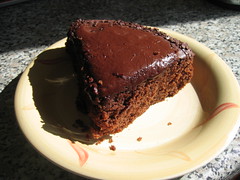
A family friend was visiting yesterday. She bought with her a magnificent chocolate cake (pictured). It was still in good shape when she left – it isn’t now  .
.
I can’t see it lasting the rest of the day, the diets are definitely out of the window today. I’ve already been down the gym this morning so I’m using that as my justification for just one more piece, or perhaps two, I did work very hard, honest  .
.
I’m sure it was bigger than this when I left for the gym, perhaps the kids had some in their lunch boxes  .
.
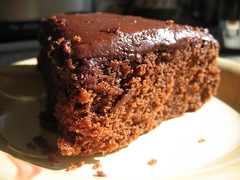 It’s very nice with a cup of coffee.
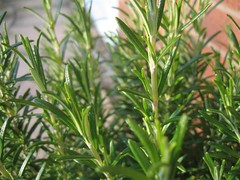
We don’t have a vegetable patch in our garden, but we do have a number of pots which we use to grow various things that we like to eat. Taste is not the only criteria for growing things though, we only grow stuff which doesn’t require too much attention, we also like things that produce results quickly.
Over the last few days we have started to eat some of the things that we have grown.
On Sunday we had a first carrots, thinned out little ones which were really tasty. The carrots were followed by wonderfully tasty strawberries.
Last night we had lettuce and rocket, along with new potato seasoned with fresh mint.
These all tasted infinitely better than anything we have bought in a shop. Whether an independent taste test would confirm this; I don’t know. If beauty is in the eye of the beholder, taste is definitely in the mouth of the grower. I grew them, and to me they taste fabulous.
We still have beans, peas, courgette, tomatoes and sweet corn to look forward too, as well as more lettuce, rocket, strawberries and carrots – delicious, perhaps not all in the same dish though.
I don’t really see myself as the grower though – I just planted them and gave them the occasional watering.
Jesus told a number of parables about crops and harvesting. It’s not surprising really, he was talking to a rural community. One of the famous ones is this one:
“What do you make of this? A farmer planted seed. As he scattered the seed, some of it fell on the road, and birds ate it. Some fell in the gravel; it sprouted quickly but didn’t put down roots, so when the sun came up it withered just as quickly. Some fell in the weeds; as it came up, it was strangled by the weeds. Some fell on good earth, and produced a harvest beyond his wildest dreams.”
Another translation goes like this:
“A farmer went out to plant some seed. As he scattered it across his field, some seeds fell on a footpath, and the birds came and ate them. Other seeds fell on shallow soil with underlying rock. The plants sprang up quickly, but they soon wilted beneath the hot sun and died because the roots had no nourishment in the shallow soil. Other seeds fell among thorns that shot up and choked out the tender blades. But some seeds fell on fertile soil and produced a crop that was thirty, sixty, and even a hundred times as much as had been planted.”
That’s an interesting story, but then Jesus goes on to say these words:
“Anyone who is willing to hear should listen and understand!”
Understand what? Hear what? Why was he talking in parables anyway? These were exactly the stories the disciples asked. If you read the rest of the chapter Jesus goes on to explain why he uses parables and the meaning of this particular parable. I’m not going to go over His explanation other than to say:
“The seed cast on good earth is the person who hears and takes in the News, and then produces a harvest beyond his wildest dreams.”

There are some things you don’t think about until you work from home.
I will, again, be embarrassed today. Today the Window Cleaner will come and clean the windows on our house. Every time he comes he embarrass me twice.
The first time he will embarrass me is when he is cleaning the window behind me as I write this blog. I won’t hear him until he is there, he will make me jump and then I’ll be embarrassed .
The second time he will embarrass me will be approximately 10 minutes after the first when he knocks on the door demanding payment. I will be very embarrassed to tell him, again, that I have no money and that’s he’ll have to come back later .
I’m a man of the modern age and never have any cash. It has never been necessary for me to have cash. I have got up in a morning and gone into an office and not needed any cash. All of those years of conditioning make it a near certainty that I won’t have any money.
The things you have to deal with when you work from home .
Perhaps I’ll just have to put the days he comes into my diary and plan to be in the office on those days .
Stop, wait a minute, I remember now, let me check, I do have a £10 note in my wallet today. Perhaps I’ll only be embarrassed once today.

One of the mind games I try to play in order to keep my brain active is to try and learn a new word every day. I do this by subscribing to wordsmith.org A.Word.A.Day. I don’t always remember them because, to be honest, sometimes the word is not one I’m likely to use in my normal life.
I’ve been away on business this week. I left on Tuesday and returned late Thursday. On Wednesday the word for the day was nostomania.
Nostomania: An overwhelming desire to return home or to go back to familiar places.
I’m not sure I was suffering an ‘overwhelming desire’ but when I am away the desire to be home is always there.
I count it a real blessing that my home is somewhere that I actually want to return to.
Thing may not always be rosy at home, but I’d rather be here than anywhere else on earth.
But what makes a home – a home. It’s not the building, or even the things in it, it is the people inside and the people near by.

Today I went out into the garden to do some reading. I was reading from my computer so wanted to sit on a chair in the shade. As I tramped across the grass in my bare feet it suddenly became refreshingly cold and damp. It was a wonderful feeling on such a warm day.
Mean-tempered leaders are like mad dogs;
the good-natured are like fresh morning dew.
(No it isn’t my garden in the picture, I’m not that fortunate)

Having got my tablet with Windows Vista Beta 2 and Feedburner (and other bits) working how I want it to I was able do something today that you rarely get to do in Lancashire.
I sat in the garden with my tablet and caught up on blogs.
Feedburner is definitely nicer than NewsGator for Outlook on the Tablet. It’s really helping my new resolution of posting to del.icio.us too.
(No Jimmy and Grandad today because they are, apparently, sold out in ELC in Preston)
Tags: Feedburner,Vista,Tablet,NewsGator
 Graham Chastney