
Anyone like to raise their hand in agreement?
This picture reminded me of this post: I could spend hours doing this…

Anyone like to raise their hand in agreement?
This picture reminded me of this post: I could spend hours doing this…
Just as I was writing my post yesterday – Did you really share that online? – another incident was playing out on the US stock market:
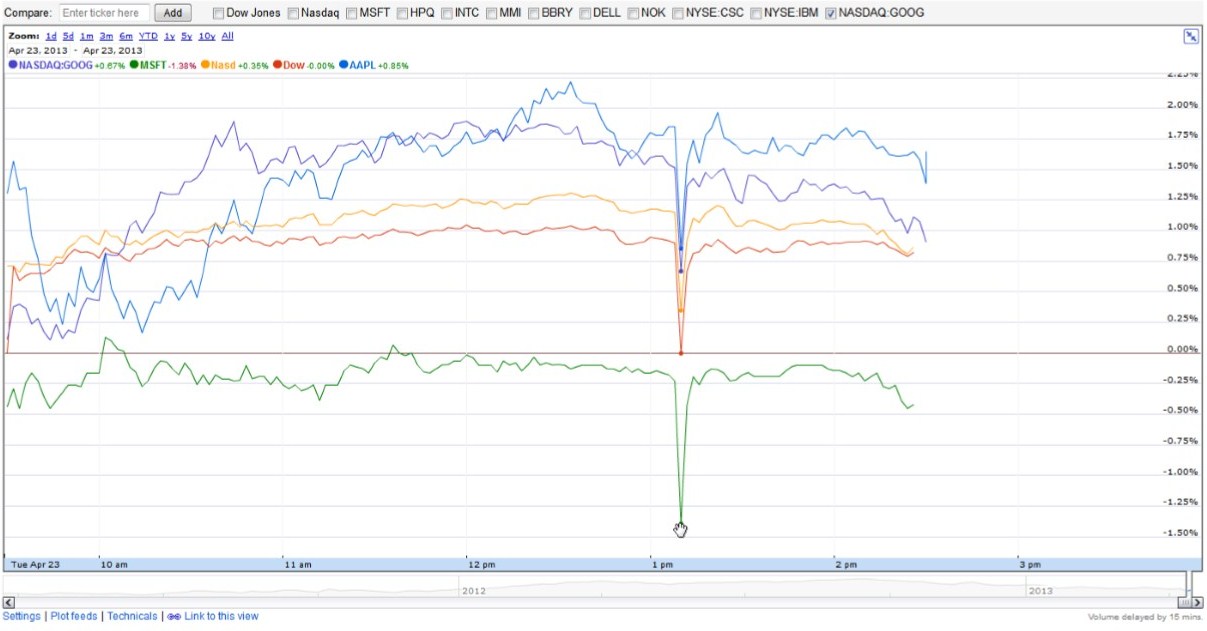
The chart above shows the impact of a single tweet from the Associated Press twitter account on the stock of Apple, Google and Microsoft as well as the NASDAQ and Dow Jones indexes. That dip right in the middle was all caused by a single tweet.
The tweet reported, falsely as it turns out:”Breaking: Two Explosions in the White House and Barack Obama is injured.”
This wasn’t news at all, it was a hack, and Associated Press had to move quickly to quash the false information.
What this demonstrates, again, is the power of the tools that we have available to us to communicate information rapidly. The real power that caused the impact wasn’t, however, with Twitter, it’s with Associated Press as a trusted source of news. The tweet only had an impact because of where it appeared to come from, but it only had an immediate impact because of Twitter’s ability to communicate broadly and quickly.
The problem for Associated Press now is that the level of trust in its Twitter feed has been diminished and the current embarrassment is in danger of having a last impact. It’s the same for us as individuals. If our Twitter (or Facebook, or any other site you’d like to choose) gets hacked the level of trust from others goes down. Associated Press responded decisively and with clarity, it’s a good strategy. We will have to do the same if we are ever in that situation our reputation may depend upon it.
It takes 20 years to build a reputation and five minutes to ruin it. If you think about that, you’ll do things differently.
Warren Buffett
What is productivity?
I quite like this definition:
The quality, state, or fact of being able to generate, create, enhance, or bring forth goods and services
Productivity is also a measure in economics; being a ratio of production output to what is required to produce it.
In purely economic terms that’s an easy measure to make – an organisation spends x to produce good that it sells for y meaning that it’s productivity is simply y/x. But that’s really poor measure to use within an organisation or between individuals or teams, especially when the goods and services aren’t monetary in value.
For a long time now the productivity of knowledge workers has been measured by other outputs, the primary one being the document. The measure of cost being the number of hours required to produce it. I’ve worked on numerous projects where the planning process has primarily consisted of repeatedly asking the question “how long will it take to write this xyz report?” The cost of the project being the sum total of the time required to write the documents. The measured output being a set of documents.
But it’s not the document that people want!
A document is simply a way of recording and transferring information. What’s really wanted are the insights, the information, the knowledge.
Using the measure of the document creates all sorts of distortions. The distortion that I regularly come across can be characterised by the phrase “never mind the quality feel the width”. Because it’s the document itself that is being measured then a document it is that will be produced. There is a hidden viewpoint that reasons the size of the document should be proportional to the amount of time spent on it.
Einstein (possibly) once said:
Everything should be made as simple as possible, but no simpler.
This gets forgotten when time is allocated to a document. I’ve never seen a published hours to pages ratio, but there is a hidden pressure on the author to make the work look credible by providing an appropriate volume of words to support the amount of time spent.
It’s not the number of pages that makes a document more valuable than another, it’s the insight that it contains.
I’m not sure I have too many answers here, but I have been intrigued by people looking to metrics to try and find an answer. The latest has been Chris Dancy now at BMC who has made it his mission to measure all sorts of elements of his life:
Dancy is connected to at least three sensors all day, every day. Sometimes, it’s as much as five. They measure his pulse, his REM sleep, his skin temperature, and more. He also has sensors all over his house. There’s even one on his toilet so he can look for correlations between his bathroom habits and his sleep patterns.
From Wired.
Dancy’s view is interesting:
Soon, Dancy says, companies will start tracking their employees in much the same way he tracks himself. They have no choice. “Enterprise needs new measurements of success for knowledge workers. Today’s knowledge work is measured in really inappropriate ways,” he says.
From Wired.
Dancy doesn’t think that all tracking is necessarily positive, but he’s fatalistic about the future. Even if workers reject more Orwellian surveillance from employers — or companies determine these measures to be counter productive — individual workers will likely use self-tracking to gain a competitive edge.
Perhaps new metrics and “quantified self” are the way forward, but personally that makes me shiver. Most people struggle to adequately compensate for the impact of technology in their life today.
I’m not sure whether I’m ready for this level of immersion but change is on the way, that’s for sure.
Over the last few years Cisco have produced a report on the changing attitude of people to being permanently connected.
This years report – 2012 Cisco Connected World Technology Report – has just been released. The report is based on two surveys, one looking into the attitudes of Gen Y, and the other looking at the attitude of IT Professionals.
At the heart of this year’s study is the smartphone and the constant connectivity it provides to work, entertainment, shopping, and friends. There are 206 bones in the human body, and the smartphone should be considered the 207th bone for Generation Y. They view smartphones as an appendage to their beings — an indispensable part of their lives, and yet they are concerned about data management and Internet security.
Who knew that 43% of British Gen Y always check there smart-phone as part of their morning ritual alongside brushing there teeth? It wasn’t much of a surprise to me having seen how many of them check their smart phone while stood at the latrine at work! The French are far less bothered about such things with only 29% always checking. It’s interesting that women are significantly more driven to be connected with 85% of them being compulsive checkers; it’s only 63% of men.
There’s a fun visualisation that enables you to calculate your data footprint, I apparently have a highly connected lifestyle. As you might expect there’s also a report highlighting some of the statistics and drawing some conclusions along with the seemingly mandatory set of Infographics including an interactive one showing the results for the different countries that took part.
The world is changing fast, there are a lot of people who don’t realise how fast.

A wonderful cartoon from the New Yorker today. I know some people who would think that this cartoon was a good idea:

Speaking personally, there are some things that should remain private.
I thought we’d start the first week of December with some statistics on social media from 2012.
There are some interesting ones in this particular infographic:
+350 millions users suffer from Facebook Addiction Syndrome
Not sure what that is then perhaps you should read about the Bergan Facebook Addiction Scale (BFAS).

Following on from my post – Relating to the machines – do you see yourself in this infographic of The Social Media Sickness.
I must admit, I do have a tendency to be a bit like The Constant Checker:

Like many of my blogs this one is a coming together of a number of thoughts and events.
It starts with reading the Gollum Effect by Venkatesh Rao which links to a video of a hand model. The video is the creepiest thing I’ve seen in a long time:

";” alt=””>
As Venkat puts it:
The concrete idea is something I call the Gollum effect. It is a process by which regular humans are Gollumized: transformed into hollow shells of their former selves, defined almost entirely by their patterns of consumption.
Imagine that the woman in the video is holding an iPhone and tell me that you don’t know someone who treats it in a similar way? Now ask yourself who’s in charge, the iPhone or the person?
The other day I watched Andrew McAfee’s presentation at TED – Are droids taking our jobs? (covering some of the content from his book: Race Against the Machines):
Within [our lifetimes], we’re going to transition into an economy that … doesn’t need a lot of human workers. Managing that transition is going to be the greatest challenge that our society faces.
But McAfee is an optimist:
So, yeah, the droids are taking our jobs, but focusing on that fact misses the point entirely. The point is that then we are freed up to do other things, and what we are going to do, I am very confident, what we’re going to do is reduce poverty and drudgery and misery around the world. I’m very confident we’re going to learn to live more lightly on the planet, and I am extremely confident that what we’re going to do with our new digital tools is going to be so profound and so beneficial that it’s going to make a mockery out of everything that came before.

";” alt=””>
About the same time I came across this quote from Marshall McLuhan:
“We become what we behold. We shape our tools and then our tools shape us."
Marshall is also the person who penned oft used phrase – "the medium is the message". It’s interesting to note that Marshall died in 1980 before much of the current change was envisaged.
And then another quote, this time, from Danny Hillis:
“In some sense you can argue that the science fiction scenario is already starting to happen. The computers are in control. We just live in their world.”
The final circumstance was reading about a jacket that gives you a hug when someone likes you on Facebook.

";” alt=””>
What each of these observations and events have in common is that they are all highlighting the changing relationship between ourselves and the machines around us. The pace of change has been building for some time. There was a time when information technology was limited to the work place, but that day has long gone. We are now in a world where information technology is connecting us into the machines wherever we are and whatever we are doing.
What impact is that change having?
We are relationship beings and we build relationships with people, animals, objects and substances. Technology is no exception but the relationship is changing as the machines change. It seems to me that we have a choice in how we approach this changing relationship. We can either become subservient (and become Gollumised) or we can become liberated (as Andrew McAfee hopes). We can choose a relationship where we hand over all of the responsibility to the machine and let them make us sub-human, or we can use the power of the machines to enable us to do new things. Either way there’s a huge change already in progress.
Some of these changes are seemingly innocuous, how
many people have you bumped into in the street because they were too busy interacting with their smart-phone? But even these changes have consequences. Commenting on a new safety campaign, here in the UK, Martin Gallagher, head of level crossings for Network Rail, said:
"Although we have thousands, if not millions of people who use level crossings every day, we’ve seen a trend in incidents and accidents where distraction, because people are wearing headphones, or walking dogs, or sending text messages, has become a causal factor."
That’s right, people are being killed because they are too encapsulated in their technology to notice a train speeding towards them.
Other changes are going to be more fundamental. I quite like the idea of self driving cars, but that’s going to radically change the roads and our day-to-day travel. What happens when the automated cars are so sophisticated and accurate that it’s too dangerous for us to drive alongside them? What happens when we have to hand control of the roads over to the machines?
We are in pioneering days and we still don’t really understand what it is that we are dealing with. We are giving people increasingly powerful tools but I’m not sure that we are yet giving them the necessary training on how to handle those tools. I’m not sure we even know what the required training is or what the necessary safeguards are. Every time I see another person prosecuted for writing something malevolent on Twitter or Facebook I wonder whether it was really malice or stupidity that was the primary factor.
On the whole I’m an optimist, but I think that we’ll make some pretty big mistakes along the way. Our relationship with technology is shifting and I’d prefer it became one that was similar to the relationship we have with the car rather than the one we have with heroine.
Choose freedom!
Daniel W. Rasmus has started an interesting series of blog posts on the design of meetings, or more specifically, the design of meetings that use collaborative software. He introduces his first post in a series with these words:
How to Design a Meeting: Lesson 1
We all run meetings like we know what we’re doing. We have been to so many meetings we just know how to run them. What we really know is how to model and perpetuate the poor habits and practices of our mentors and coaches, managers and colleagues. In the era of collaboration software our meetings need to be redesigned so they are driven through the collaboration environment in real-time, as the meeting takes place. Stop all the e-mails and document duplications, or even worse, handouts and get people to engage in a collaborative way through a meeting environment that captures all of the content, the tasks and the decisions in one view (not necessarily, as you will read, in one place).
The other day I finished work exhausted. As I sat and considered what I had achieved that day I realised that I had spent most of it in meetings, but what had I achieved? Honestly, precious little. Why was that? Well, and this is where I might be getting a bit too personal for some, boredom tires me out, and I’d spent much of the day bored.
I’m not saying that meetings are boring, but I am suggesting that many of the meetings that I attend are boring. Sometimes meetings need to happen that are in their very make-up dull, the context and the subject makes it difficult to make them interesting. These are the minority of meetings though, many meetings with interesting content are made colourless by the way that we run them. We spend so much of our time in meetings we should care that they are effective. If a meeting is effective it, at least, has a chance of not being boring.
I need to hold my hands up here and apologise for the drab meetings that I’ve run too, there’s a lot I need to learn, relearn and unlearn. Daniel has provided an infographic of where he is going with the series, I’ll read with interest:


I was interested to read some of the mainstream press coverage of Google’s recent GDrive announcement. There were a number of things about this coverage that interested me, but the one that caught my eye the most was the use of the term ‘cloud’.
 From the BBC:
Cloud services have become hugely popular as people seek to access content from a variety of places and devices.
Dropbox helped popularise the idea of storage in the cloud, but risks being undercut by its rivals
Richard Edwards, principal analyst at research firm Ovum, said that Google was "very late" to the market but that its move could spur others.
"Facebook doesn’t have a cloud service but this may prompt it into an acquisition," he said.
Really? I’m sure that Facebook would regard everything they do as ‘cloud’. Pick any definition you like and I’m reasonably sure that Facebook would fit. (I’m also quite prepared for this to be a misquote)
In my experience most terms loose most of their meaning when they become popularised. It’s the principle of entropy again. When something is new it has very little that describes it so a new set of definitions are created. In the creation process the terms come to have form and meaning as they are honed and understood by those in the initial phases of the new thing. As the terms is used by more and more people it’s clarity dissipates much like heat.
Cloud is the term we’ve got and it’s the term that will carry on being used, but it’s meaning will be dissipated. Perhaps we’ll eventually get to replace it with the more meaningful term – utility.
This is probably more than one post, but all of the thoughts came at the same time and they kind of fit together so here they are as a single stream:
I have a rule, if I’m in a conversation with someone and they start to look at their mobile device or laptop I stop talking. I used to just sit there until the person came back, but after a couple of occasions where I’ve sat for a few minutes waiting for the person to come back I’ve modified my behaviour and I now leave. I give them a little while to come back, but if they have clearly left the conversation I will leave too.
 Previously I’ve written about being In the same room, but not together when observing the interactions in my own family. At this year’s TED Sherry Turkle gave a talk on Connected, but alone? She has some very interesting, and worrying, things to say about our relationship with our devices:
Our little devices are so psychologically powerful that they don’t only change what we do, they change who we are.
She makes a much better job than I did of explaining the worry that I was expressing in my post Post 1000: Thinking about thinking, the brain and information addiction.
She goes on to say when talking about the way that we flit between being present and being somewhere else:
Across the generations I see that people can’t get enough of each other if, and only if, they can have each other at a distance in amounts they can control. I call it the goldilocks effect – not too close, not too far, just right.
In other words – we are desperate to connect but we want to do it on our own terms and in a way that provides immediate gratification.

";” alt=””>
If you watch the recent Project Glass video posted by Google you’ll notice many of these same characteristics in the interactions that they envisage. Notice how long it is before the person wearing the glasses interacts with a real person and how many opportunities he had to interact that were replaced by technology.

";” alt=””>
In a report from August 2011 Ofcom highlighted our changing attitude towards technology and, in particular smartphones:
I wasn’t sure about the statistic on usage in the toilet until the other day when I went into a toilet and noticed the gentleman (teenager) at the latrine next to me had one hand dealing with normal latrine activity while texting/tweeting with the other.
In a recent InformationWeek article Cindy Waxer describes 6 Ways To Beat IT Career Burnout and what’s #6:
6. Take a week off. Seriously.
"By off, I mean off," says Russell. No smartphone, no email, no telephone calls.
It’s been interesting over the last couple of week talking to colleagues returning from an Easter holiday break. Some of them have said something along the lines of "it was great i completely got away from it all" while others have said "I stayed on top of my email while I was away so the return was much easier". To the second set of individuals I’d like to ask the question – "what was the person you went on holiday with doing while you were staying on top?"
Most of my posts have a conclusion on them, but I’m struggling to work out what it should be on this post. We need to start to understand where we are letting the technology take us to, but what does that mean? We need to work out what our relationships are going to look like in the future, but how do we do that? We need to understand what the new etiquette is going to be, but how? I think, though, I’ll finish off with Sherry’s words "it’s time to talk".
"Let us make a special effort to stop communicating with each other, so we can have some conversation." Mark Twain

 Graham Chastney