
Time for another change of role and a change of working practice.
Having spent much of the early 00s on the road building a visiting a team across several sites in the UK a change of role brought a change of working location.
The change came after I realised that I wasn’t really cut out to be a full-time people manager. The team wanted a team leader; I was constantly being distracted by the interesting technical stuff. It was a mindset thing. Given a burgeoning list of things to do I would avoid, at all costs, those administrative ones that were really important to people. The thought of fighting with the organisation to get some training approved filled me with dread. This was especially so when the choice was between expenses and a customer with a high-priority red-hot complex incident that needed someone to dive in deep. The team deserved better than I was shaped to give them.
It was about this time that the term “individual contributor” was going through a resurgence. Here was a definition that I could identify with. There was a realisation that I didn’t need to be a manager to gain salary, achieve recognition, or any of those other reasons why people stay at their level of incompetence. As an individual contributor I could feed my family and do a job that I enjoyed.
I became aware of an opportunity to join the team that was helping one of our biggest customers define their strategy and to govern the technical side of a large portfolio of projects. Brilliant, an individual contributor role, bringing high value to an important customer, but what did I know about strategy and governance? As it turns out, I knew about as much as everyone else and while that wasn’t a lot, it was a massive opportunity to learn.
The other huge advantage to this role was the location. It was based in an office just a couple of miles from my house. Physical meetings were still dominant, but the teleconference was starting to become mainstream. These were the days when special people were issued with a conference number and a pin. If you weren’t special-enough you would have to borrow someone else’s number or schedule time using the team number. When the time for the meeting came you would reach for your desk phone, if you were fortunate, you’d put on your headset, and you’d dial, dial and dial. First was the number for the external conferencing service, then the number for the meeting, then your pin. The conference service would likely ask you several questions about the meeting and then you’d be in. If you were fortunate no-one else was using your number, if they were you’d have to politely point out that you had need for your number and that they should go elsewhere. You’d then wait for others to join which was indicated by a beep, or if you’d set it up that way, they would announce themselves with a recording of their name.
You’d have to do a rollcall to work out who you had, if it was a sensitive meeting you’d check the number of people on the meeting with the rollcall. The two never rarely first time around, so you’d try again. Eventually you’d convince yourself that you’d got the people you were expecting.
If there was a group of people in a room they would join from a spider phone from which the sound would be terrible. The meeting would be peppered with people saying “John/Mary please get closed to the microphone” or “Can whoever is eating crisps next to the spider phone please stop it or move the phone” or “Whoever is having a separate meeting in the meeting room please go elsewhere to have it.”
In the situations where most of the people were in a meeting room and you were the one who was on the phone you had no chance of being an active participant. The best you could hope for was that people would forget you were there.
The desk-phone headphones were all uncomfortable. They were made of materials that made your ears bake. They had heavy cables that pulled down on one side of your neck. The sound quality was, at best, poor. There was no volume normalisation, and you’d go from listening intently to catch a word to having your eardrums blown out by that colleague who was related to Brian Blessed.
We’ve still not fixed some of these issues.
Yet, despite all the drawbacks this was now the standard way to work in an organisation with multiple locations.
I would spend several hours of every day dialling into calls with different teams, contributing to the project or problem that they were working on.
This was also the era of the mobile phone car kit. While Bluetooth existed, it wasn’t mainstream enough to be standard in most cars. If you wanted to use your mobile in the car you needed to get a kit fitted for your specific make and model of mobile phone. Using a phone without a handsfree capability, while driving, became illegal in the UK in 2003.
As I look back on it, I see how deadly the combination of these two things was. Mobile phone access in your car, conference calls on your mobile. How any of us survived that distracted era is a miracle, several did not.
There was also a couple of changes in the major mobile phone manufacturers during this time, the emergence of the laptop as the standard device for most workers, the explosion of home internet and the growth of Instant Messaging.
However, I’m already over 1,000 words so I think I’ll leave those thoughts for another day. Oh, also, what I did and how I went about it changed significantly.
My changing workplace:
- part 1: The 1980′s
- part 2: Into the 90′s
- part 3: The mid-to-late 90′s
- part 4: Connecting across the 90′s
- part 5: Client-server 90′s
- part 6: Outsourcing 90′s
- part 7: The late 90′s
- part 8: 00’s on the road
- 13 year gap…
- part 9: An “Individual Contributor” in the second half of 00s and early 10s
Header Image: Out and about in the local farmland this hansome fella wanted to say hello. Thankfully there is a wall betwen the two of us.


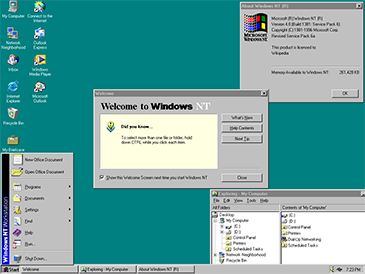 The team was also given quite a high level of autonomy. Some decisions were made for us, we didn’t have completely free reign. The outsourcing organisation that I worked for had a preferred desktop management approach using the CA Unicenter toolset and we weren’t going to change that. I’m not sure where the decision to use Windows NT 4.0 and Office 97 were ultimately made, but I do remember there being a whole load of discussions about it.
 Then there was the domain structure that we would use and the trust hierarchy. This was in the days before Windows used DNS and address resolution was done using WINS; WINS required a whole load more dialogue. Naming standards also needed consideration and designing. Then there was printing, server sizing and location, support processes, alerting, anti-virus, application deployment, remote control, security, peripheral support, imaging, packaging and so on.
 My first experience of a graphical client-server application was

 as the way of achieving this. They’d already done some work with the technology, some of it out of curiosity about it’s key developer,
  Today I sit in an office and there are three networks available to me. There’s a wired network using Cat 5 UTP Ethernet, there’s a wireless network using Wi-Fi and there’s also the packet based 3G network that my phone and Kindle are using.
 We already had a number of ways of connecting things. There was the IBM
  At home I had a PC with a modem connected to it. The modem would connect to a service called
  There were UNIX workstations from Sun, Digital, Silicon Graphics and IBM. I remember being quite impressed by the Sun SPARCstations, particularly the ‘lunch-box’ sized ones that stacked together with other SCSI connected peripherals. If I remember correctly there was one particular character in the office who’s stack of papers on his desk were always at least as high as his stacks of SPARCstation equipment. The IBM AIX Workstations were used extensively in the design department for 3D CAD. There were a few Silicon Graphics devices, limited to some high-end graphics requirements that we had. There were also VAXstations and X-terminals. These systems were all used for engineering purposes. Calculation has always been a huge part of engineering, those calculations where becoming computations and the computations were being integrated into applications. The human barrier to calculation was being removed.
 Over on the business systems side another set of personal computers and operating systems were being used. DOS was still being used, as was Windows ’95 and Windows ’98, we also used IBM OS/2 1.3, 2.0 and Warp 3. As business systems these devices were used for word processing, spread-sheets and the newly emerging activity of presentations. Because we had a strong IBM heritage and also a history with Lotus Software we preferred the IBM OS/2 and Lotus SmartSuite approach. People would ask us all the time why we didn’t use WordPerfect, they were wrong. When Lotus was purchased by IBM in 1995 we thought that there was a winning formula there, we were very wrong too. Neither WordPerfect or Lotus SmartSuite would be the ultimate winners in the battle for dominance of office automation software.
 On the hardware side of things, being an IBM shop, we preferred the PS/2. We thought that the MCA architecture was superior to the ISA architecture that all the clone manufacturers were pursuing. We stuck with IBM even after the PS/2 had been superseded by the IBM PC Series 300 and 700 (named in BMW model style). PCI was replacing both MCA and ICA. There were a number of clone devices around, primarily those from DEC and latterly Compaq, but there were also a number of Toshiba laptops around. The DEC devices were introduced by the teams supporting the engineering computing environment. IBM’s grip on the PC hardware and software market was well and truly slipping. At some point, I don’t quite remember when, we left IBM behind for desktop devices and moved over to HP Pavilions we never went back.
 The laptop was a luxury and only provided to those who were important enough to justify it. I remember the embarrassment of one particular manager who had left his laptop on the roof of his car, forgotten about it, and then reversed down a hill, eventually driving over the top of his much loved Toshiba. It survived quite well, remaining in working order apart from a big crack down the middle of the screen. Most laptops were, however, IBM ThinkPad even after we had switched over to HP for the desktops. There was a number of people who got massively excited about the Toshiba Libretto. The problem with laptops of the day was weight and the diminutive Libretto promised a lot more mobility. They never really took off. The same was also true for the HP OmniBook 300 with it’s odd, inbuilt, mouse contraption. I’ve had a number of ThinkPad’s down the years and they’ve always been reliable work-horses.
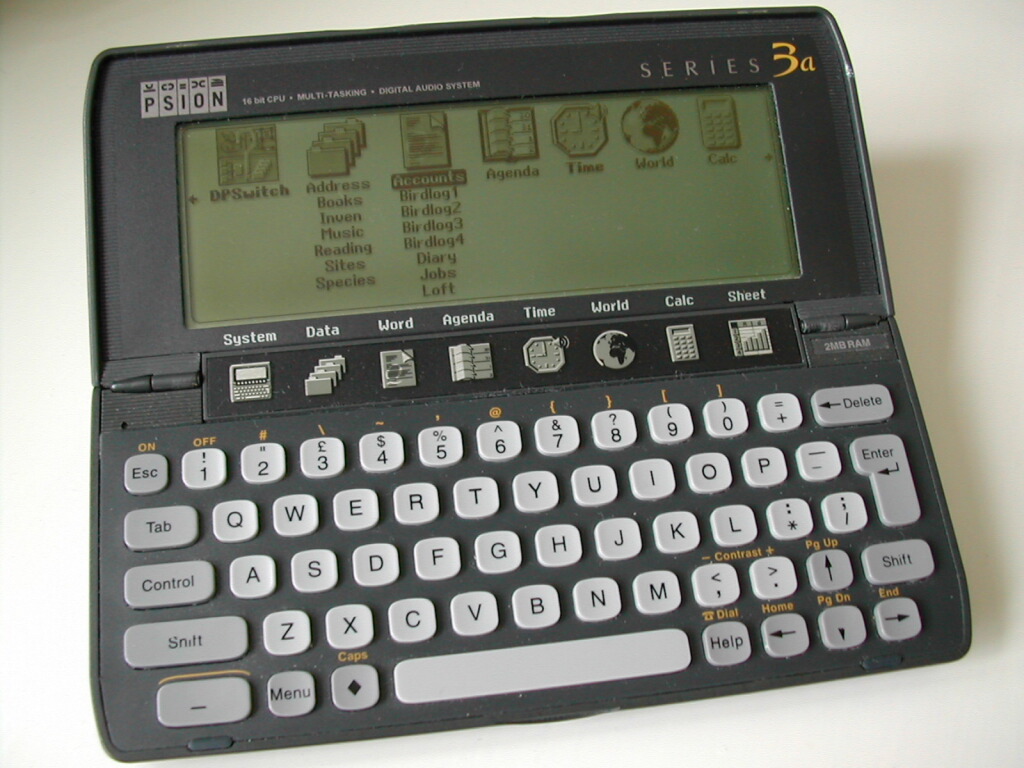 Another class of devices were also starting to be used, the PDA. Some people had tried to use the original Psion organisers but it was the release of the Psion Series 3 that moved these devices into the mainstream. When in 1998 Psion got together with other Nokia and Ericcson to form Symbian everyone thought that this plucky British company was onto a winner, we were, again, wrong. Another set of devices were already starting to become popular, the PalmPilot. The Apple man in the office played around with the Newton for a period of time too. HP introduced the Jornada PDA running Windows CE in 1998, that never really took off either.
 Like I said in
  One of the office systems team had been looking at a system called Microsoft Windows, but no-one was quite sure why you would use it. Very soon, though, things were about to change because there was talk of something new called Windows 3.1.
